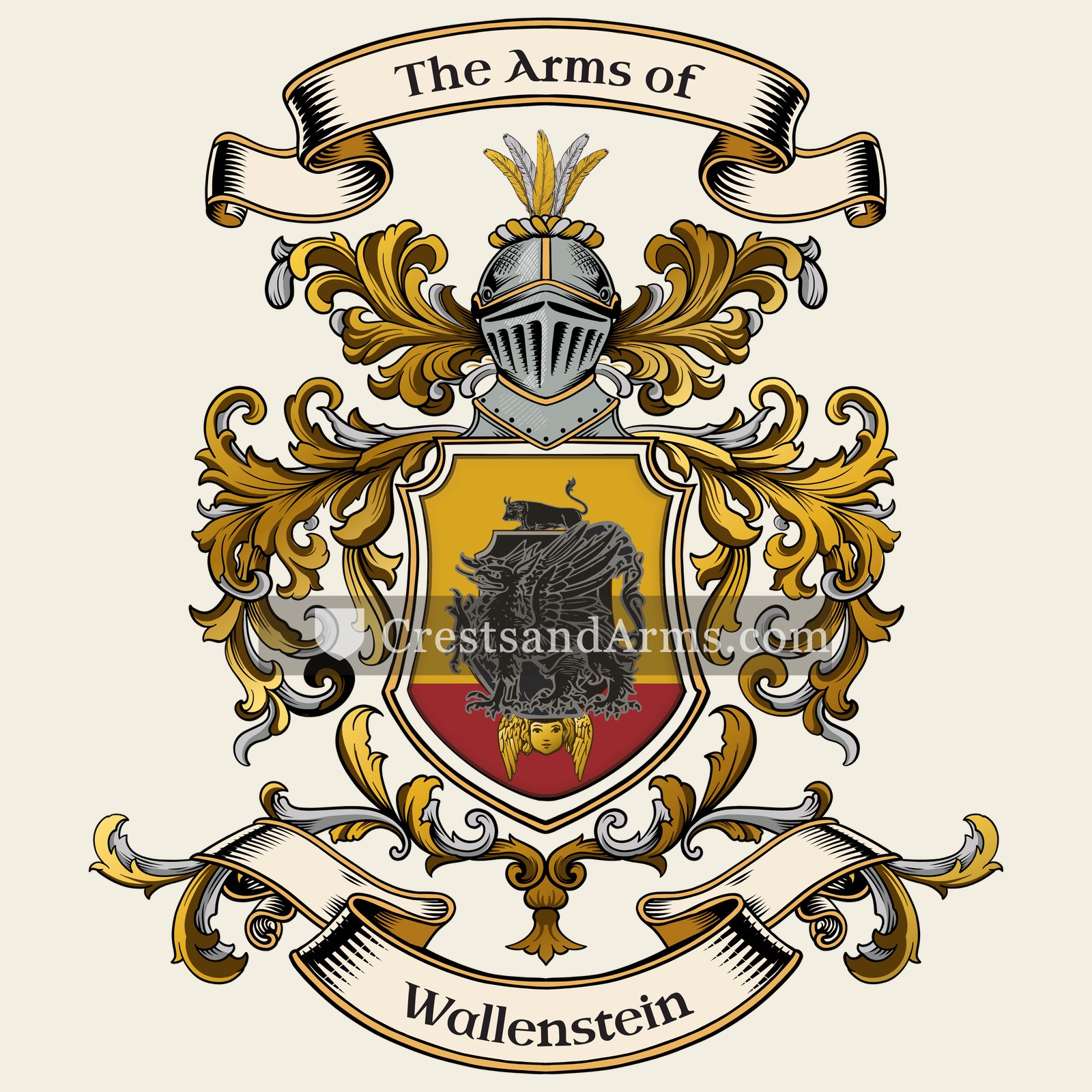
A record of documented arms, meaning and origin, researched for the Wallenstein family of Germany.
Reg. 6160 · German, W–Z
Coat of Arms & Family Crest Details
Symbols on this shield
cross symbolChristian faith and service
armA person of action, industrious and laborious
dragonA most valiant defender of treasure
griffinValour and vigilance, guarding great treasure
bullValour and generosity
eagleNobility, strength and a keen mind
cherubDivine protection over the innocent
Colours
Gold (Or)Means: Generosity
Red (Gules)Means: Military strength
Black (Sable)Means: Constancy
Historical info
Source
J. B. Rietstap, Armorial Général, Gouda: G. B. van Goor Zonen, 1884–87
Blazon (the actual original written record)
“Tiercé en fasce, le 1 tiercé en pal, les 2 et 3 partis, ce qui fait sept quartiers: au 1 de Mecklembourg (d'or à un rencontre de buffle de sa., langué de gu., accorné et bouclé d'arg., cour. de gu.); au 2 de Silésie (d'or à l'aigle de sa., bq., m. et cour. du champ, ch. sur la poitrine d'un croiss. treflé d'arg. qui s'étend sur les ailes et supporte une croisette d'arg.); au 3 de Sagan (de gu. à un ange d'or, mouv. du bas); au 4 de Stargardt (de gu. à un senestrochère, paré d'arg., sortant d'une nuée d'arg. mouv. du flanc, la main de carn. tenant une bague d'or, châtonnée d'arg.); au 5 de Vandalie (de gu. à un dragon ailé d'or); au 6 de Schwerin (coupé de gu. sur or); au 7 de Rostock (d'azur à un grffon pass. d'or). Sur le tout les armes des comtes de Waldstein-Arnau.]”
Germanyc. 1623
Digital archive packCoat of arms PNG, gold border print PDF, vector SVG and the certificate of authenticity. Sent to your email in minutes.
Map of Germany showing where the Wallenstein arms are recorded
The Wallenstein arms were recorded in Germany, c. 1623.
Arms such as these were typically recorded in Bavaria.
Bavaria was a country of old landed families and walled market towns. Estates passed down the same line for centuries, and both the landowners and the leading townsmen kept arms, which is why so many Bavarian names sit in the registers.
This is where the arms were entered in the register. Families often moved to other parts of the country, so the same name can turn up in more than one region.
The body that granted and recorded arms in Germany in this period.
Ferdinand II, Holy Roman Emperor
Sovereign of the period
Ferdinand II, Holy Roman Emperor
1619–1637
Reigning in Germany when the Wallenstein arms are first recorded.
How Arms Worked in Germany
In the Holy Roman Empire, coats of arms were often granted to individuals by the Emperor or his representatives. These arms were then passed down through the generations to all legitimate descendants of the original holder. Younger branches of a family usually kept the same shield design without needing to change it, as the arms belonged to the entire lineage.
Granting authority
The Holy Roman Emperor held the sole power to grant new coats of arms throughout his vast imperial territories.
How they got arms
Families typically obtained their coats of arms through a formal imperial grant or by proving their noble status to the authorities.
Where arms were recorded
These grants were officially recorded in the Imperial Chancery registers, which began keeping formal records of such honors during the Middle Ages.
The family's standing
Recorded among the armigerous families of Germany.
Origin & History of the Wallenstein Family in Germany
The family name Wallenstein traces its roots to the medieval period in the regions of modern-day Germany and the Czech Republic. The name is locational in origin, derived from the German words for wall and stone, which likely referred to a fortified residence or a castle built of masonry. By the early seventeenth century, the family had established a significant presence in Bavaria, a time when the region was deeply involved in the political and religious conflicts of the Thirty Years' War. During this era, members of the family rose to prominence through military service and administrative roles within the Holy Roman Empire. Their influence grew as they navigated the complex social hierarchies of the time, eventually securing land and titles that allowed them to become key players in Central European history.
Related Branches & Arms
Root word
Wallen-stein
Derived from the Middle High German words for wall and stone.
This name
WallensteinRefers to someone who lived near a fortified stone wall or castle.
also spelled
Waldstein
Wallensteyn
Wallenstine
Related arms
Waldsteinvariant spelling
Documented Sources
J. B. Rietstap, Armorial Général, Gouda: G. B. van Goor Zonen, 1884–87
Biedermann, Johann Gottfried, Geschlechts-Register der löblichen Ritterschafft im Voigtlande, 1752
Pekař, Josef, Valdštejn: 1630–1634. Doba valdštejnská, 1934
Bayerisches Hauptstaatsarchiv, Geheimes Hausarchiv, Korrespondenz und Akten der Familie von Wallenstein, 1623–1634
Digital archive packCoat of arms PNG, gold border print PDF, vector SVG and the certificate of authenticity. Sent to your email in minutes.


 cross symbolChristian faith and service
 armA person of action, industrious and laborious
 dragonA most valiant defender of treasure
 griffinValour and vigilance, guarding great treasure
 bullValour and generosity
 eagleNobility, strength and a keen mind
 cherubDivine protection over the innocent