A record of documented arms, meaning and origin, researched for the Waller family lines. Documented in 3 countries.
Reg. 1915 · Dutch, W–Z
Coat of Arms & Family Crest Details
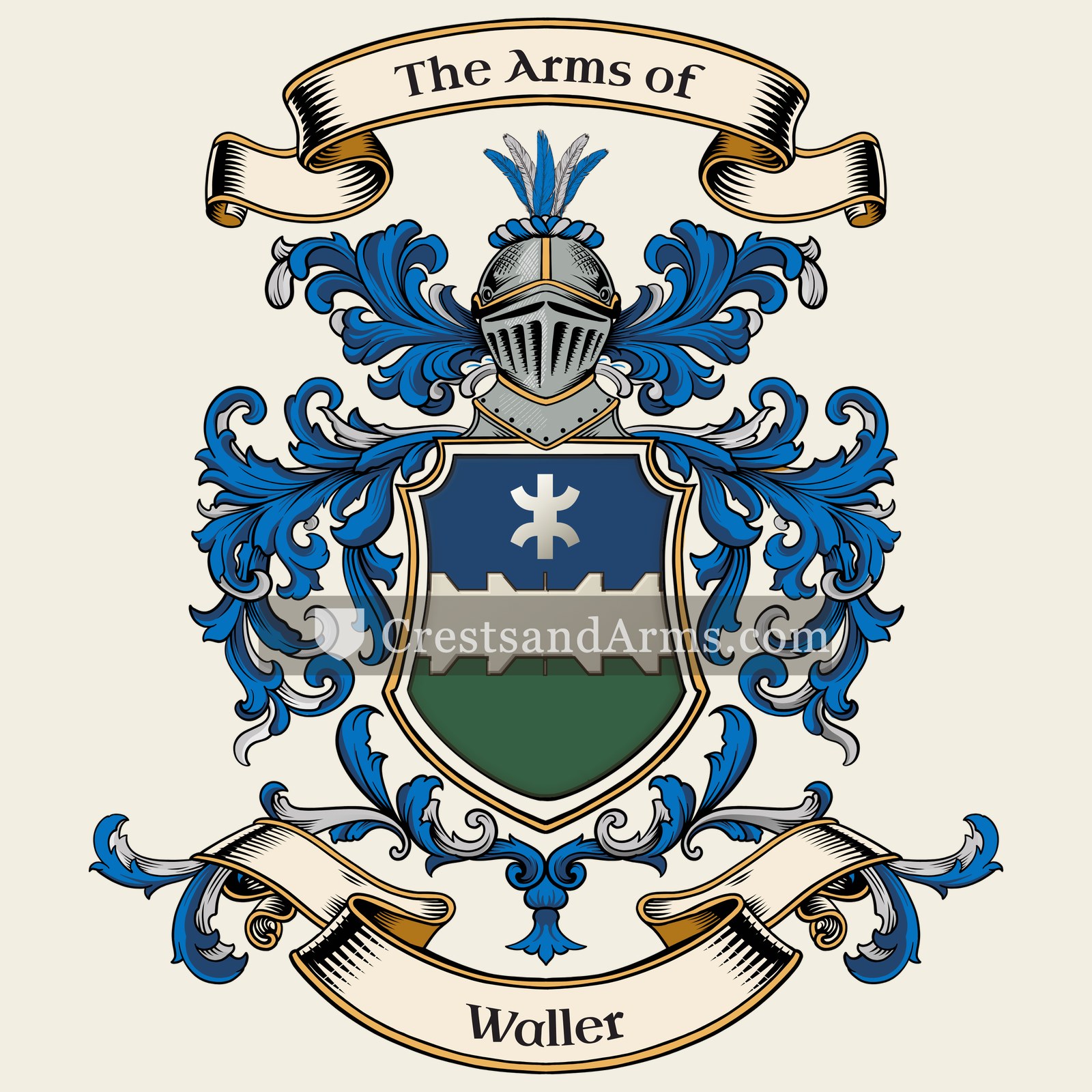
Symbols on this shield
fessThe military belt, and readiness to serve
millrind / fer de molineThe mill's iron, and the grinding of grain
riverThe bounds of a land, and life carried through it
Colours
Blue (Azure)Means: Loyalty and truth
Green (Vert)Means: Hope
Silver (Argent)Means: Peace and sincerity
Historical info
Source
J. B. Rietstap, Armorial Général, Gouda: G. B. van Goor Zonen, 1884–87
Blazon (the actual original written record)
“Coupé, d'azur ch. d'un fer-de-moulin d'arg., sur une mer de sin.; à la fasce crén. de trois pièces d'arg., br. sur le coupé. C.: le fer-de-moulin, entre un vol à l'antique d'azur. L. d'arg. et d'azur.”
NetherlandsAmsterdam, c. 1815
Digital archive packCoat of arms PNG, gold border print PDF, vector SVG and the certificate of authenticity. Sent to your email in minutes.
Map of Netherlands showing where the Waller arms are recorded
The Waller arms were recorded in Amsterdam, c. 1815.
This is where the arms were entered in the register. Families often moved to other parts of the country, so the same name can turn up in more than one region.
Region
Amsterdam
Town
Amsterdam
First recorded
1815
Granting Authority for the Waller Arms
Hoge Raad van Adel
Photograph made by me · CC BY-SA 3.0
The body that granted and recorded arms in Netherlands in this period.
William I of the Netherlands
Sovereign of the period
William I of the Netherlands
1815–1840
Reigning in Netherlands when the Waller arms are first recorded.
How Arms Worked in Netherlands
In the Netherlands, coats of arms were often used by noble families and those who held specific public offices. These arms were passed down through the generations to legitimate descendants. Younger branches of a family usually kept the original design without needing to add special marks. This system ensured that the family identity remained clear and consistent over many years.
Granting authority
The Hoge Raad van Adel is the official body that regulates and manages noble titles and coats of arms in the Netherlands.
How they got arms
Families typically obtained their coats of arms through official royal grants or by proving their long-standing historical use of the symbols.
Where arms were recorded
Coats of arms are officially recorded in the registers held by the Hoge Raad van Adel, which began its work in 1814.
The family's standing
Recorded among the armigerous families of Netherlands.
Origin & History of the Waller Family in Netherlands
The history of the Waller family in the Netherlands is deeply connected to the bustling commercial environment of Amsterdam during the early nineteenth century. By 1815, members of the family were already established in the city, participating in the vibrant trade and financial networks that defined the post-Napoleonic era. The name itself likely originated as a topographical or occupational descriptor, referring to someone who lived near a wall or worked as a builder. As Amsterdam grew into a major center for international shipping and banking, the Wallers integrated into the urban professional class. They contributed to the city’s recovery and expansion as the Netherlands transitioned into a new period of national stability. Through their presence in the capital, the family became part of the long tradition of merchant families who helped shape the economic identity of the Dutch state.
Coat of Arms & Family Crest Details
Symbols on this shield
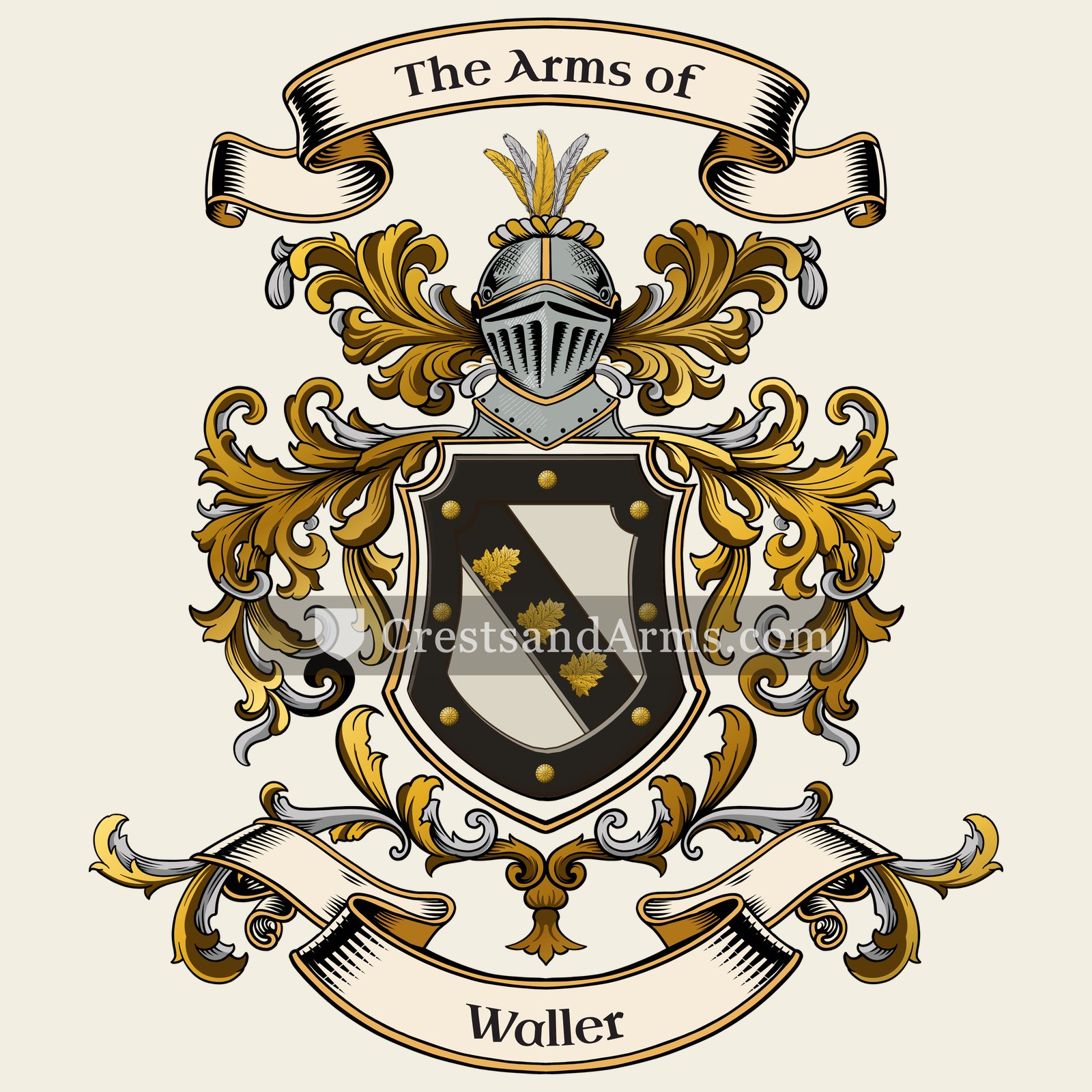
bendDefence, and the scarf of a commander
bordureA difference between branches of one family
leafHappiness and abundance
roundelA coin, and one who has been to the crusades
Colours
Silver (Argent)Means: Peace and sincerity
Black (Sable)Means: Constancy
Gold (Or)Means: Generosity
Historical info
Source
Sir Bernard Burke, The General Armory of England, Scotland, Ireland and Wales, London: Harrison & Sons, 1884
Blazon (the actual original written record)
“Ar. on a bend sa. three elm leaves or, a border of the second bezantée”
DevonDevon, c. 1620
Digital archive packCoat of arms PNG, gold border print PDF, vector SVG and the certificate of authenticity. Sent to your email in minutes.
Map of England showing where the Waller arms are recorded
The Waller arms were recorded in Devon, c. 1620.
Devon was a county of small manors and seafaring families. Its gentry were spread thickly across the countryside, and money made at sea often bought an estate, which in turn brought a coat of arms.
This is where the arms were entered in the register. Families often moved to other parts of the country, so the same name can turn up in more than one region.
The body that granted and recorded arms in England in this period.
James VI and I
Sovereign of the period
James VI and I
1603–1625
Reigning in Netherlands when the Waller arms are first recorded.
How Arms Worked in England
English heraldry allowed arms to be shared by all legitimate descendants of the original owner. These symbols were treated as personal property that moved through the generations to all children. While the eldest son kept the original design, other family members could use the same shield without needing to change it or register their own unique versions.
Granting authority
The College of Arms in London has regulated the use of coats of arms throughout England and Wales since 1484.
How they got arms
Families typically obtained their coats of arms through a formal grant from the Crown or by proving their ancient right to them.
Where arms were recorded
All official coats of arms are recorded in the registers kept at the College of Arms, which date back to the fifteenth century.
The family's standing
Recorded among the armigerous families of Devon.
Origin & History of the Waller Family in England
The surname Waller is an occupational name that originated in medieval England, likely referring to a person who built walls or worked as a mason. By the early 17th century, the family had established a notable presence in the county of Devon. During this period, Devon was a hub of maritime activity and agricultural development, providing a stable environment for families to settle and grow. Records from 1620 confirm that individuals bearing this name were integrated into the local community, living as part of the social fabric that defined the West Country. These early ancestors were likely involved in the trades or farming practices common to the region, contributing to the local economy long before the era of mass migration. This deep connection to the Devon landscape highlights the family's long-standing roots in English history.
Coat of Arms & Family Crest Details
Symbols on this shield
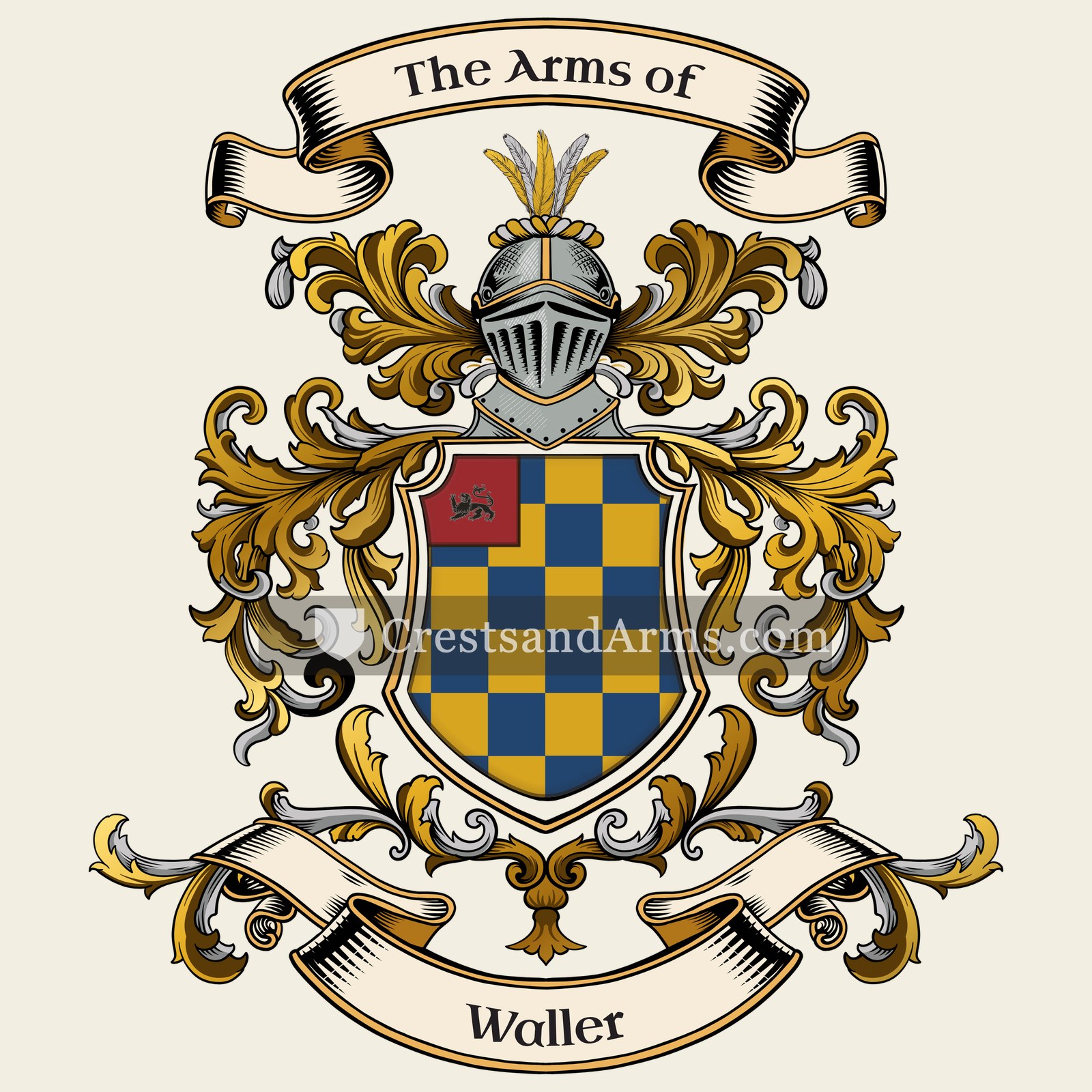
chequyConstancy, and the counting-board
cantonA mark of honour granted by the sovereign
lionCourage, strength and royalty
Colours
Gold (Or)Means: Generosity
Red (Gules)Means: Military strength
Blue (Azure)Means: Loyalty and truth
Historical info
Source
Sir Bernard Burke, The General Armory of England, Scotland, Ireland and Wales, London: Harrison & Sons, 1884
Blazon (the actual original written record)
“Chequy or and az. on a canton gu. a lion ramp. double queued of the first”
DublinDublin, c. 1642
Digital archive packCoat of arms PNG, gold border print PDF, vector SVG and the certificate of authenticity. Sent to your email in minutes.
Map of Ireland showing where the Waller arms are recorded
The Waller arms were recorded in Dublin, c. 1642.
Dublin was the seat of government in Ireland and the place where grants were sought and recorded. Families with business at the castle or the courts settled nearby, and settling there put their arms on record.
This is where the arms were entered in the register. Families often moved to other parts of the country, so the same name can turn up in more than one region.
The body that granted and recorded arms in Ireland in this period.
Charles I of England
Sovereign of the period
Charles I of England
1625–1649
Reigning in Netherlands when the Waller arms are first recorded.
How Arms Worked in Ireland
The Ulster King of Arms granted coats of arms to individuals who proved their social standing and good character. These symbols were typically inherited by all legitimate descendants of the original holder. If a family branch wanted a unique look, they could apply for a specific change to their design through the office to ensure their identity remained distinct.
Granting authority
The Ulster King of Arms acted as the official body that regulated and issued all coats of arms throughout Ireland.
How they got arms
Families obtained their arms through formal grants issued by the office after proving their eligibility and paying the required fees.
Where arms were recorded
All official grants were recorded in the registers held by the Ulster King of Arms starting from the year 1552.
The family's standing
Recorded among the armigerous families of Dublin.
Origin & History of the Waller Family in Ireland
The history of the Waller name in Ireland is deeply connected to the political and military shifts of the seventeenth century. While the name has roots in England, records confirm that members of the Waller family were firmly established in Dublin by 1642. This period was a time of great instability due to the Irish Rebellion, and many families of English descent moved to the capital to seek safety or to serve in the administrative and military structures of the time. As the family settled into life in Ireland, they became involved in the local governance and land management systems that defined the era. Over the following decades, the family expanded their influence beyond Dublin, eventually becoming landowners in various parts of the country. Their presence in Ireland reflects the broader movement of settlers who helped shape the social and political landscape of the island during a transformative time in history.
Waller Meaning & Related Branches
Root word
Walther
Derived from Germanic elements meaning ruler of the army or power.
This name
WallerA topographic name for someone who lived near a wall or a rampart.
also spelled
Wallere
Wallar
Wallor
Walers
Related arms
Wanlersame arms
Walervariant spelling
Walersvariant spelling
Conollyrecorded with Waller, same area
Documented Sources
J. B. Rietstap, Armorial Général, Gouda: G. B. van Goor Zonen, 1884–87
Stadsarchief Amsterdam, Doop-, trouw- en begraafregisters
Nationaal Archief, Bevolkingsregister Amsterdam
Brugmans, H., Geschiedenis van Amsterdam, 1972
Frijhoff, W. and Prak, M., Geschiedenis van Amsterdam: Centrum van de wereld 1578-1650, 2004
Digital archive packCoat of arms PNG, gold border print PDF, vector SVG and the certificate of authenticity. Sent to your email in minutes.


 fessThe military belt, and readiness to serve
 millrind / fer de molineThe mill's iron, and the grinding of grain
 riverThe bounds of a land, and life carried through it
 fessThe military belt, and readiness to serve
 millrind / fer de molineThe mill's iron, and the grinding of grain
 riverThe bounds of a land, and life carried through it


 bendDefence, and the scarf of a commander
 bordureA difference between branches of one family
 leafHappiness and abundance
 roundelA coin, and one who has been to the crusades


 chequyConstancy, and the counting-board
 cantonA mark of honour granted by the sovereign
 lionCourage, strength and royalty