A record of documented arms, meaning and origin, researched for the Wallis family lines. Documented in 3 countries.
Reg. 9383 · Austrian, W–Z
Coat of Arms & Family Crest Details
Symbols on this shield
fessThe military belt, and readiness to serve
lionCourage, strength and royalty
armA person of action, industrious and laborious
towerGrandeur and solidity, and a stronghold defended
Colours
Gold (Or)Means: Generosity
Red (Gules)Means: Military strength
Blue (Azure)Means: Loyalty and truth
Silver (Argent)Means: Peace and sincerity
Historical info
Source
J. B. Rietstap, Armorial Général, Gouda: G. B. van Goor Zonen, 1884–87
Blazon (the actual original written record)
“Parti d'un trait, coupé de deux autres, qui font six quartiers: aux 1 et 6 d'or au lion d'azur, cour. d'or, celui du 1 cont.; aux 2 et 3 de gu., au 2 un senestrochère, au 3 un dextrochère, tous deux arm. d'arg. et tenant une épée du même; aux 4 et 5 de sa. à une tour d'arg., ouv. et aj. du champ. Sur le tout un écusson d'azur, sommé d'une couronne à neuf perles et ch. d'un lion d'arg., arm. et lamp. de gu., cour. d'or; à la fasce partie d'arg. et de gu., br. sur le lion. Trois cq. cour. C.: 1º la tour des 4 et 5, accostée de deux lions affr d'or, cour. du même, ramp. contre la tour, chacun de ces objets posés sur un des cq.; la tour supp. un cygne d'arg., percé d'une flèche de gu. en barre, la pointe en bas. D. au-dessus du cimier: QUOD ERO SPERO. L.: à dextre d'arg. et de gu., à sen. d'or et de sa. — L'écu accosté de deux petits écussons, timbrés chacun d'un cq. cour.; l'écusson à dextre répétant les armes du 3e quartier, le bras en cimier, iss. de la couronne; celui à sen. répétant les armes du surtout; cimier: un lion iss. d'azur, cour. d'or; I. des deux cq., d'arg. et de gu.”
Austriac. 1706
Digital archive packCoat of arms PNG, gold border print PDF, vector SVG and the certificate of authenticity. Sent to your email in minutes.
Map of Austria showing where the Wallis arms are recorded
The Wallis arms were recorded in Austria, c. 1706.
Arms such as these were typically recorded in Tyrol.
Tyrol was mountain country in western Austria, where the valleys were held by families who had been there a very long time. Old tenure counted for more than money, and old families carried arms.
This is where the arms were entered in the register. Families often moved to other parts of the country, so the same name can turn up in more than one region.
Region
Tyrol
First recorded
1706
Granting Authority for the Wallis Arms
Imperial and Royal chancery
Sodacan · CC BY-SA 3.0
The body that granted and recorded arms in Austria in this period.
Joseph I, Holy Roman Emperor
Sovereign of the period
Joseph I, Holy Roman Emperor
1705–1711
Reigning in Austria when the Wallis arms are first recorded.
How Arms Worked in Austria
Austrian coats of arms were often linked directly to noble titles granted by the Emperor. These symbols belonged to the entire family line rather than just one individual. When a family grew, new branches kept the original design without needing to change it. This system allowed all members of a noble house to share the same identity across many generations.
Granting authority
The Imperial and Royal chancery managed all heraldic matters and controlled the official granting of arms throughout the Austrian lands.
How they got arms
Families typically received their arms through a formal imperial decree that often accompanied the elevation of a person to noble status.
Where arms were recorded
Official records of these grants were kept in the Imperial Register of Nobility which began its formal documentation process in 1453.
The family's standing
Recorded among the armigerous families of Austria.
Origin & History of the Wallis Family in Austria
The history of the Wallis family in Austria is deeply connected to the strategic landscape of the Tyrol region during the early eighteenth century. While the name itself has roots that stretch back to the medieval period in Western Europe, the family established a notable presence in the Austrian Alps by 1706. During this era, the Wallis family integrated into the local social and political structures of Tyrol, often serving in administrative or military capacities that were vital to the Habsburg monarchy. Their movement into this mountainous territory was likely influenced by the shifting borders and the need for loyal officials to manage regional affairs. By settling in Tyrol, the family became part of a complex network of landowners and public servants who helped maintain order in a key gateway between the Italian states and the heart of the Austrian Empire. This transition marked a significant chapter in their family story as they adapted to the unique customs and challenges of life in the high alpine environment.
Coat of Arms & Family Crest Details
Symbols on this shield
fessThe military belt, and readiness to serve
cantonA mark of honour granted by the sovereign
Colours
Red (Gules)Means: Military strength
ErmineMeans: Dignity
Historical info
Source
Sir Bernard Burke, The General Armory of England, Scotland, Ireland and Wales, London: Harrison & Sons, 1884
Blazon (the actual original written record)
“Gu. a fess erm. a canton of the last”
CornwallMevegesie · Cornwall, c. 1590
Digital archive packCoat of arms PNG, gold border print PDF, vector SVG and the certificate of authenticity. Sent to your email in minutes.
Map of England showing where the Wallis arms are recorded
The Wallis arms were recorded in Cornwall, c. 1590.
Cornwall was a county apart, with its own language and its own tight-knit gentry. Tin and the sea made money there, and families who made it bought land, which is what brought arms with it.
This is where the arms were entered in the register. Families often moved to other parts of the country, so the same name can turn up in more than one region.
The body that granted and recorded arms in England in this period.
Elizabeth I of England
Sovereign of the period
Elizabeth I of England
1558–1603
Reigning in Austria when the Wallis arms are first recorded.
How Arms Worked in England
English heraldry allowed arms to be shared by all legitimate descendants of the original owner. These symbols were treated as personal property that moved through the generations to all children. While the eldest son kept the original design, other family members could use the same shield without needing to change it or register their own unique versions.
Granting authority
The College of Arms in London has regulated the use of coats of arms throughout England and Wales since 1484.
How they got arms
Families typically obtained their coats of arms through a formal grant from the Crown or by proving their ancient right to them.
Where arms were recorded
All official coats of arms are recorded in the registers kept at the College of Arms, which date back to the fifteenth century.
The family's standing
Recorded among the armigerous families of Cornwall.
Origin & History of the Wallis Family in England
The surname Wallis is a classic example of a locative name, which means it was originally used to identify people based on where they came from. In medieval England, the term "Walys" or "Walleis" was used by the English to describe people who originated from Wales or spoke a Celtic language. As families moved across the country, neighbors often used this name to distinguish newcomers from the local population. By the time records appear in Cornwall in 1590, the name had become a permanent family identifier rather than just a description of a person’s birthplace. These early families in Cornwall were likely part of the regional movement of people that occurred as trade and agriculture expanded throughout the southwestern peninsula. Over several generations, the name shifted from a simple label for a foreigner into a stable hereditary surname passed down through the family line.
Coat of Arms & Family Crest Details
Symbols on this shield
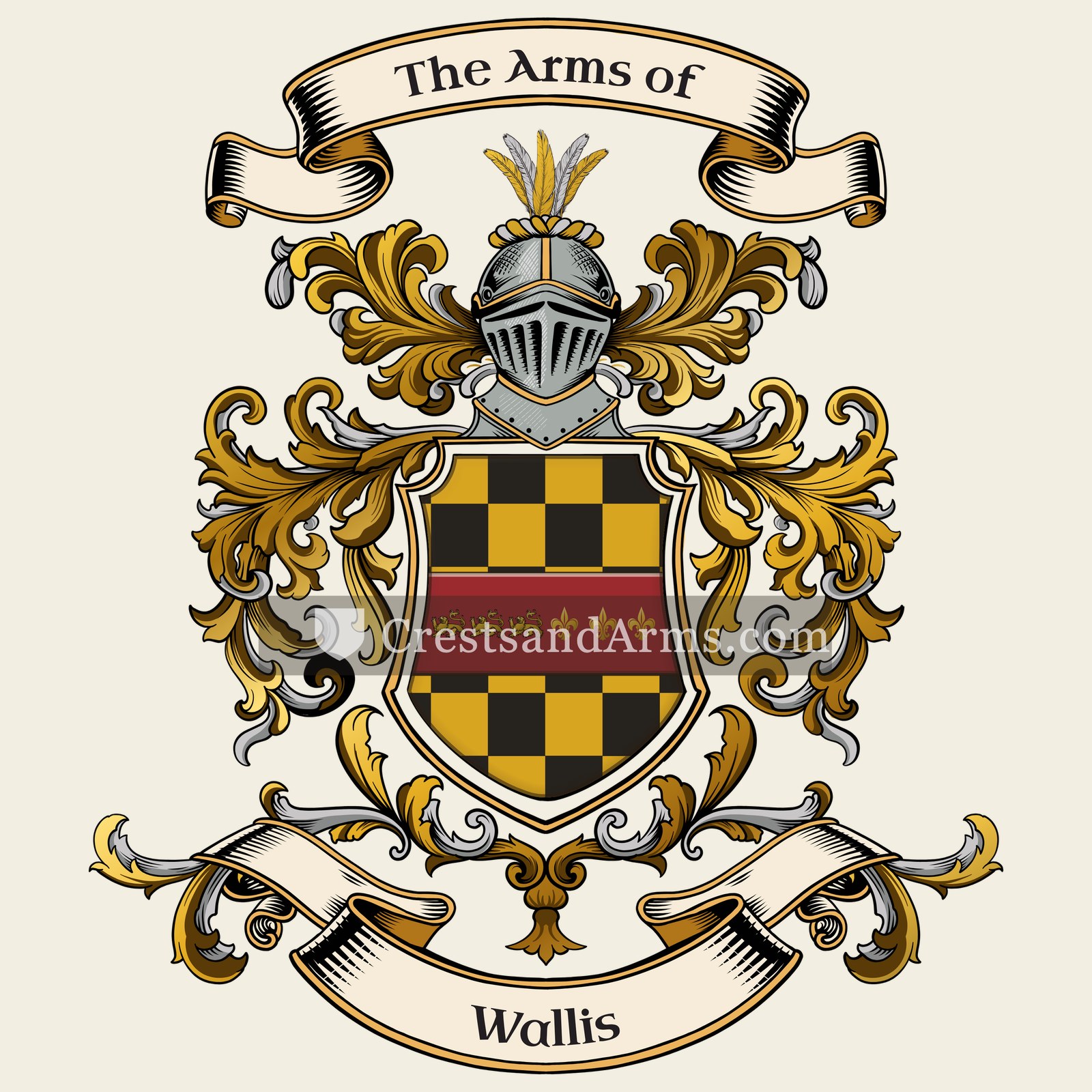
chequyConstancy, and the counting-board
fessThe military belt, and readiness to serve
lionCourage, strength and royalty
fleur de lisPurity, light, and the sixth son
Colours
Gold (Or)Means: Generosity
Red (Gules)Means: Military strength
Black (Sable)Means: Constancy
Historical info
Source
Sir Bernard Burke, The General Armory of England, Scotland, Ireland and Wales, London: Harrison & Sons, 1884
Blazon (the actual original written record)
“Chequy or and sa. on a fess gu. three leopards' faces jessant-de-lis or”
MonmouthLlanarth · Monmouth, c. 1647
Digital archive packCoat of arms PNG, gold border print PDF, vector SVG and the certificate of authenticity. Sent to your email in minutes.
Map of Wales showing where the Wallis arms are recorded
The Wallis arms were recorded in Monmouth, c. 1647.
Monmouthshire lay on the Welsh border, where land was held in return for military service. Families were expected to arm and to fight, and fighting households carried shields of their own.
This is where the arms were entered in the register. Families often moved to other parts of the country, so the same name can turn up in more than one region.
The body that granted and recorded arms in Wales in this period.
Charles I of England
Sovereign of the period
Charles I of England
1625–1649
Reigning in Austria when the Wallis arms are first recorded.
How Arms Worked in Wales
English heraldry allowed arms to be shared by all legitimate descendants of the original owner. These symbols were treated as personal property that moved through the generations to all children. While the eldest son kept the original design, other family members could use the same shield without needing to change it or register their own unique versions.
Granting authority
The College of Arms in London has regulated the use of coats of arms throughout England and Wales since 1484.
How they got arms
Families typically obtained their coats of arms through a formal grant from the Crown or by proving their ancient right to them.
Where arms were recorded
All official coats of arms are recorded in the registers kept at the College of Arms, which date back to the fifteenth century.
The family's standing
Recorded among the armigerous families of Monmouth.
Origin & History of the Wallis Family in Wales
The name Wallis is rooted in the historical interactions between the Welsh people and their neighbors. In the Middle Ages, the term was often used by English speakers to describe someone of Welsh origin, functioning as a descriptive label rather than a fixed surname. By the seventeenth century, families bearing this name had established a firm presence in the border regions of Wales, specifically in Monmouth. Records from 1647 confirm that members of the Wallis family were active in the local community during this period of significant political upheaval in Britain. As the family settled into these Welsh borderlands, the name transitioned from a general description of heritage into a stable family identifier passed down through generations. This evolution reflects the complex blending of cultures and identities that defined life in the Welsh Marches during the early modern era.
Related Branches & Arms
Root word
Walah
A Germanic term meaning a foreigner or a stranger.
This name
WallisOriginally used to identify people of Celtic or Romance-speaking origin living among Germanic tribes.
also spelled
Walis
Walles
Wallace
Wallys
Related arms
Wallacevariant spelling
Gualesvariant spelling
Walles, or Walleysvariant spelling
Wallysvariant spelling
Documented Sources
J. B. Rietstap, Armorial Général, Gouda: G. B. van Goor Zonen, 1884–87
Fuchs, Konrad. Die Geschichte Tirols: Von den Anfängen bis zur Gegenwart. 1999
Wurzbach, Constantin von. Biographisches Lexikon des Kaiserthums Oesterreich. 1885


 fessThe military belt, and readiness to serve
 lionCourage, strength and royalty
 armA person of action, industrious and laborious
 towerGrandeur and solidity, and a stronghold defended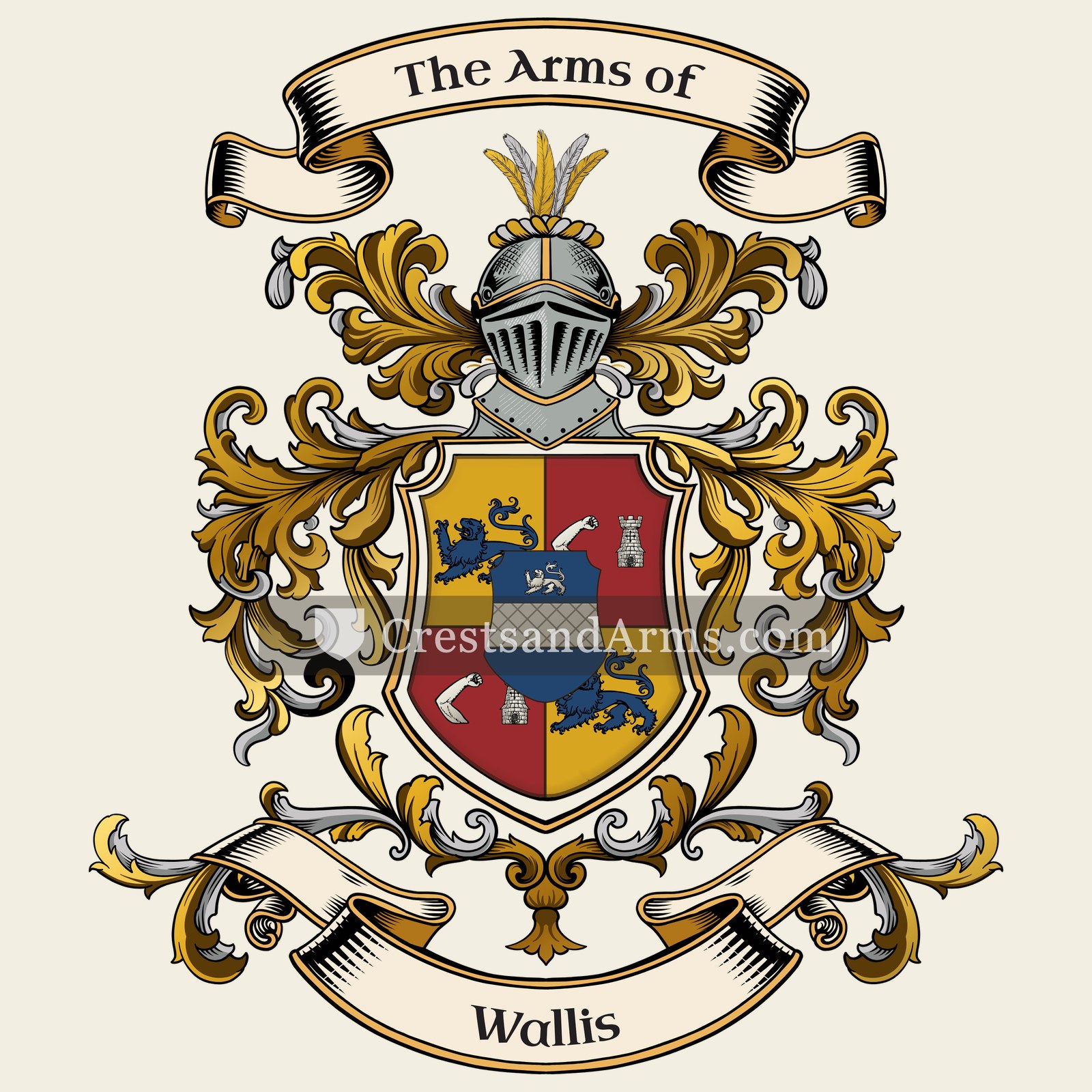


 cantonA mark of honour granted by the sovereign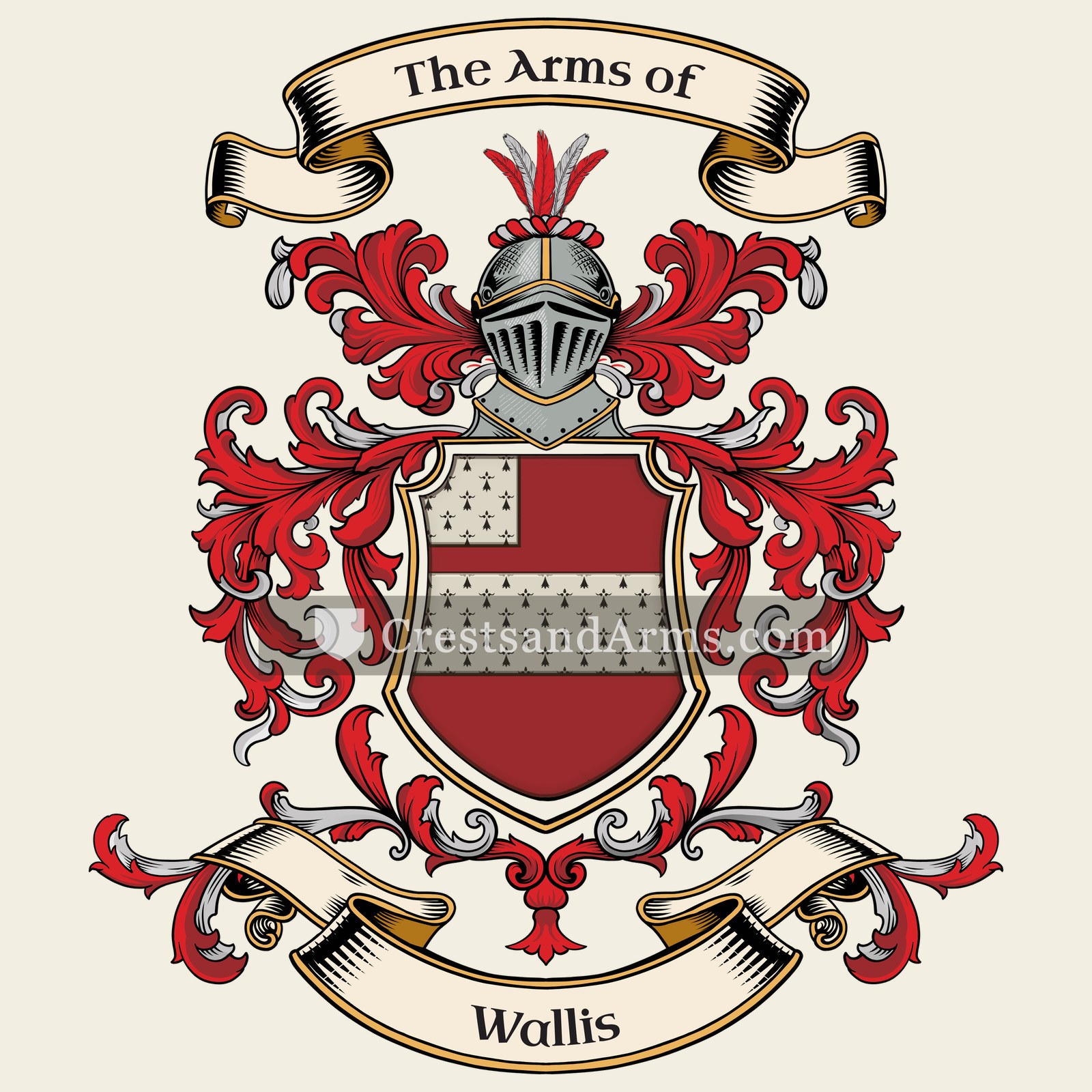


 chequyConstancy, and the counting-board
 fleur de lisPurity, light, and the sixth son