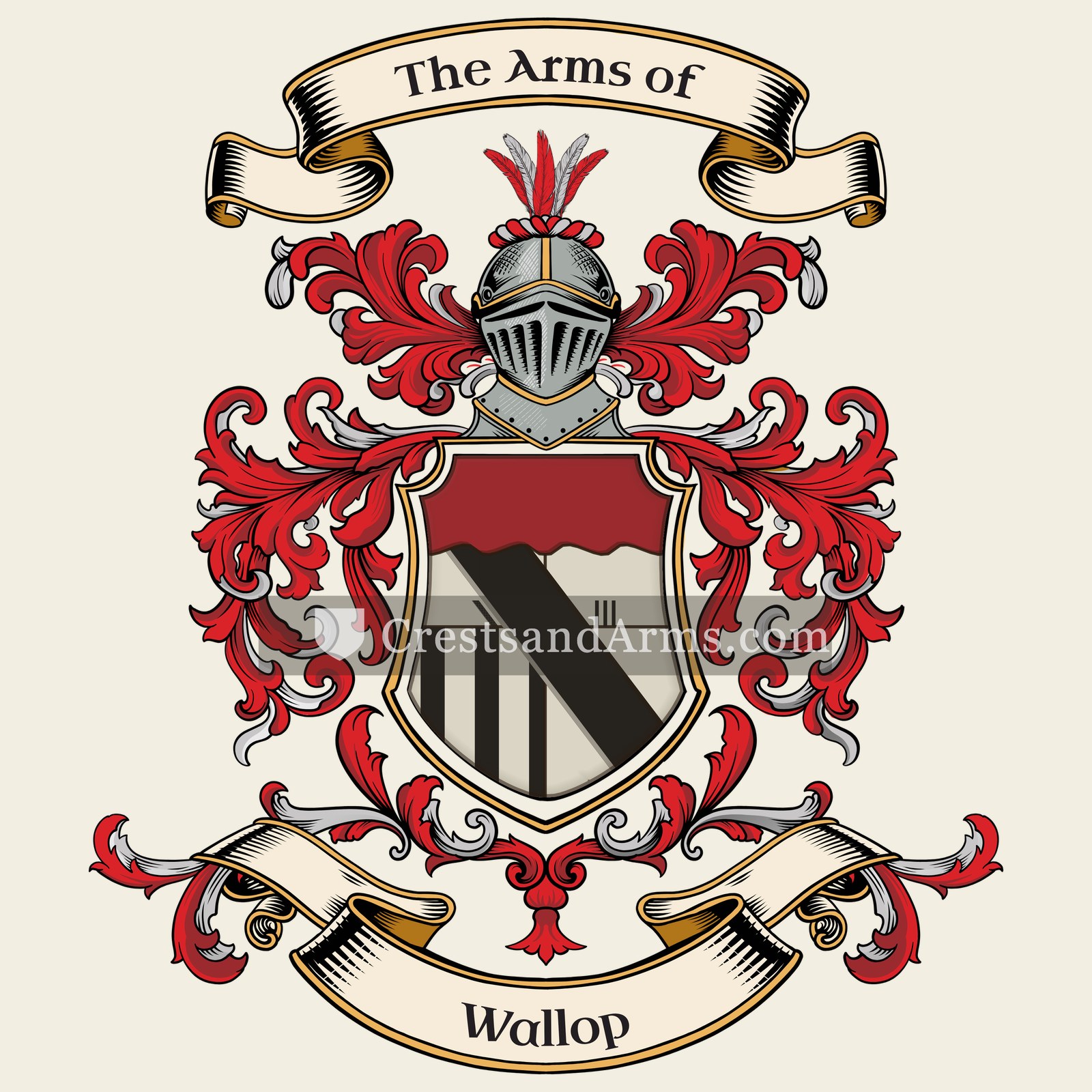
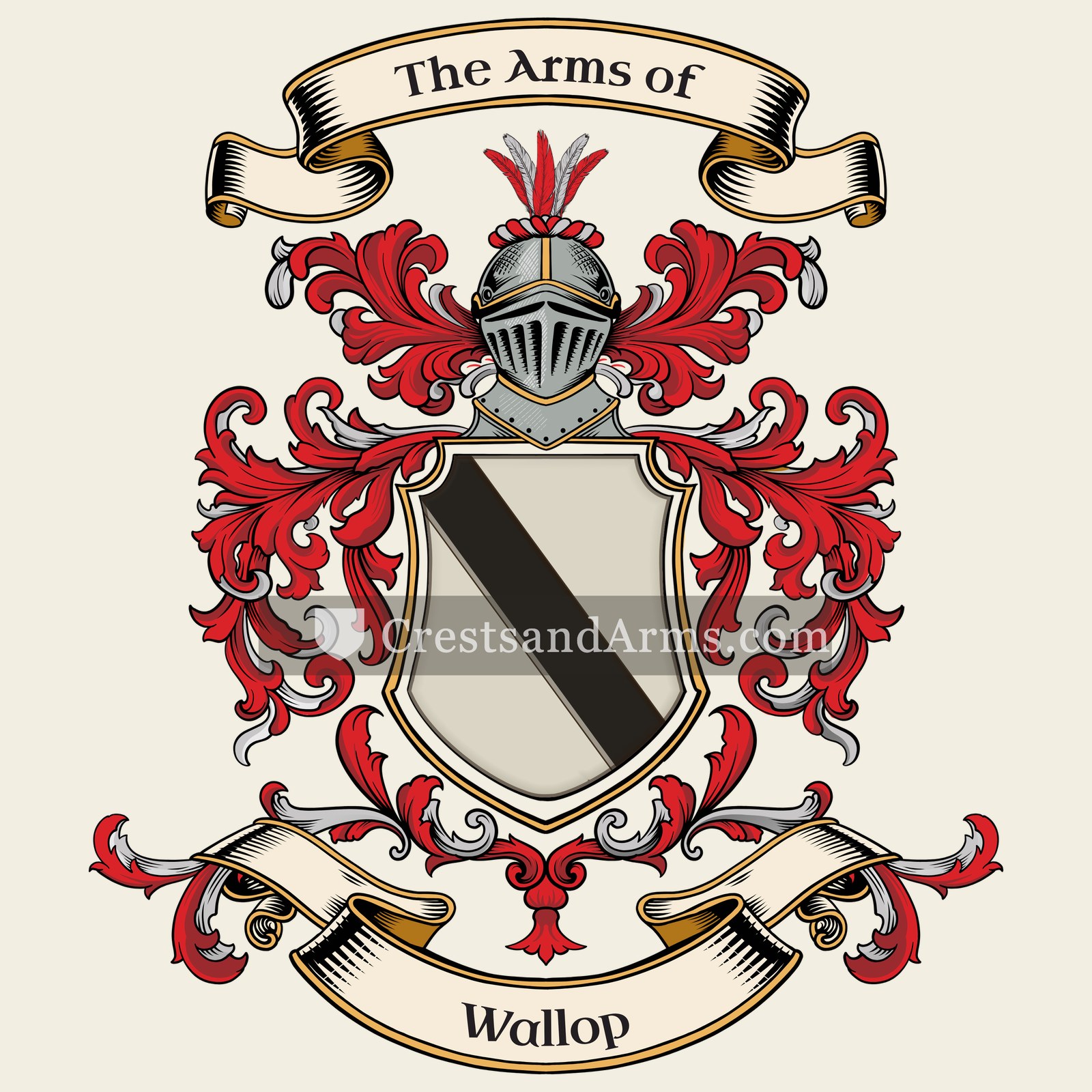
A record of documented arms, meaning and origin, researched for the Wallop family lines. Documented in 3 countries.
Reg. 9170 · French, W–Z
Coat of Arms & Family Crest Details
Symbols on this shield
bendDefence, and the scarf of a commander
Colours
Silver (Argent)Means: Peace and sincerity
Black (Sable)Means: Constancy
Historical info
Source
J. B. Rietstap, Armorial Général, Gouda: G. B. van Goor Zonen, 1884–87
Blazon (the actual original written record)
“D'arg. à la bande ondée de sa. C.: une sirène, tenant de sa main dextre un peigne et de sa sen. un miroir. S.: deux boucs de sa. D.: EN SUIVANT LA VÉRITÉ.”
Francec. 1720
Digital archive packCoat of arms PNG, gold border print PDF, vector SVG and the certificate of authenticity. Sent to your email in minutes.
Map of France showing where the Wallop arms are recorded
The Wallop arms were recorded in France, c. 1720.
Arms such as these were typically recorded in Bretagne.
More families held coats of arms in Bretagne than anywhere else in France. The land was divided into many small estates rather than a few large ones, so far more households counted as gentry, and each needed a shield of its own to be told apart.
This is where the arms were entered in the register. Families often moved to other parts of the country, so the same name can turn up in more than one region.
The body that granted and recorded arms in France in this period.
Louis XV of France
Sovereign of the period
Louis XV of France
1715–1774
Reigning in France when the Wallop arms are first recorded.
How Arms Worked in France
In France, a coat of arms was a mark of honor that passed down through the male line to all legitimate descendants. Families often used the same shield without changes to show their shared heritage. If a branch wanted to stand out, they could add a small mark to their shield to show their specific place in the family tree.
Granting authority
The Juge d'armes de France acted as the official authority that regulated and verified coats of arms across the country.
How they got arms
Families typically inherited their arms from ancestors, though they could also receive them through royal grants or by proving their noble status.
Where arms were recorded
Coats of arms were officially recorded in the Armorial Général de France, which began its main collection in the year 1696.
The family's standing
Recorded among the armigerous families of France.
Origin & History of the Wallop Family in France
The history of the Wallop family in France is deeply tied to the region of Brittany, where members of the family were documented as early as 1720. While the name is often associated with English nobility, its presence in France suggests a history of migration and integration into the local social fabric of the eighteenth century. During this period, families of similar standing often moved across the English Channel for reasons related to trade, military service, or religious shifts. Once in Brittany, these individuals likely adapted to the local culture and administrative systems of the French provinces. By embedding themselves in the regional records of the time, the Wallop family became part of the complex social landscape of pre-revolutionary France. This transition highlights how families moved between nations and established new roots in foreign territories while maintaining their ancestral identity.
Coat of Arms & Family Crest Details
Symbols on this shield
bendDefence, and the scarf of a commander
paleMilitary strength, and a fortified defence
chiefAuthority, wisdom and dominion
saltireResolution, and St Andrew's cross
Colours
Silver (Argent)Means: Peace and sincerity
Black (Sable)Means: Constancy
Red (Gules)Means: Military strength
Historical info
Source
Sir Bernard Burke, The General Armory of England, Scotland, Ireland and Wales, London: Harrison & Sons, 1884
Blazon (the actual original written record)
“Quarterly, 1st and 4th, ar. a bend wavy sa; 2nd and 3rd, ar. three palets wavy sa. on a chief gu. a saltire or”
DublinIreland · Dublin, c. 1581
Digital archive packCoat of arms PNG, gold border print PDF, vector SVG and the certificate of authenticity. Sent to your email in minutes.
Map of Ireland showing where the Wallop arms are recorded
The Wallop arms were recorded in Dublin, c. 1581.
Dublin was the seat of government in Ireland and the place where grants were sought and recorded. Families with business at the castle or the courts settled nearby, and settling there put their arms on record.
This is where the arms were entered in the register. Families often moved to other parts of the country, so the same name can turn up in more than one region.
The body that granted and recorded arms in Ireland in this period.
Elizabeth I of England
Sovereign of the period
Elizabeth I of England
1558–1603
Reigning in France when the Wallop arms are first recorded.
How Arms Worked in Ireland
The Ulster King of Arms granted coats of arms to individuals who proved their social standing and good character. These symbols were typically inherited by all legitimate descendants of the original holder. If a family branch wanted a unique look, they could apply for a specific change to their design through the office to ensure their identity remained distinct.
Granting authority
The Ulster King of Arms acted as the official body that regulated and issued all coats of arms throughout Ireland.
How they got arms
Families obtained their arms through formal grants issued by the office after proving their eligibility and paying the required fees.
Where arms were recorded
All official grants were recorded in the registers held by the Ulster King of Arms starting from the year 1552.
The family's standing
Recorded among the armigerous families of Dublin.
Origin & History of the Wallop Family in Ireland
The Wallop family first established a significant presence in Ireland during the late sixteenth century, primarily as part of the English administration in Dublin. Sir Henry Wallop arrived in the country in 1581 to serve as the Vice-Treasurer and Treasurer at War, a role that placed him at the center of political and military affairs during a time of great unrest. His appointment marked the beginning of a long association between the family and the Irish landscape, as he was granted extensive lands in County Wexford as a reward for his service to the Crown. These estates, centered around the town of Enniscorthy, became the family seat for many generations. By settling in this region, the Wallops transitioned from temporary government officials to prominent landowners who played a direct role in the development and management of local rural society. This transition helped anchor the name within the history of the region, linking the family to the complex social and economic shifts occurring in Ireland during the Tudor period.
Coat of Arms & Family Crest Details
Symbols on this shield
bendDefence, and the scarf of a commander
Colours
Silver (Argent)Means: Peace and sincerity
Black (Sable)Means: Constancy
Historical info
Source
Sir Bernard Burke, The General Armory of England, Scotland, Ireland and Wales, London: Harrison & Sons, 1884
Blazon (the actual original written record)
“Ar. a bend wavy sa”
EnglandPortsmouth, c. 1620
Digital archive packCoat of arms PNG, gold border print PDF, vector SVG and the certificate of authenticity. Sent to your email in minutes.
Map of England showing where the Wallop arms are recorded
The Wallop arms were recorded in Portsmouth, c. 1620.
This is where the arms were entered in the register. Families often moved to other parts of the country, so the same name can turn up in more than one region.
The body that granted and recorded arms in England in this period.
James VI and I
Sovereign of the period
James VI and I
1603–1625
Reigning in France when the Wallop arms are first recorded.
How Arms Worked in England
English heraldry allowed arms to be shared by all legitimate descendants of the original owner. These symbols were treated as personal property that moved through the generations to all children. While the eldest son kept the original design, other family members could use the same shield without needing to change it or register their own unique versions.
Granting authority
The College of Arms in London has regulated the use of coats of arms throughout England and Wales since 1484.
How they got arms
Families typically obtained their coats of arms through a formal grant from the Crown or by proving their ancient right to them.
Where arms were recorded
All official coats of arms are recorded in the registers kept at the College of Arms, which date back to the fifteenth century.
The family's standing
Recorded among the armigerous families of England.
Origin & History of the Wallop Family in England
The Wallop family name is deeply rooted in the history of Hampshire, England, where it originated as a locative surname derived from the village of Wallop. The name itself is thought to come from Old English terms meaning a well or a spring in a valley. By the early 17th century, the family had established a notable presence in the coastal region of Portsmouth. This area was a vital hub for maritime activity and trade during the reign of King James I. Records from 1620 confirm that members of the family were living in this bustling port city, likely contributing to the local economy or the growing naval interests of the time. Their transition from rural landowners in the Hampshire countryside to residents of a major maritime center reflects the broader social mobility and economic shifts occurring in England during the early modern period.
Related Branches & Arms
Root word
Gualo
A Germanic personal name derived from the word for stranger or foreigner.
This name
WallopA locational surname referring to someone from the village of Gualo in Normandy.
also spelled
Walop
Wallope
Wallup
Wollop
Related arms
Dowderecorded with Wallop, same area
Fellowesrecorded with Wallop, same area
Goughrecorded with Wallop, same area
Gylesrecorded with Wallop, same area
Documented Sources
J. B. Rietstap, Armorial Général, Gouda: G. B. van Goor Zonen, 1884–87
Archives départementales d'Ille-et-Vilaine, Série B: Cours et juridictions
Archives départementales du Morbihan, Série E: Familles et seigneuries
Poter de Courcy, Pol, Nobiliaire et armorial de Bretagne, 1890
Digital archive packCoat of arms PNG, gold border print PDF, vector SVG and the certificate of authenticity. Sent to your email in minutes.


 bendDefence, and the scarf of a commander
 bendDefence, and the scarf of a commander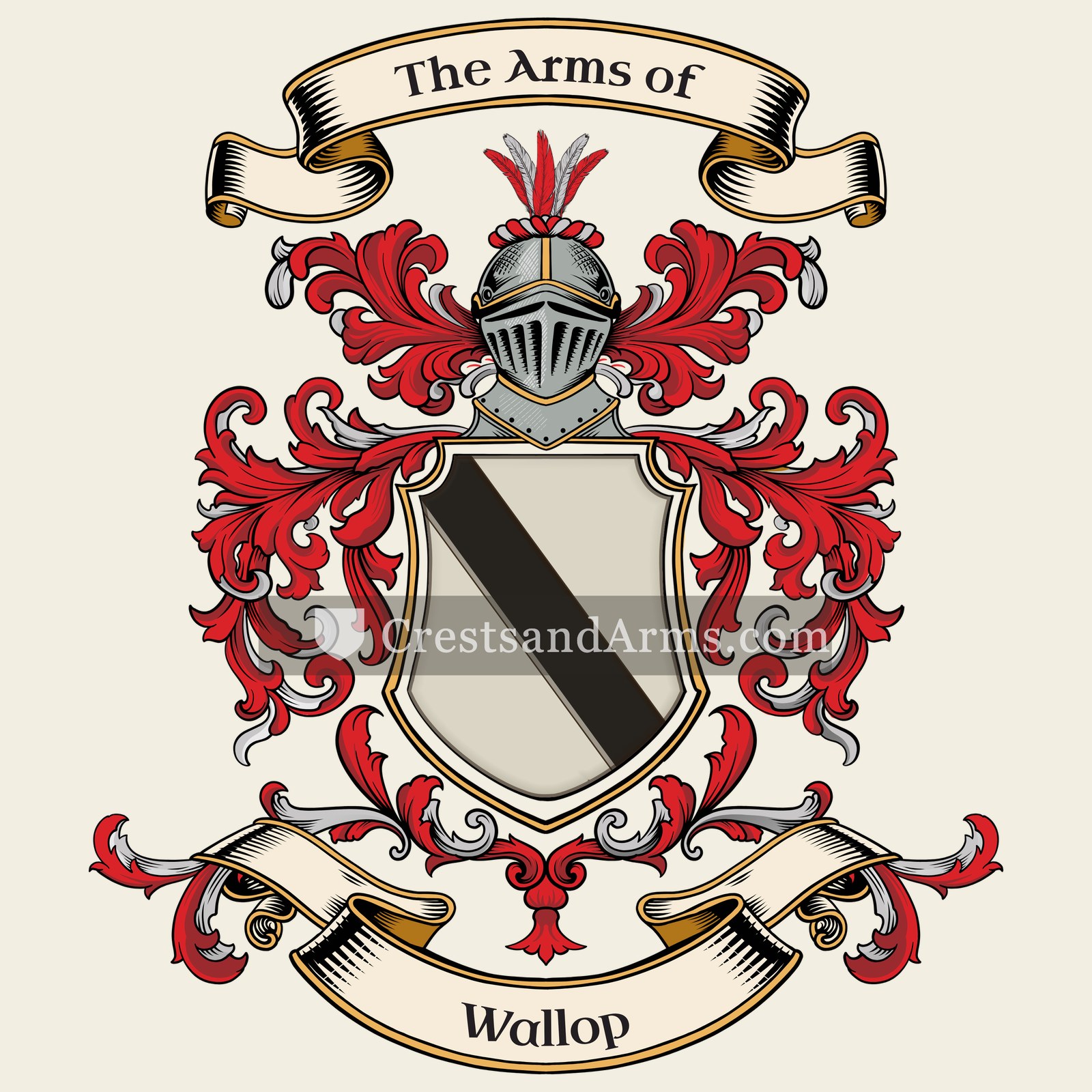


 paleMilitary strength, and a fortified defence
 chiefAuthority, wisdom and dominion
 saltireResolution, and St Andrew's cross