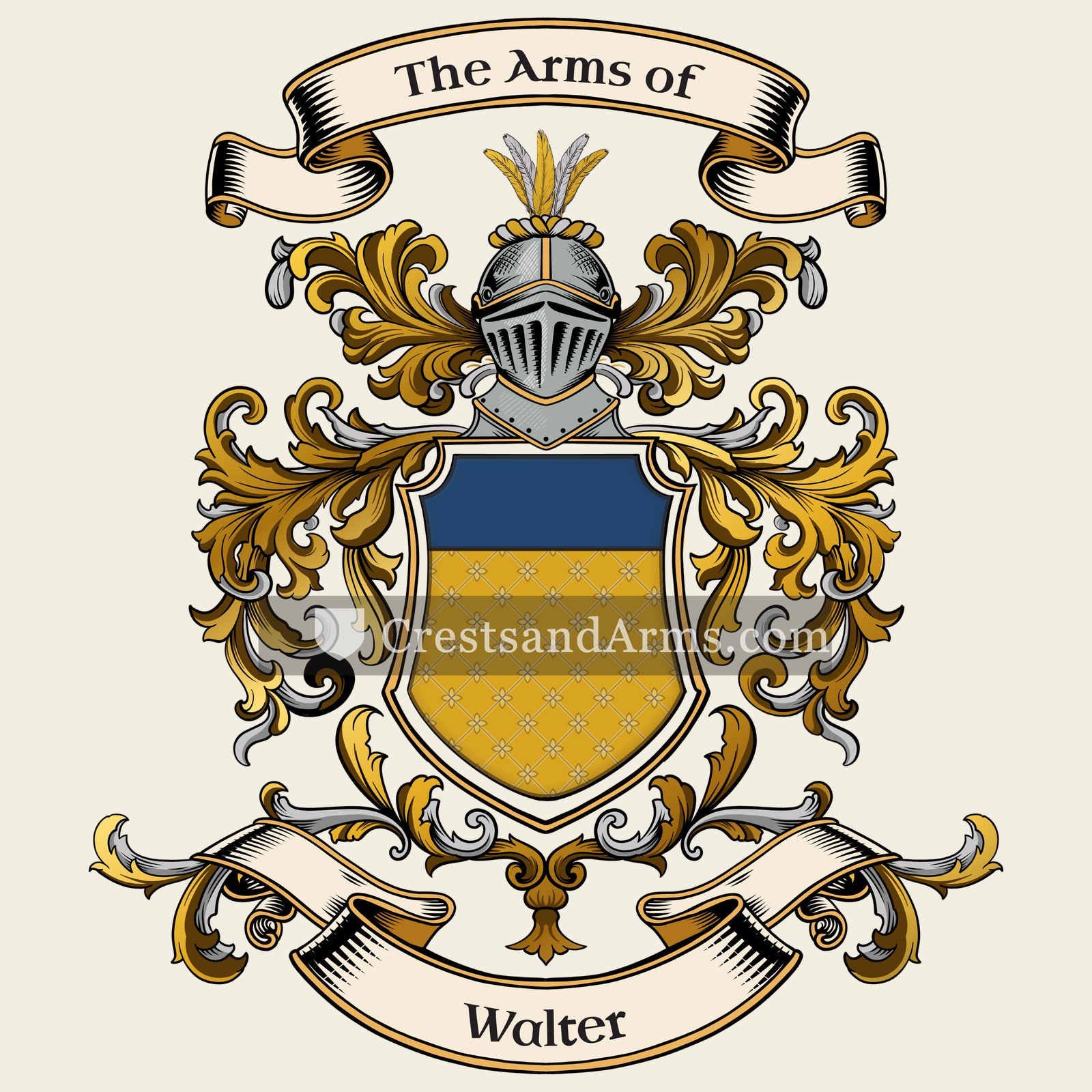
A record of documented arms, meaning and origin, researched for the Walter family lines. Documented in 3 countries.
Reg. 5049 · German, W–Z
Coat of Arms & Family Crest Details
Symbols on this shield
eagleNobility, strength and a keen mind
towerGrandeur and solidity, and a stronghold defended
mulletThe third son, and a divine quality from above
Colours
Red (Gules)Means: Military strength
Silver (Argent)Means: Peace and sincerity
Black (Sable)Means: Constancy
Gold (Or)Means: Generosity
Historical info
Source
J. B. Rietstap, Armorial Général, Gouda: G. B. van Goor Zonen, 1884–87
Blazon (the actual original written record)
“parti de gu. et d'arg., à l'aigle ép. de l'un en l'autre; au 2 de Walter qui est coupé d'arg. sur un pignon d'un seul degré de sa., le sa. ch. d'une étoile d'or. Deux cq., le 2 cour. C.: 1° un chapeau pyramidal de sa., retr. et cour. d'or, ch. d'une étoile d'or et sommé de plumes de coq de sa. (Walter); 1. d'or et de sa.; 2° un homme iss., hab. d'un parti d'arg. et de gu., coiffé d'un bonnet de gu. retr. d'arg., tenant de sa main dextre un drapeau de gu. ch. d'un W d'arg. et sa sen. une palme de sin.; le tout entre un vol, de gu. et d'arg.; l. d'arg. et de gu.”
Germanyc. 1765
Digital archive packCoat of arms PNG, gold border print PDF, vector SVG and the certificate of authenticity. Sent to your email in minutes.
Map of Germany showing where the Walter arms are recorded
The Walter arms were recorded in Germany, c. 1765.
Arms such as these were typically recorded in Bavaria.
Bavaria was a country of old landed families and walled market towns. Estates passed down the same line for centuries, and both the landowners and the leading townsmen kept arms, which is why so many Bavarian names sit in the registers.
This is where the arms were entered in the register. Families often moved to other parts of the country, so the same name can turn up in more than one region.
The body that granted and recorded arms in Germany in this period.
Francis I, Holy Roman Emperor
Sovereign of the period
Francis I, Holy Roman Emperor
1745–1765
Reigning in Germany when the Walter arms are first recorded.
How Arms Worked in Germany
In the Holy Roman Empire, coats of arms were often granted to individuals by the Emperor or his representatives. These arms were then passed down through the generations to all legitimate descendants of the original holder. Younger branches of a family usually kept the same shield design without needing to change it, as the arms belonged to the entire lineage.
Granting authority
The Holy Roman Emperor held the sole power to grant new coats of arms throughout his vast imperial territories.
How they got arms
Families typically obtained their coats of arms through a formal imperial grant or by proving their noble status to the authorities.
Where arms were recorded
These grants were officially recorded in the Imperial Chancery registers, which began keeping formal records of such honors during the Middle Ages.
The family's standing
Recorded among the armigerous families of Germany.
Origin & History of the Walter Family in Germany
The name Walter originates from the Old High German name Walthari, which combines the words for power and army. This name was common among Germanic tribes and eventually evolved into a popular surname during the Middle Ages as people began adopting hereditary family names. By the time your ancestors were recorded in Bavaria in 1765, the name had been established for centuries as a reflection of leadership and military strength. Families bearing this name were often integrated into the local agrarian or artisan communities of southern Germany. During the eighteenth century, the region of Bavaria was a hub for families who worked the land or practiced skilled trades. The presence of your ancestors in this area during that time suggests they were part of the stable, hardworking population that helped define the social fabric of the Bavarian countryside.
Coat of Arms & Family Crest Details
Symbols on this shield
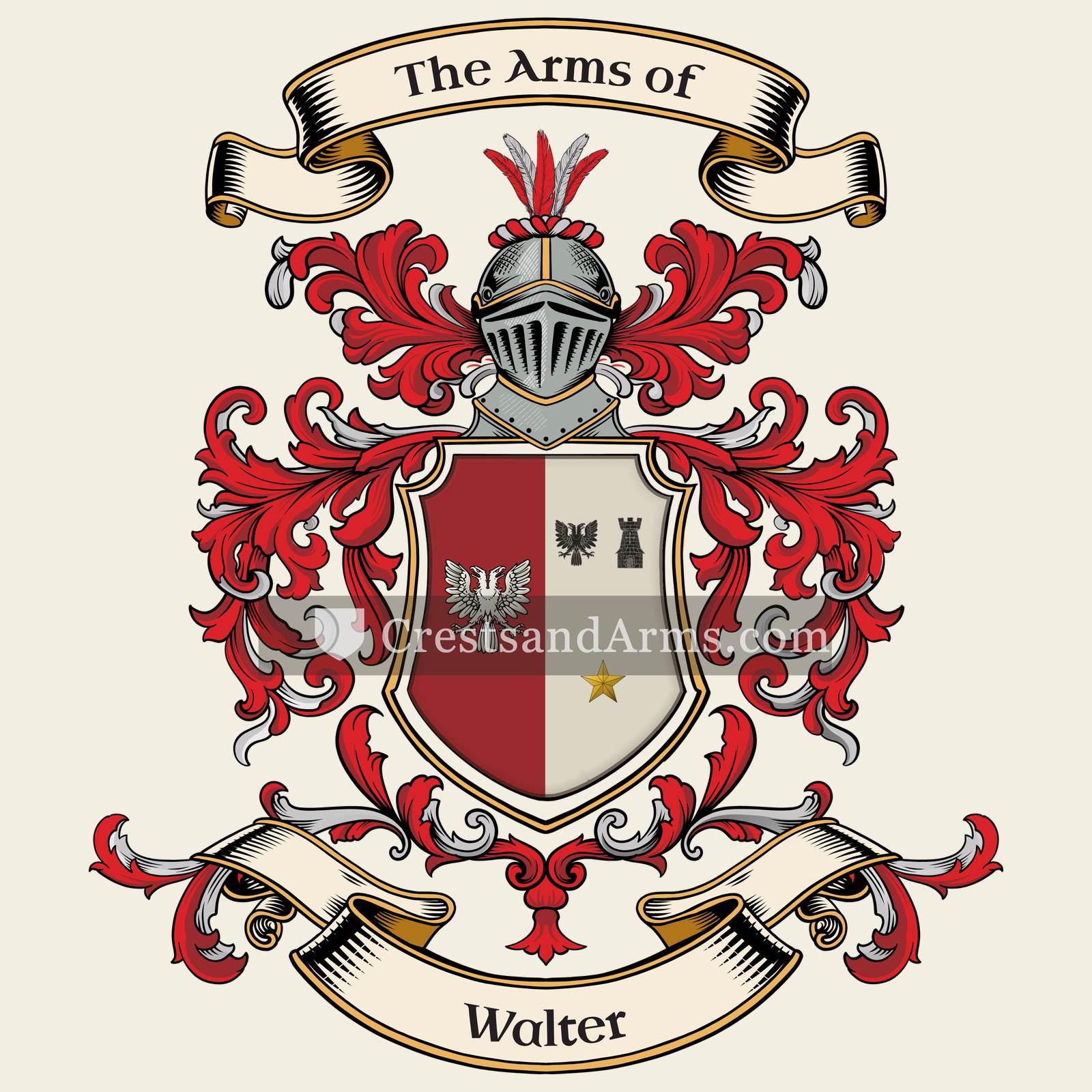
chevronProtection, and faithful service completed
chess rookStrategy, and the defence of a position
crescentHonour by the sovereign, and the second son
Colours
Silver (Argent)Means: Peace and sincerity
Black (Sable)Means: Constancy
Gold (Or)Means: Generosity
Historical info
Source
Sir Bernard Burke, The General Armory of England, Scotland, Ireland and Wales, London: Harrison & Sons, 1884
Blazon (the actual original written record)
“Ar. on a chev. engr. betw. three chessrooks sa. as many crescents or”
YorkYork, c. 1603
Digital archive packCoat of arms PNG, gold border print PDF, vector SVG and the certificate of authenticity. Sent to your email in minutes.
Map of England showing where the Walter arms are recorded
The Walter arms were recorded in York, c. 1603.
Yorkshire is the largest of the English counties, and it held more gentry families than any other. Land there was split among a great many households rather than a few, so a great many of them carried arms.
This is where the arms were entered in the register. Families often moved to other parts of the country, so the same name can turn up in more than one region.
The body that granted and recorded arms in England in this period.
Elizabeth I of England
Sovereign of the period
Elizabeth I of England
1558–1603
Reigning in Germany when the Walter arms are first recorded.
How Arms Worked in England
English heraldry allowed arms to be shared by all legitimate descendants of the original owner. These symbols were treated as personal property that moved through the generations to all children. While the eldest son kept the original design, other family members could use the same shield without needing to change it or register their own unique versions.
Granting authority
The College of Arms in London has regulated the use of coats of arms throughout England and Wales since 1484.
How they got arms
Families typically obtained their coats of arms through a formal grant from the Crown or by proving their ancient right to them.
Where arms were recorded
All official coats of arms are recorded in the registers kept at the College of Arms, which date back to the fifteenth century.
The family's standing
Recorded among the armigerous families of York.
Origin & History of the Walter Family in England
The surname Walter originated as a personal name of Germanic roots, meaning "ruler of the army," and it became widely popular in England following the Norman Conquest of 1066. Because it was a common given name, it naturally evolved into a hereditary surname as families began to adopt fixed names to distinguish themselves in growing communities. By the time the family was established in York in 1603, the name had been in use for centuries across various social classes, ranging from landowners to tradespeople. Living in a historic city like York suggests that early members of the family were likely integrated into the urban economy, perhaps participating in the vibrant merchant guilds or local governance that defined the city during the early seventeenth century. As the family settled into this northern hub, they became part of the long tradition of English families who helped shape the social and economic landscape of their local parishes through steady work and community involvement.
Coat of Arms & Family Crest Details
Symbols on this shield
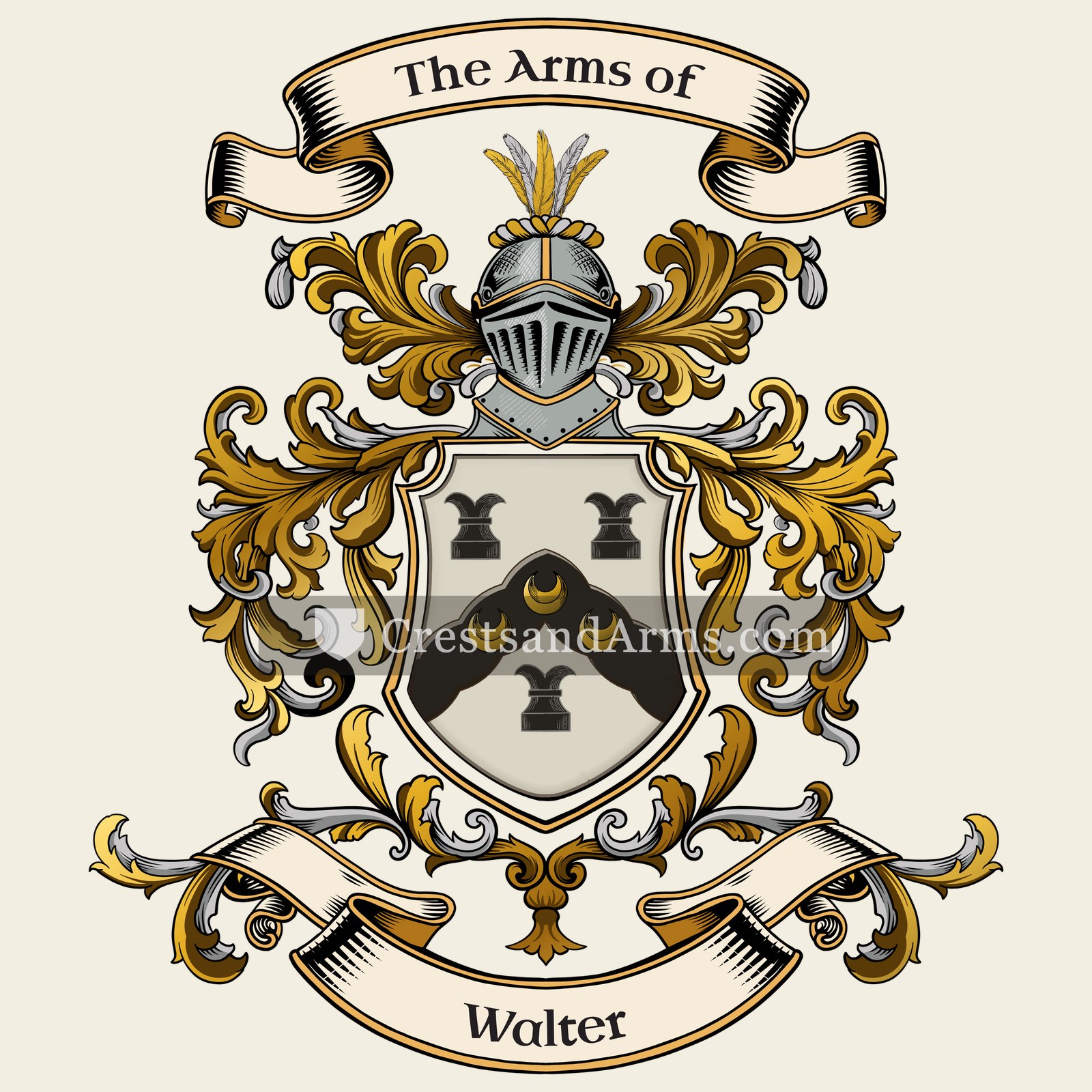
chiefAuthority, wisdom and dominion
Colours
Gold (Or)Means: Generosity
Blue (Azure)Means: Loyalty and truth
Historical info
Source
Sir Bernard Burke, The General Armory of England, Scotland, Ireland and Wales, London: Harrison & Sons, 1884
Blazon (the actual original written record)
“Or, a chief indented az”
Walesc. 1189
Digital archive packCoat of arms PNG, gold border print PDF, vector SVG and the certificate of authenticity. Sent to your email in minutes.
Map of Wales showing where the Walter arms are recorded
The Walter arms were recorded in Wales, c. 1189.
Arms such as these were typically recorded in Denbigh.
Denbighshire was north Welsh country of hills and small estates. Land was held by a great many families rather than a few, and each holding brought its own claim to a coat of arms.
This is where the arms were entered in the register. Families often moved to other parts of the country, so the same name can turn up in more than one region.
The body that granted and recorded arms in Wales in this period.
Henry II of England
Sovereign of the period
Henry II of England
1154–1189
Reigning in Germany when the Walter arms are first recorded.
How Arms Worked in Wales
English heraldry allowed arms to be shared by all legitimate descendants of the original owner. These symbols were treated as personal property that moved through the generations to all children. While the eldest son kept the original design, other family members could use the same shield without needing to change it or register their own unique versions.
Granting authority
The College of Arms in London has regulated the use of coats of arms throughout England and Wales since 1484.
How they got arms
Families typically obtained their coats of arms through a formal grant from the Crown or by proving their ancient right to them.
Where arms were recorded
All official coats of arms are recorded in the registers kept at the College of Arms, which date back to the fifteenth century.
The family's standing
Recorded among the armigerous families of Wales.
Origin & History of the Walter Family in Wales
The surname Walter traces its roots back to the Germanic name Waldhar, which translates to a ruler of the army. While the name became widespread across Britain following the Norman Conquest, its presence in Wales is particularly notable due to early records from the region of Denbigh. By 1189, individuals bearing this name were already established in the area, likely serving as settlers or administrators during a time of significant political transition in North Wales. Because the Welsh naming system traditionally relied on patronymics, the adoption of a fixed surname like Walter often indicated a family that held land or maintained connections with the incoming Anglo-Norman administration. These early Walters in Denbigh were part of a small group of families who helped bridge the gap between local Welsh customs and the changing legal structures of the medieval period. Their presence in the historical record suggests they were integrated into the social hierarchy of the borderlands, where they played a role in the local economy and governance of the town.
Walter Meaning & Related Branches
Root word
Waldhari
Derived from Germanic elements meaning rule and army.
This name
WalterA powerful warrior who commands or leads an army.
also spelled
Walther
Valter
Walters
Wauter
Gualter
Related arms
Gualtervariant spelling
Walthervariant spelling
Adamsrecorded with Walter, same area
Bettensonrecorded with Walter, same area
Documented Sources
J. B. Rietstap, Armorial Général, Gouda: G. B. van Goor Zonen, 1884–87
Bahlow, Hans. Deutsches Namenlexikon: Familien- und Vornamen nach Ursprung und Sinn erklärt. 1967
Heintze, Albert. Die deutschen Familien-Namen: geschichtlich, geographisch, sprachlich. 1903


 eagleNobility, strength and a keen mind
 towerGrandeur and solidity, and a stronghold defended
 mulletThe third son, and a divine quality from above
 eagleNobility, strength and a keen mind
 towerGrandeur and solidity, and a stronghold defended
 mulletThe third son, and a divine quality from above


 chevronProtection, and faithful service completed
 chess rookStrategy, and the defence of a position
 crescentHonour by the sovereign, and the second son


 chiefAuthority, wisdom and dominion