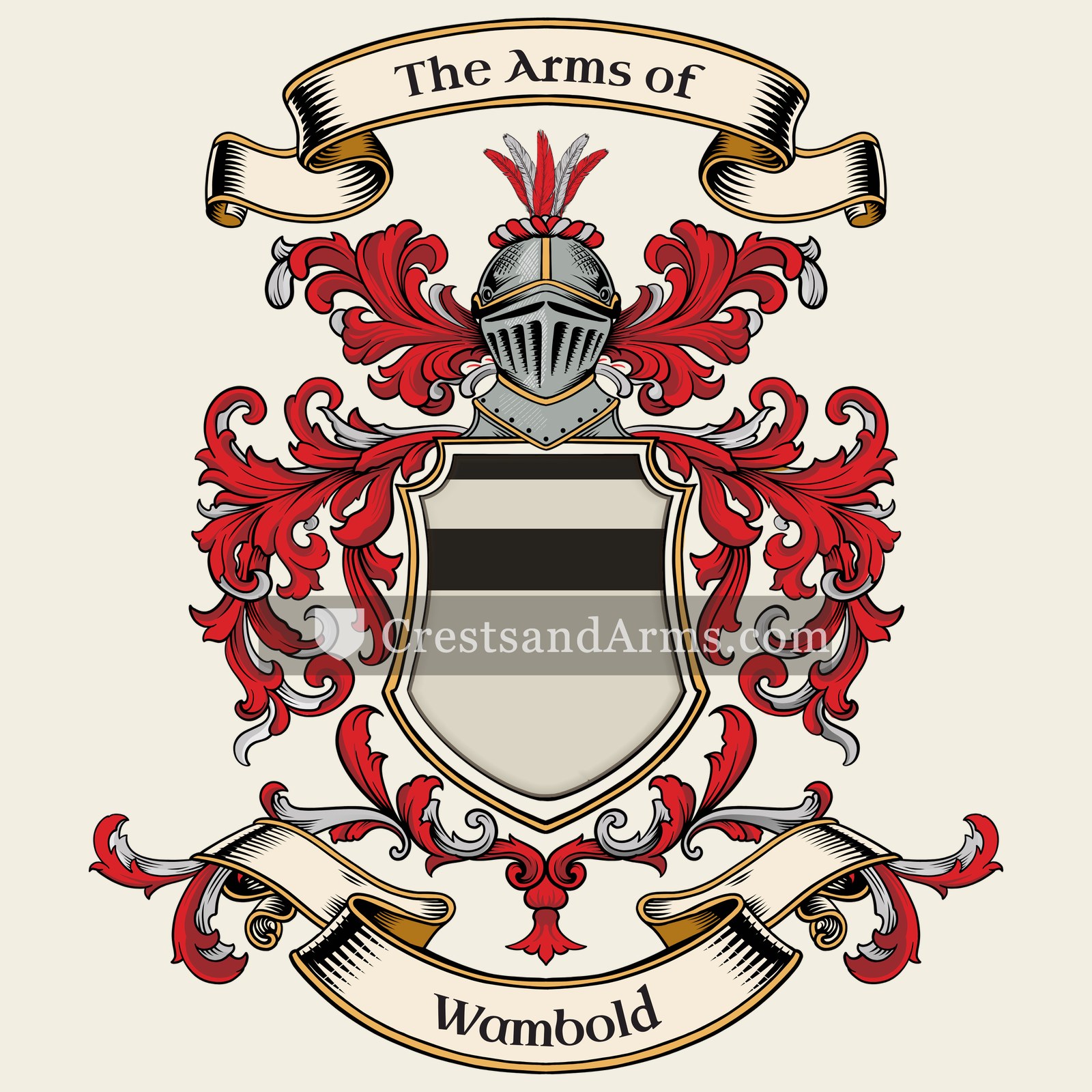
A record of documented arms, meaning and origin, researched for the Wambold family of Germany.
Reg. 4576 · German, W–Z
Coat of Arms & Family Crest Details
Colours
Black (Sable)Means: Constancy
Silver (Argent)Means: Peace and sincerity
Historical info
Source
J. B. Rietstap, Armorial Général, Gouda: G. B. van Goor Zonen, 1884–87
Blazon (the actual original written record)
“Coupé de sa. sur arg.; à trois fusées accolées et touchant les bords de l'écu, de l'un en l'autre. C.: une tête et col de chien braque d'arg., languée de gu., coll. et bouclée d'or, les oreilles de sa.”
HesseBade · Hesse, c. 1664
Digital archive packCoat of arms PNG, gold border print PDF, vector SVG and the certificate of authenticity. Sent to your email in minutes.
Map of Germany showing where the Wambold arms are recorded
The Wambold arms were recorded in Hesse, c. 1664.
Hesse was central German country, divided among a large number of small landowners and prosperous towns. So many separate households held ground there that the region produced an unusual number of coats of arms.
This is where the arms were entered in the register. Families often moved to other parts of the country, so the same name can turn up in more than one region.
The body that granted and recorded arms in Germany in this period.
Leopold I, Holy Roman Emperor
Sovereign of the period
Leopold I, Holy Roman Emperor
1658–1705
Reigning in Germany when the Wambold arms are first recorded.
How Arms Worked in Germany
In the Holy Roman Empire, coats of arms were often granted to individuals by the Emperor or his representatives. These arms were then passed down through the generations to all legitimate descendants of the original holder. Younger branches of a family usually kept the same shield design without needing to change it, as the arms belonged to the entire lineage.
Granting authority
The Holy Roman Emperor held the sole power to grant new coats of arms throughout his vast imperial territories.
How they got arms
Families typically obtained their coats of arms through a formal imperial grant or by proving their noble status to the authorities.
Where arms were recorded
These grants were officially recorded in the Imperial Chancery registers, which began keeping formal records of such honors during the Middle Ages.
The family's standing
Recorded among the armigerous families of Hesse.
Origin & History of the Wambold Family in Germany
The Wambold family name has deep roots in the historical region of Hesse, Germany, where members of the family were documented as early as 1664. During the seventeenth century, the area was recovering from the long and destructive Thirty Years' War, which had significantly altered the social and economic landscape of the German states. Families like the Wambolds were often tied to the land as farmers or skilled tradespeople who helped rebuild local communities after years of instability. The name itself likely originated from a combination of Old High German words, reflecting a naming tradition that focused on traits like strength or protection. As the family established itself in Hesse, they became part of the local fabric, participating in the agricultural and civic life that defined the rural German provinces of that era.
Related Branches & Arms
Root word
Wambolt
Derived from the Old High German elements for bold or brave.
This name
WamboldA surname denoting a person of courageous or daring character.
also spelled
Wambold
Wamboldstadt
Wambold Umstat
Documented Sources
J. B. Rietstap, Armorial Général, Gouda: G. B. van Goor Zonen, 1884–87
Hessisches Staatsarchiv Marburg, Kirchenbücher der evangelischen Kirchengemeinden in Hessen, 1664
Knetsch, Carl, Die hessische Landesgeschichte, 1928
Zimmermann, Walther, Die hessische Bevölkerung im 17. Jahrhundert, 1955
Digital archive packCoat of arms PNG, gold border print PDF, vector SVG and the certificate of authenticity. Sent to your email in minutes.