A record of documented arms, meaning and origin, researched for the Wangerin family lines. Documented in 2 countries.
Reg. 3816 · German, W–Z
Coat of Arms & Family Crest Details
Symbols on this shield
bendDefence, and the scarf of a commander
lionCourage, strength and royalty
Colours
Red (Gules)Means: Military strength
Blue (Azure)Means: Loyalty and truth
Gold (Or)Means: Generosity
Historical info
Source
J. B. Rietstap, Armorial Général, Gouda: G. B. van Goor Zonen, 1884–87
Blazon (the actual original written record)
“Coupé: au 1 de gu. au lion léopardé d'or; au 2 bandé d'azur et d'or, de quatre pièces. Cq. cour. C.: un lion ramp. d'or, tenant de ses pattes une banderole flottante à dextre, coupée d'azur sur or. L. d'or et de gu.”
FranconiaFranconia, c. 1765
Digital archive packCoat of arms PNG, gold border print PDF, vector SVG and the certificate of authenticity. Sent to your email in minutes.
Map of Germany showing where the Wangerin arms are recorded
The Wangerin arms were recorded in Franconia, c. 1765.
Franconia was a patchwork of small territories in central Germany, full of minor landowners and prosperous market towns. So many separate households held land there that the region produced a great many coats of arms.
This is where the arms were entered in the register. Families often moved to other parts of the country, so the same name can turn up in more than one region.
The body that granted and recorded arms in Germany in this period.
Francis I, Holy Roman Emperor
Sovereign of the period
Francis I, Holy Roman Emperor
1745–1765
Reigning in Germany when the Wangerin arms are first recorded.
How Arms Worked in Germany
In the Holy Roman Empire, coats of arms were often granted to individuals by the Emperor or his representatives. These arms were then passed down through the generations to all legitimate descendants of the original holder. Younger branches of a family usually kept the same shield design without needing to change it, as the arms belonged to the entire lineage.
Granting authority
The Holy Roman Emperor held the sole power to grant new coats of arms throughout his vast imperial territories.
How they got arms
Families typically obtained their coats of arms through a formal imperial grant or by proving their noble status to the authorities.
Where arms were recorded
These grants were officially recorded in the Imperial Chancery registers, which began keeping formal records of such honors during the Middle Ages.
The family's standing
Recorded among the armigerous families of Franconia.
Origin & History of the Wangerin Family in Germany
The family name Wangerin traces its roots to the historical region of Franconia, where members of the family were firmly established by 1765. The name itself is likely locational, derived from the town of Wangerin located in the historic Pomeranian region, suggesting that early ancestors may have migrated from the north toward the southern German territories. During the eighteenth century, families in Franconia were often deeply connected to the local agrarian economy and the shifting political boundaries of the Holy Roman Empire. As the family settled into this region, they became part of the local social fabric, likely working as skilled craftsmen or farmers who contributed to the stability of their village communities. This period was defined by a strong emphasis on parish record-keeping, which allowed families to maintain a sense of continuity and identity as they navigated the complex social hierarchies of the time.
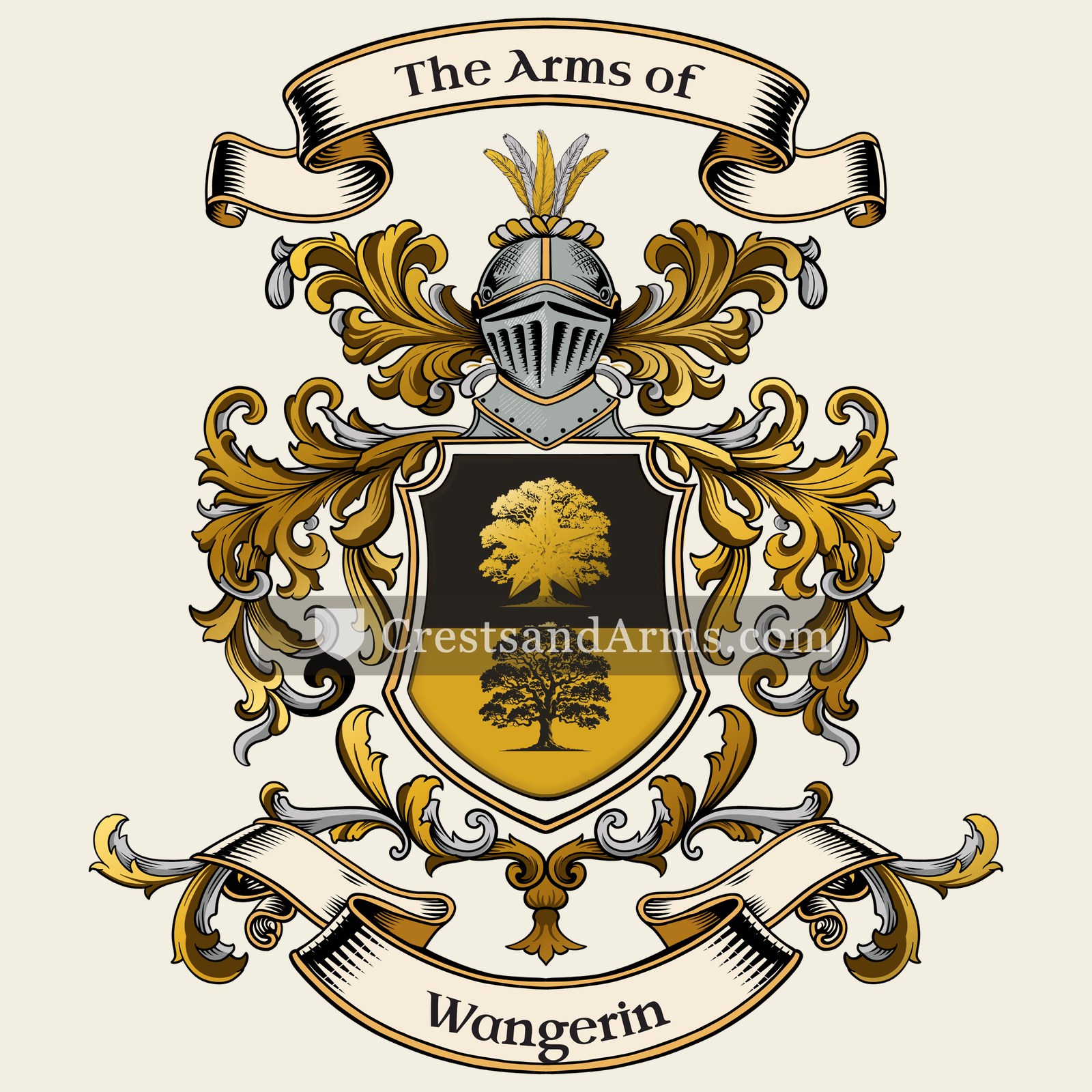
Coat of Arms & Family Crest Details
Symbols on this shield
treeLife, endurance and deep roots
mulletThe third son, and a divine quality from above
Colours
Black (Sable)Means: Constancy
Gold (Or)Means: Generosity
Historical info
Source
J. B. Rietstap, Armorial Général, Gouda: G. B. van Goor Zonen, 1884–87
Blazon (the actual original written record)
“Coupé de sa. sur or; à un tronc d'arbre de l'un en l'autre, posé en bande, adextré d'uue étoile d'or sur le sa. C.: cinq pl. d'aut., alt. d'or et de sa.”
SwitzerlandBaden Argovie, c. 1745
Digital archive packCoat of arms PNG, gold border print PDF, vector SVG and the certificate of authenticity. Sent to your email in minutes.
Map of Switzerland showing where the Wangerin arms are recorded
The Wangerin arms were recorded in Baden Argovie, c. 1745.
This is where the arms were entered in the register. Families often moved to other parts of the country, so the same name can turn up in more than one region.
The body that granted and recorded arms in Switzerland in this period.
How Arms Worked in Switzerland
In Switzerland, coats of arms were not restricted to the nobility and were often adopted by common citizens and families. These symbols were passed down through generations to show family identity. When branches of a family grew, they often changed small details of the design to distinguish their own line from the original group.
Granting authority
Cantonal and civic authorities managed the use of coats of arms within their specific regions and local jurisdictions.
How they got arms
Families typically assumed their own coats of arms based on local custom rather than receiving them from a central monarch.
Where arms were recorded
Arms were recorded in various cantonal and civic registers starting from the fourteenth century throughout the Swiss region.
The family's standing
Recorded among the armigerous families of Switzerland.
Origin & History of the Wangerin Family in Switzerland
The family name Wangerin carries a deep history tied to the movement of people across the German-speaking regions of Europe. While records confirm the family was well-established in the Baden region by 1745, historical patterns suggest that many families with similar names migrated through the Swiss territories during the early modern period. Switzerland served as a major crossroads for families traveling between the Rhine Valley and the surrounding mountain regions. During the eighteenth century, individuals often moved across these borders to find better farmland or to pursue new trades in growing market towns. The Wangerin name likely evolved as families settled into these local communities, adapting to the regional dialects and administrative record-keeping styles of the time. By tracing their presence in Baden, we can see that the family was part of a larger network of people who moved steadily through the heart of Europe to build stable lives in new provinces.
Related Branches & Arms
Root word
Wang
A meadow or a field in Old High German.
This name
WangerinA habitational name for someone who lived on or near a meadow.
also spelled
Wangar
Vanger
Documented Sources
J. B. Rietstap, Armorial Général, Gouda: G. B. van Goor Zonen, 1884–87
Bauer, Karl, Geschichte der fränkischen Lande, 1975
Staatsarchiv Bamberg, Kirchenbücher der Pfarreien im Hochstift Bamberg, 1765
Zimmermann, Hans, Die Besiedlung und Namensgebung in Süddeutschland, 1982
Digital archive packCoat of arms PNG, gold border print PDF, vector SVG and the certificate of authenticity. Sent to your email in minutes.


 bendDefence, and the scarf of a commander
 lionCourage, strength and royalty
 bendDefence, and the scarf of a commander
 lionCourage, strength and royalty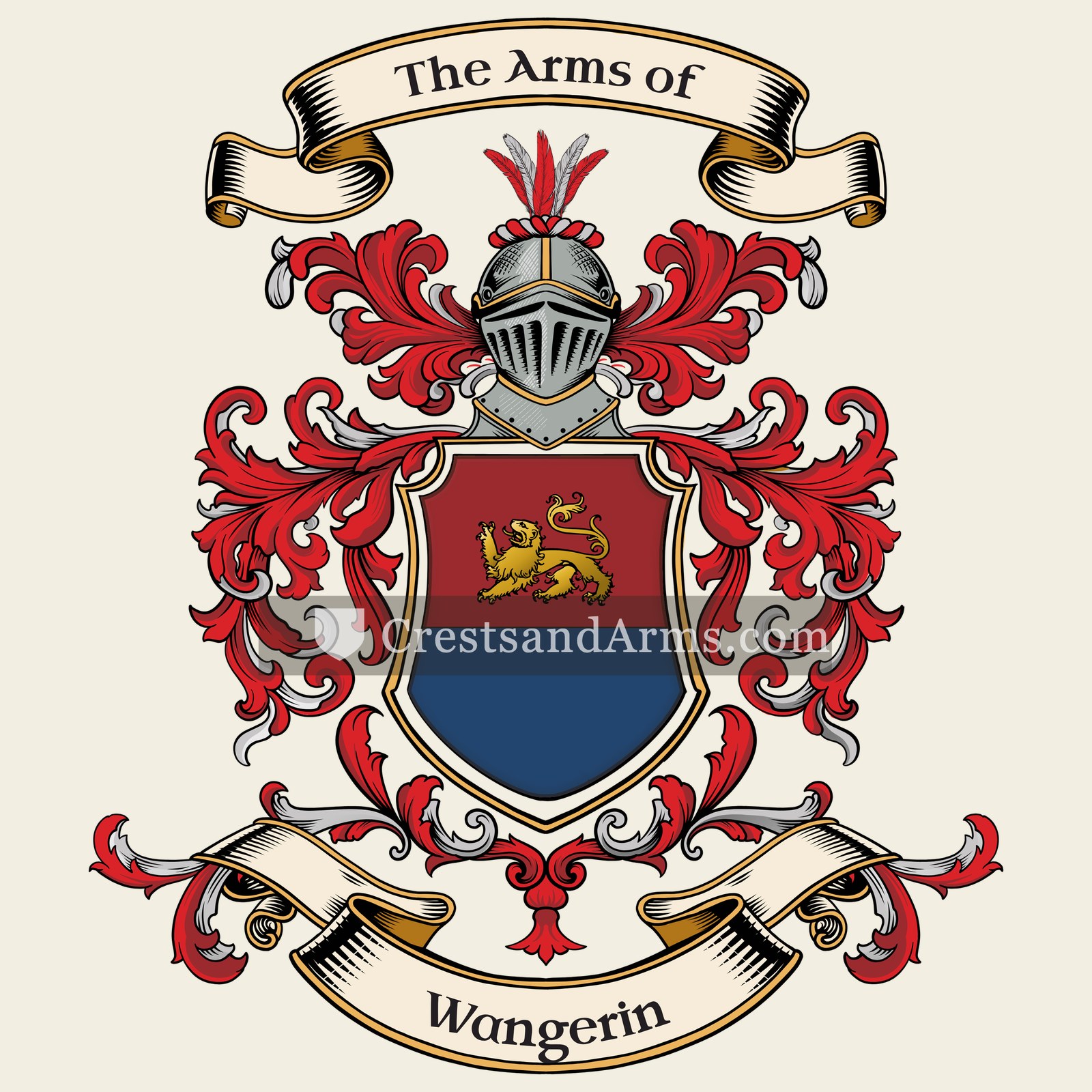


 treeLife, endurance and deep roots
 mulletThe third son, and a divine quality from above