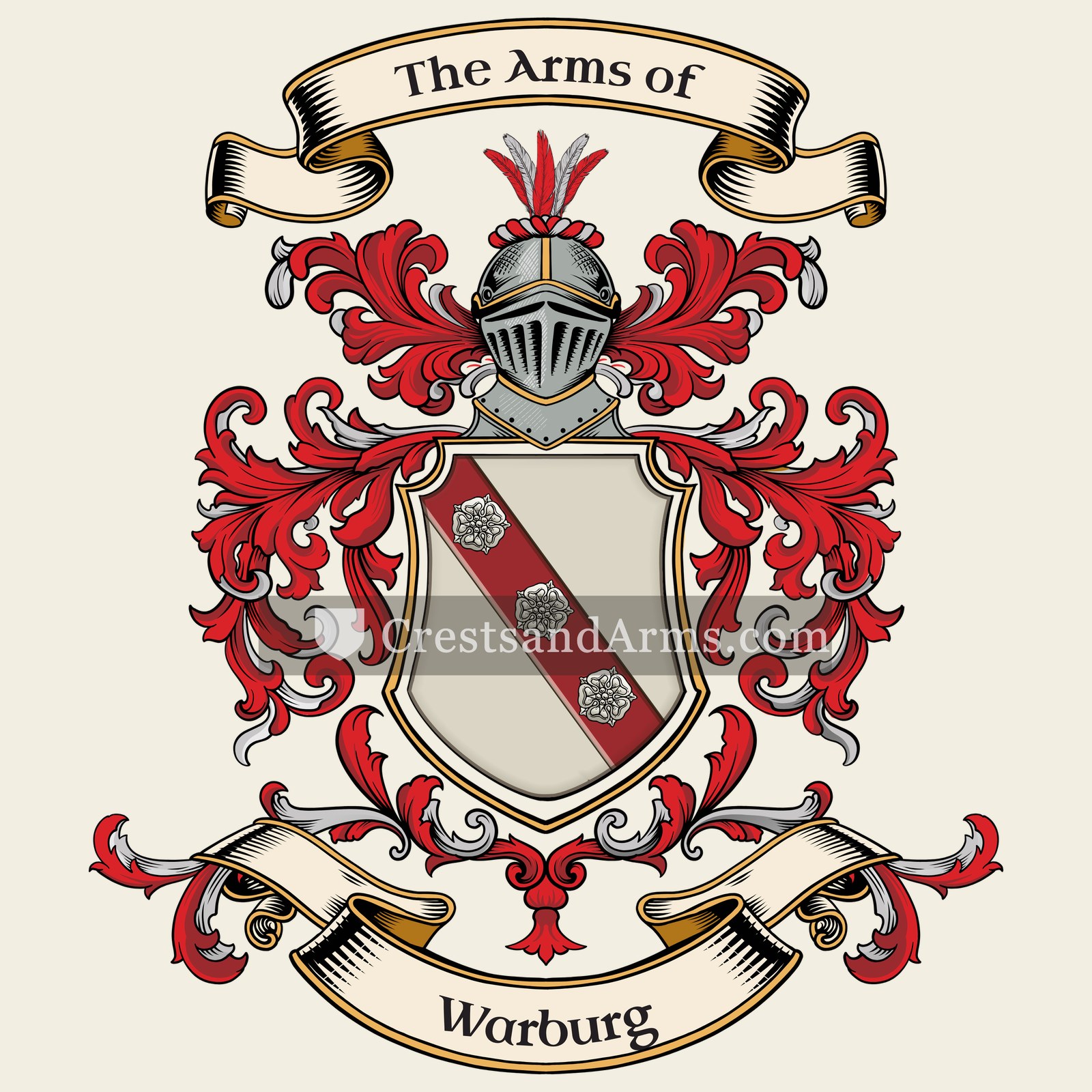
A record of documented arms, meaning and origin, researched for the Warburg family of Germany.
Reg. 6714 · German, W–Z
Coat of Arms & Family Crest Details
Symbols on this shield
bendDefence, and the scarf of a commander
roseThe seventh son, and beauty with grace
Colours
Silver (Argent)Means: Peace and sincerity
Red (Gules)Means: Military strength
Historical info
Source
J. B. Rietstap, Armorial Général, Gouda: G. B. van Goor Zonen, 1884–87
Blazon (the actual original written record)
“D'arg. à la bande de gu., ch. de trois roses du champ. C.: un château de trois tours de gu.; sur le seuil de la porte un homme, hab. d'arg., coiffé d'un chapeau du même, tenant de sa main dextre une pique, la sen. appuyée sur sa hanche.”
PomeraniaPomerania, c. 1765
Digital archive packCoat of arms PNG, gold border print PDF, vector SVG and the certificate of authenticity. Sent to your email in minutes.
Map of Germany showing where the Warburg arms are recorded
The Warburg arms were recorded in Pomerania, c. 1765.
Pomerania was flat farming country on the Baltic coast, held in large estates by a small number of families. They kept their land for generations, and generations of landholding is what fills the registers.
This is where the arms were entered in the register. Families often moved to other parts of the country, so the same name can turn up in more than one region.
The body that granted and recorded arms in Germany in this period.
Francis I, Holy Roman Emperor
Sovereign of the period
Francis I, Holy Roman Emperor
1745–1765
Reigning in Germany when the Warburg arms are first recorded.
How Arms Worked in Germany
In the Holy Roman Empire, coats of arms were often granted to individuals by the Emperor or his representatives. These arms were then passed down through the generations to all legitimate descendants of the original holder. Younger branches of a family usually kept the same shield design without needing to change it, as the arms belonged to the entire lineage.
Granting authority
The Holy Roman Emperor held the sole power to grant new coats of arms throughout his vast imperial territories.
How they got arms
Families typically obtained their coats of arms through a formal imperial grant or by proving their noble status to the authorities.
Where arms were recorded
These grants were officially recorded in the Imperial Chancery registers, which began keeping formal records of such honors during the Middle Ages.
The family's standing
Recorded among the armigerous families of Pomerania.
Origin & History of the Warburg Family in Germany
The Warburg family name is a locational surname, meaning it was originally derived from the town of Warburg in the Westphalia region of Germany. During the late Middle Ages, members of the family began to migrate eastward from this region, eventually establishing roots in various parts of Northern Germany and beyond. By 1765, records confirm that the family had a notable presence in the Pomerania region, which was then part of the Kingdom of Prussia. As was common for families during this era, the name served as a way to identify their ancestral origins as they moved to new cities for trade and community building. Over the following generations, the family became well known for their contributions to finance, science, and the arts, transitioning from their early roots as regional merchants into a prominent international lineage.
Related Branches & Arms
Root word
Warburg
A fortified town or castle located on a hill or mountain.
This name
WarburgRefers to an individual who originated from the town of Warburg in Westphalia, Germany.
also spelled
Warburgh
Warberg
Varburg
Documented Sources
J. B. Rietstap, Armorial Général, Gouda: G. B. van Goor Zonen, 1884–87
Bernhard, G. Die Warburgs: Familie und Bankhaus 1798–1964. 1964
Rosenbaum, E. and Sherman, A. J. M. M. Warburg & Co. 1798–1938: Merchant Bankers of Hamburg. 1976
Geheimes Staatsarchiv Preußischer Kulturbesitz, I. HA Rep. 76 (General Administration of the Prussian State)
Digital archive packCoat of arms PNG, gold border print PDF, vector SVG and the certificate of authenticity. Sent to your email in minutes.


 bendDefence, and the scarf of a commander
 roseThe seventh son, and beauty with grace
 bendDefence, and the scarf of a commander
 roseThe seventh son, and beauty with grace