A record of documented arms, meaning and origin, researched for the Warden family lines. Documented in 3 countries.
Reg. 8775 · Polish, W–Z
Coat of Arms & Family Crest Details
Symbols on this shield
wolfReward from long service and hard work
Colours
Silver (Argent)Means: Peace and sincerity
Black (Sable)Means: Constancy
Historical info
Source
J. B. Rietstap, Armorial Général, Gouda: G. B. van Goor Zonen, 1884–87
Blazon (the actual original written record)
“D'arg. à trois têtes de loup de sa., coll. de couronnes d'or. C.: une tête de loup de l'écu. S.: deux loups au nat., coll. de couronnes d'or, enchaînés du même. D.: PRO PATRIE AMORE.”
Polandc. 1795
Digital archive packCoat of arms PNG, gold border print PDF, vector SVG and the certificate of authenticity. Sent to your email in minutes.
Map of Poland showing where the Warden arms are recorded
The Warden arms were recorded in Poland, c. 1795.
Arms such as these were typically recorded in Mazovia.
Mazovia held Warsaw, the Polish court and the assemblies where the szlachta met. Poland's nobles were unusually numerous and every one of them bore arms, and Warsaw is where those arms were argued over and recorded.
This is where the arms were entered in the register. Families often moved to other parts of the country, so the same name can turn up in more than one region.
Region
Mazovia
First recorded
1795
Granting Authority for the Warden Arms
Ennoblement by the Sejm
Author: Olek Remesz · CC BY-SA 3.0
The body that granted and recorded arms in Poland in this period.
Stanisław August Poniatowski
Sovereign of the period
Stanisław August Poniatowski
1764–1795
Reigning in Poland when the Warden arms are first recorded.
How Arms Worked in Poland
Polish noble families shared a single coat of arms across many different surnames, creating large clans rather than individual designs. These symbols were held collectively by all members of the clan regardless of their specific family name. When a new family joined the nobility, they were adopted into an existing clan and began using that group's established shield.
Granting authority
The Sejm, which was the Polish parliament, held the power to grant noble status and the right to bear arms.
How they got arms
Families typically received their coat of arms through a formal act of ennoblement granted by the Sejm for distinguished service.
Where arms were recorded
These grants were officially recorded in the Crown Metrica, which served as the central archive for state documents starting in the sixteenth century.
The family's standing
Recorded among the armigerous families of Poland.
Origin & History of the Warden Family in Poland
The family name Warden in Poland traces its roots to the historical region of Mazovia, where records confirm the family was established by at least 1795. During this period, the name was often associated with individuals who served in administrative or supervisory roles, as the term itself historically referred to a guardian or a person in charge of a specific territory or estate. Living in the heart of Poland, these early family members were part of a society undergoing significant political shifts as the borders of the Polish-Lithuanian Commonwealth were redrawn. Because Mazovia served as a central hub for trade and governance, the family likely integrated into the local agrarian and civic structures that defined the region during the late eighteenth century. Their presence in this area suggests they were deeply connected to the local community and the evolving social landscape of rural Poland before the turn of the nineteenth century.
Coat of Arms & Family Crest Details
Symbols on this shield
applePeace, plenty and long-standing settlement
Colours
Silver (Argent)Means: Peace and sincerity
Gold (Or)Means: Generosity
Historical info
Source
Sir Bernard Burke, The General Armory of England, Scotland, Ireland and Wales, London: Harrison & Sons, 1884
Blazon (the actual original written record)
“Ar. three warden pears leaved vert”
Englandc. 1620
Digital archive packCoat of arms PNG, gold border print PDF, vector SVG and the certificate of authenticity. Sent to your email in minutes.
Map of England showing where the Warden arms are recorded
The Warden arms were recorded in England, c. 1620.
Arms such as these were typically recorded in York.
Yorkshire is the largest of the English counties, and it held more gentry families than any other. Land there was split among a great many households rather than a few, so a great many of them carried arms.
This is where the arms were entered in the register. Families often moved to other parts of the country, so the same name can turn up in more than one region.
The body that granted and recorded arms in England in this period.
James VI and I
Sovereign of the period
James VI and I
1603–1625
Reigning in Poland when the Warden arms are first recorded.
How Arms Worked in England
English heraldry allowed arms to be shared by all legitimate descendants of the original owner. These symbols were treated as personal property that moved through the generations to all children. While the eldest son kept the original design, other family members could use the same shield without needing to change it or register their own unique versions.
Granting authority
The College of Arms in London has regulated the use of coats of arms throughout England and Wales since 1484.
How they got arms
Families typically obtained their coats of arms through a formal grant from the Crown or by proving their ancient right to them.
Where arms were recorded
All official coats of arms are recorded in the registers kept at the College of Arms, which date back to the fifteenth century.
The family's standing
Recorded among the armigerous families of England.
Origin & History of the Warden Family in England
The surname Warden is a locational name that originated in England, typically referring to individuals who lived near a guard post or a protected area. The name is derived from the Old English word "weard," which means a guard or a watchman. By the early 17th century, the family had established a notable presence in the historic city of York. Records from 1620 confirm that members of the Warden family were active residents in this region, likely participating in the local trade and civic life that defined the city during the Stuart period. Because York was a major center for commerce and administration, families like the Wardens often played essential roles in the urban development of Northern England. Over time, the name spread from these early northern roots to various other parts of the country as families moved for work or marriage.
Coat of Arms & Family Crest Details
Symbols on this shield
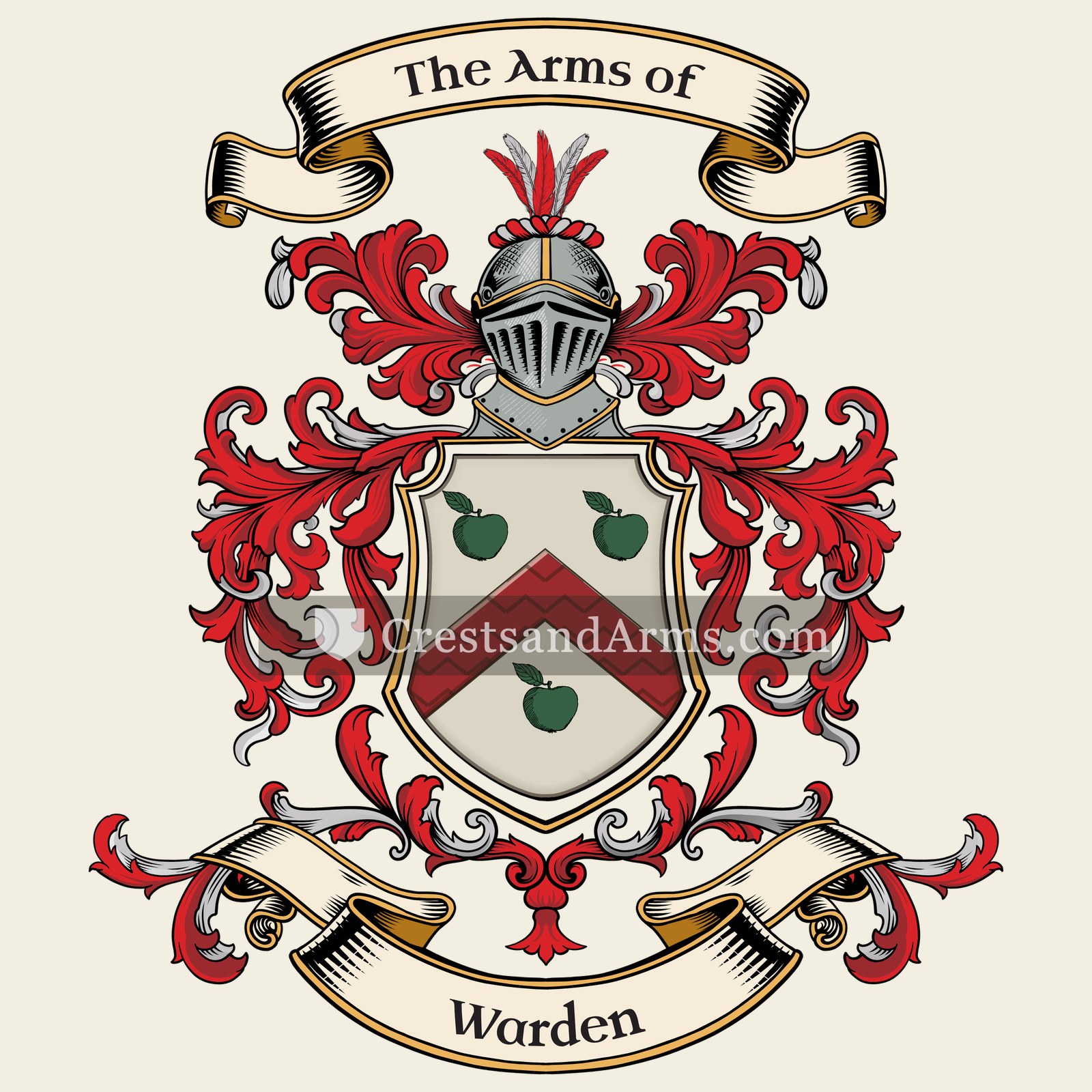
chevronProtection, and faithful service completed
applePeace, plenty and long-standing settlement
Colours
Silver (Argent)Means: Peace and sincerity
Red (Gules)Means: Military strength
Green (Vert)Means: Hope
Historical info
Source
Sir Bernard Burke, The General Armory of England, Scotland, Ireland and Wales, London: Harrison & Sons, 1884
Blazon (the actual original written record)
“Ar. a chev. gu. betw. three pears leaved vert”
Scotlandc. 1748
Digital archive packCoat of arms PNG, gold border print PDF, vector SVG and the certificate of authenticity. Sent to your email in minutes.
Map of Scotland showing where the Warden arms are recorded
The Warden arms were recorded in Scotland, c. 1748.
Arms such as these were typically recorded in Edinburgh.
Edinburgh was the seat of Scotland's government, its courts and its heralds. Families with business there settled nearby, and being close to where arms were recorded is exactly why so many of them appear.
This is where the arms were entered in the register. Families often moved to other parts of the country, so the same name can turn up in more than one region.
The body that granted and recorded arms in Scotland in this period.
George II of Great Britain
Sovereign of the period
George II of Great Britain
1727–1760
Reigning in Poland when the Warden arms are first recorded.
How Arms Worked in Scotland
Scottish heraldry is unique because it treats a coat of arms as a piece of personal property protected by law. Only one person can own a specific design at any given time. When a family grows, the head keeps the original shield while other relatives must apply for their own distinct version with slight changes to prove their specific identity.
Granting authority
The Court of the Lord Lyon acts as the official body that regulates and controls all heraldic matters throughout Scotland.
How they got arms
Individuals obtain a legal right to their arms through a formal petition process that confirms their identity and family connection.
Where arms were recorded
All valid coats of arms are officially entered into the Public Register of All Arms and Bearings starting from 1672.
The family's standing
Recorded among the armigerous families of Scotland.
Origin & History of the Warden Family in Scotland
The surname Warden is an occupational name that traces its roots back to the Middle Ages, originally identifying someone who served as a guardian or a watchman. In the context of Scotland, the name was closely tied to the administration of the law and the protection of local territories. By the mid-eighteenth century, records confirm that members of the Warden family were well-established in Edinburgh. During this period, the city was undergoing a major transformation as it transitioned from a cramped medieval capital into a center of the Scottish Enlightenment. Families like the Wardens living in Edinburgh in 1748 would have been part of a vibrant urban society that placed a high value on trade, education, and the legal profession. As the city expanded, these early residents played their part in the daily life of a growing capital, contributing to the social and economic fabric of eighteenth-century Scotland.
Related Branches & Arms
Root word
ward
Old English term for a guard, watchman, or protector.
This name
WardenAn occupational surname for a person employed as a guard, gatekeeper, or watchman.
also spelled
Wardin
Varden
Wardon
Related arms
Wardonvariant spelling
Documented Sources
J. B. Rietstap, Armorial Général, Gouda: G. B. van Goor Zonen, 1884–87
Kozłowska, Zofia, Osadnictwo na Mazowszu w XVIII wieku, 1985
Archiwum Główne Akt Dawnych w Warszawie (AGAD), Księgi metrykalne parafii rzymskokatolickich z terenu Mazowsza, 1795
Gieysztor, Aleksander, Historia Mazowsza, 1994
Digital archive packCoat of arms PNG, gold border print PDF, vector SVG and the certificate of authenticity. Sent to your email in minutes.


 wolfReward from long service and hard work
 wolfReward from long service and hard work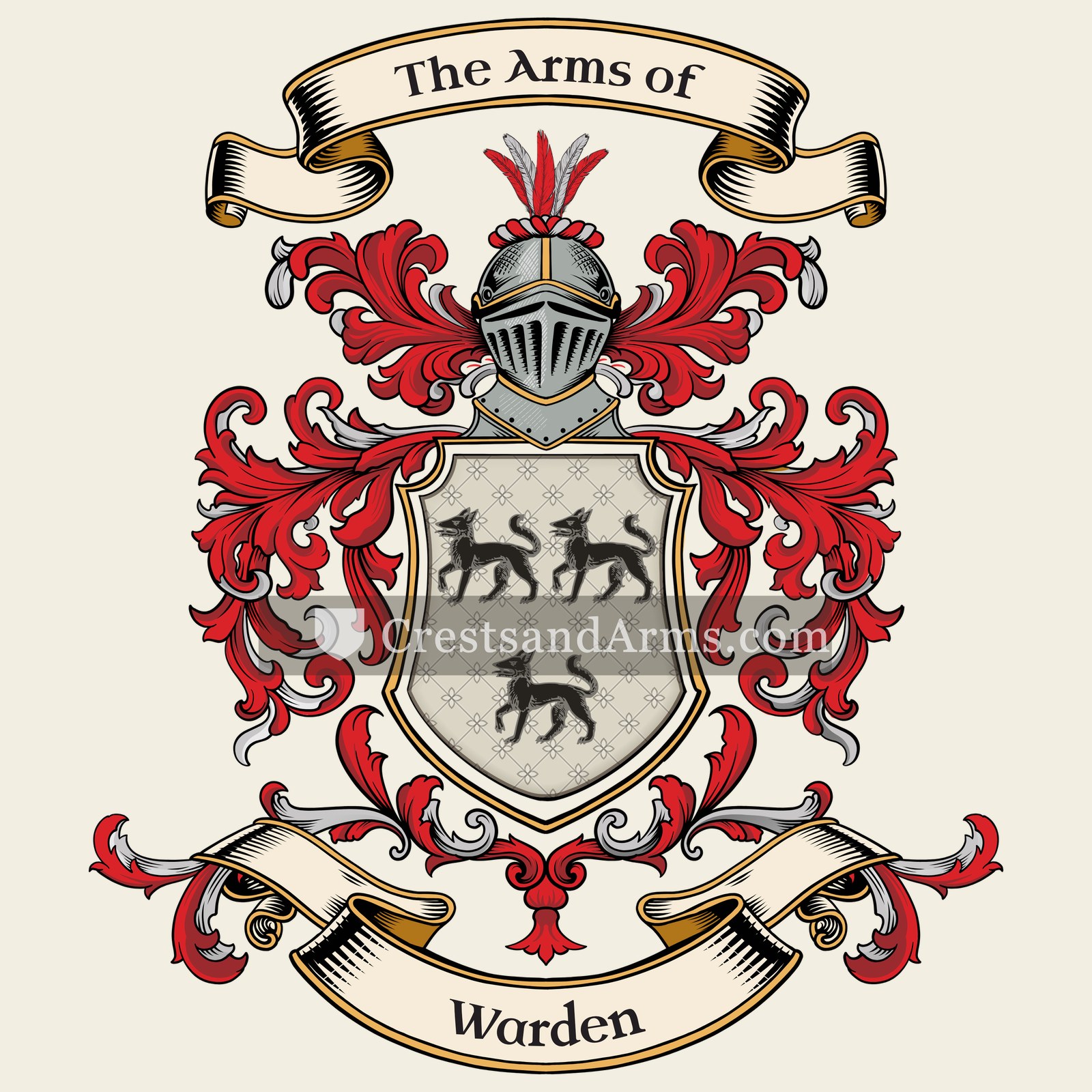


 applePeace, plenty and long-standing settlement


 chevronProtection, and faithful service completed