Map of England showing where the Waring arms are recorded
The Waring arms were recorded in Nottingham, c. 1620.
Nottinghamshire had coal under it and forest across it, and both were worth money. Families who profited bought manors, and a manor was the ordinary reason for a family to take a coat of arms.
This is where the arms were entered in the register. Families often moved to other parts of the country, so the same name can turn up in more than one region.
The body that granted and recorded arms in England in this period.
James VI and I
Sovereign of the period
James VI and I
1603–1625
Reigning in England when the Waring arms are first recorded.
How Arms Worked in England
English heraldry allowed arms to be shared by all legitimate descendants of the original owner. These symbols were treated as personal property that moved through the generations to all children. While the eldest son kept the original design, other family members could use the same shield without needing to change it or register their own unique versions.
Granting authority
The College of Arms in London has regulated the use of coats of arms throughout England and Wales since 1484.
How they got arms
Families typically obtained their coats of arms through a formal grant from the Crown or by proving their ancient right to them.
Where arms were recorded
All official coats of arms are recorded in the registers kept at the College of Arms, which date back to the fifteenth century.
The family's standing
Recorded among the armigerous families of Nottingham.
Origin & History of the Waring Family in England
The surname Waring has deep roots in the English landscape, emerging as a descriptive name that likely identified a person from a specific region or one who was a stranger to a local community. By the time the family established a documented presence in Nottingham in 1620, the name had already been circulating in various forms across the Midlands for several generations. During this era, the name was often linked to the Old French word "warin," which was a common personal name brought to England after the Norman Conquest. Families bearing this name were typically part of the rising class of tradespeople and landowners who helped shape the social structure of English market towns. As the family settled into Nottingham, they became part of a growing urban population that relied on local commerce and civic participation to build their legacy. This transition from a mobile, descriptive identity to a fixed family name reflects the broader movement of English society toward more stable and recorded community life during the early seventeenth century.
Meaning of the Waring family crest colors & symbols
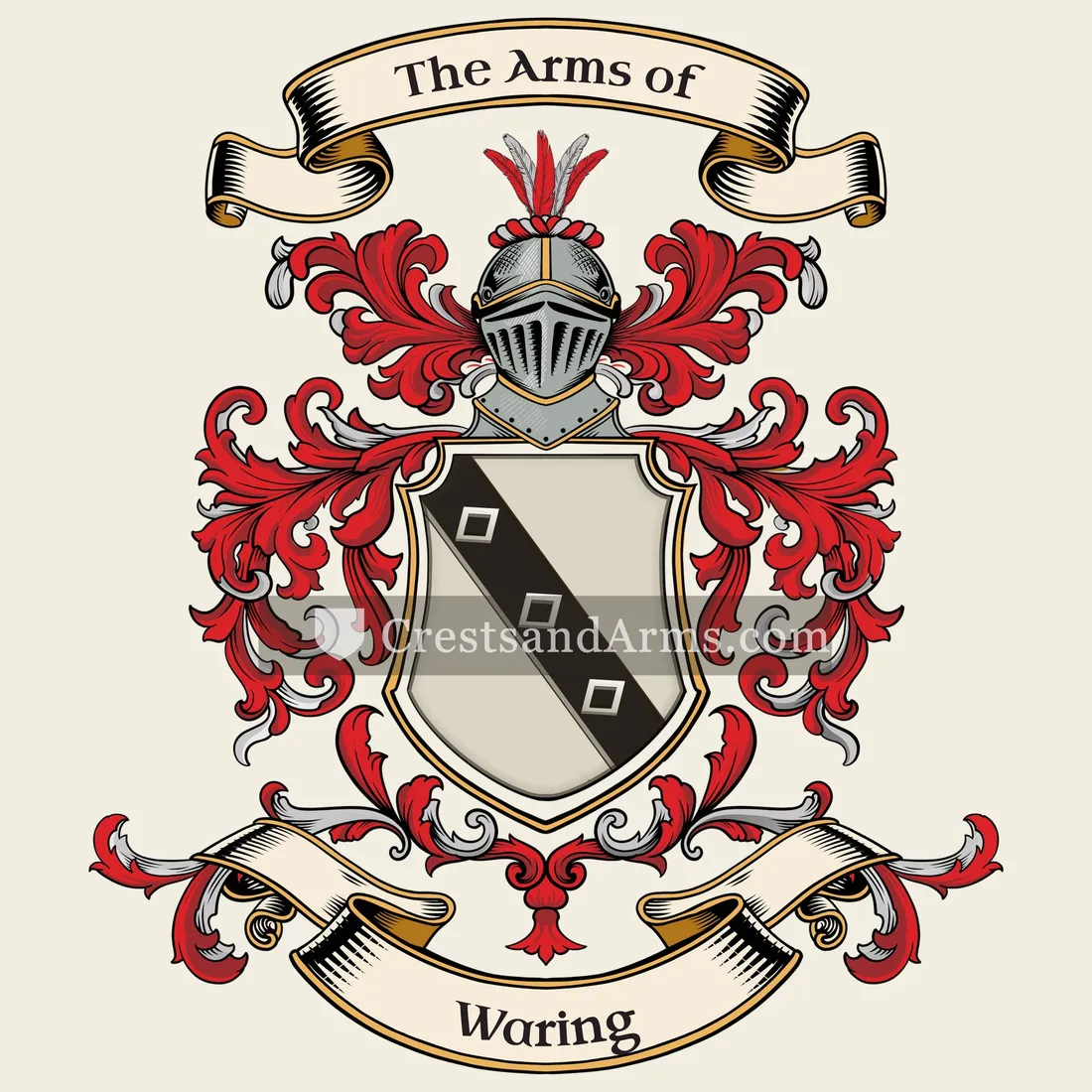
Symbols on this shield
bendDefence, and the scarf of a commander
masclePersuasion and the mail of a knight's coat
Colours
Silver (Argent)Means: Peace and sincerity
Black (Sable)Means: Constancy
Historical info
Source
Sir Bernard Burke, The General Armory of England, Scotland, Ireland and Wales, London: Harrison & Sons, 1884
Blazon (the actual original written record)
“Ar. on a bend sa. three mascles of the field”
DownWaringstown · Down, c. 1701
Digital archive packCoat of arms PNG, gold border print PDF, vector SVG and the certificate of authenticity. Sent to your email in minutes.
Map of Ireland showing where the Waring arms are recorded
The Waring arms were recorded in Down, c. 1701.
Down was north-eastern Irish country settled from Scotland in the seventeenth century. The new landowners took grants and had them recorded, which is why so many Down families carry documented shields.
This is where the arms were entered in the register. Families often moved to other parts of the country, so the same name can turn up in more than one region.
The body that granted and recorded arms in Ireland in this period.
William III of England
Sovereign of the period
William III of England
1694–1702
Reigning in England when the Waring arms are first recorded.
How Arms Worked in Ireland
The Ulster King of Arms granted coats of arms to individuals who proved their social standing and good character. These symbols were typically inherited by all legitimate descendants of the original holder. If a family branch wanted a unique look, they could apply for a specific change to their design through the office to ensure their identity remained distinct.
Granting authority
The Ulster King of Arms acted as the official body that regulated and issued all coats of arms throughout Ireland.
How they got arms
Families obtained their arms through formal grants issued by the office after proving their eligibility and paying the required fees.
Where arms were recorded
All official grants were recorded in the registers held by the Ulster King of Arms starting from the year 1552.
The family's standing
Recorded among the armigerous families of Down.
Origin & History of the Waring Family in Ireland
The Waring family name has deep roots in the history of County Down, where members of the family were firmly established by the beginning of the eighteenth century. The name itself is of Anglo-Norman origin, likely derived from the personal name Warin, which was brought to the British Isles following the Norman Conquest. Over several generations, families bearing this name migrated across the Irish Sea, finding new opportunities in the fertile lands of Ulster. By 1701, the Warings were recognized as prominent landowners and active participants in the social and economic life of the region. Their presence in County Down reflects the broader patterns of migration and settlement that shaped the local community during that era. As they integrated into Irish society, the family became closely linked to the development of local estates and the administration of their surrounding districts.
Waring Meaning & Related Branches
Root word
Warin
Derived from the Germanic element warin meaning guard or protect.
This name
WaringA patronymic surname indicating descent from a person named Warin.
also spelled
Wareing
Related arms
Wareing, or Waringevariant spelling
Warningsvariant spelling
Calveleyrecorded with Waring, same area
Coeyrecorded with Waring, same area
Documented Sources
Sir Bernard Burke, The General Armory of England, Scotland, Ireland and Wales, London: Harrison & Sons, 1884
Bardsley, Charles Wareing. A Dictionary of English and Welsh Surnames. 1901
Reaney, Percy Hide. A Dictionary of British Surnames. 1958
Nottinghamshire Archives, Nottingham St Mary Parish Registers, 1620
Digital archive packCoat of arms PNG, gold border print PDF, vector SVG and the certificate of authenticity. Sent to your email in minutes.


 peacockBeauty, power and knowledge
 peacockBeauty, power and knowledge
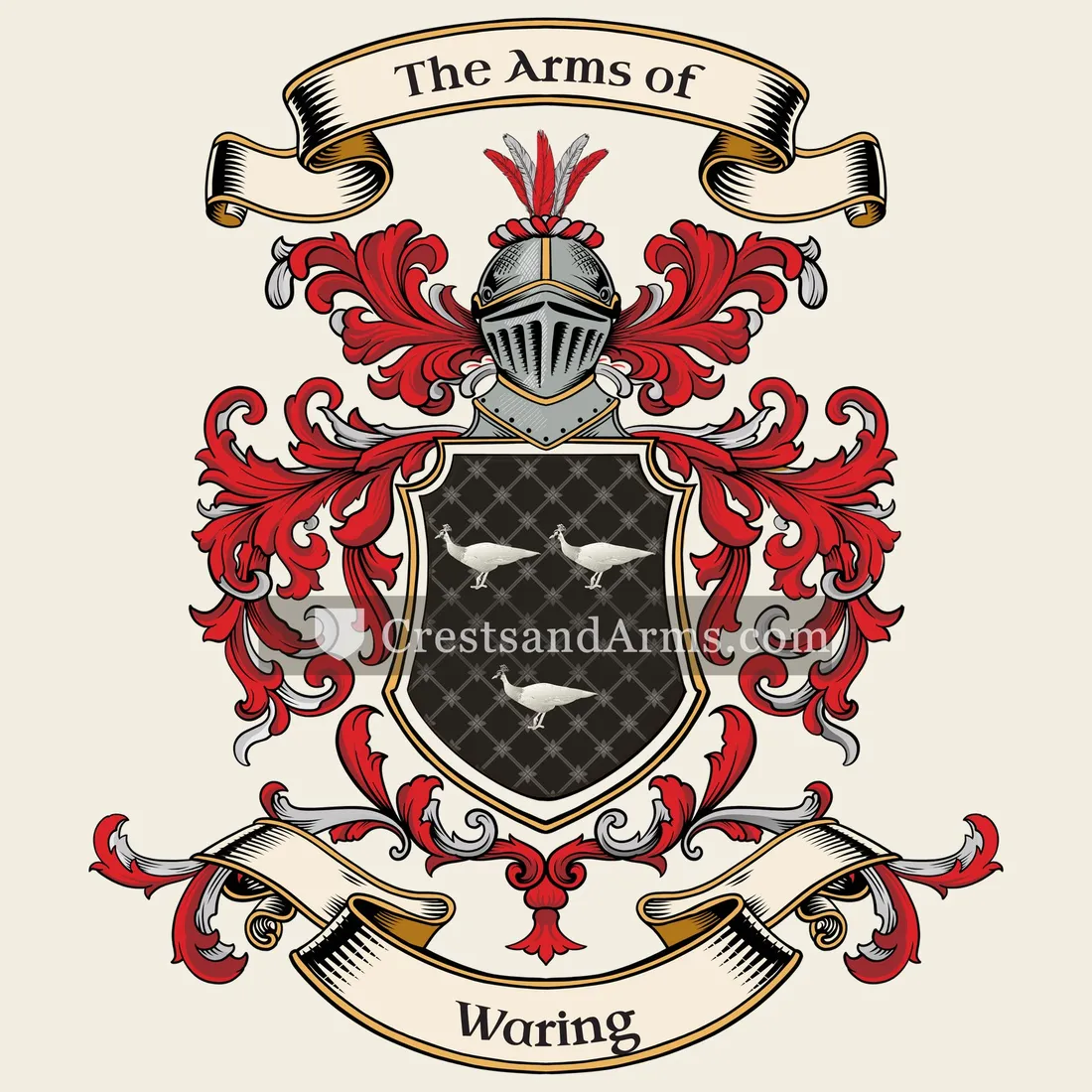


 bendDefence, and the scarf of a commander
 masclePersuasion and the mail of a knight's coat