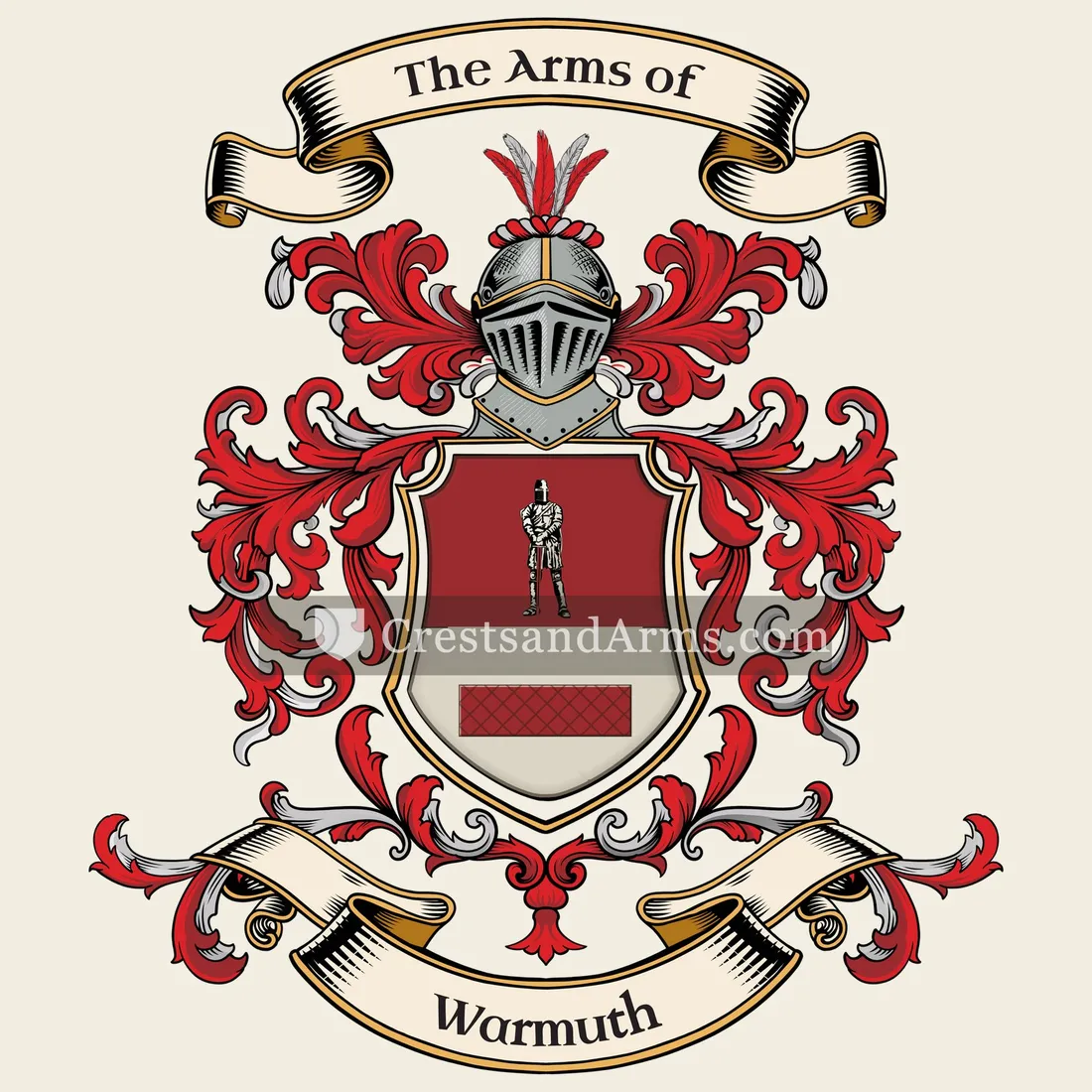
A record of documented arms, meaning and origin, researched for the Warmuth family of Germany.
Reg. 4394 · German, W–Z
Meaning of the Warmuth family crest colors & symbols
Symbols on this shield
fessThe military belt, and readiness to serve
knightChivalry and service in arms
Colours
Red (Gules)Means: Military strength
Silver (Argent)Means: Peace and sincerity
Historical info
Source
J. B. Rietstap, Armorial Général, Gouda: G. B. van Goor Zonen, 1884–87
Blazon (the actual original written record)
“Coupé: au 1 de gu. à un homme iss., posé de profil, mouv. du coupé, hab. d'arg., coiffé d'un bonnet albanais du même et tenant de sa main dextre levée une tige avec trois épis d'or, celui du milieu debout, les deux autres penchés; au 2 d'arg. à la fasce de gu. C.: l'homme iss.”
GermanyNuremberg, c. 1765
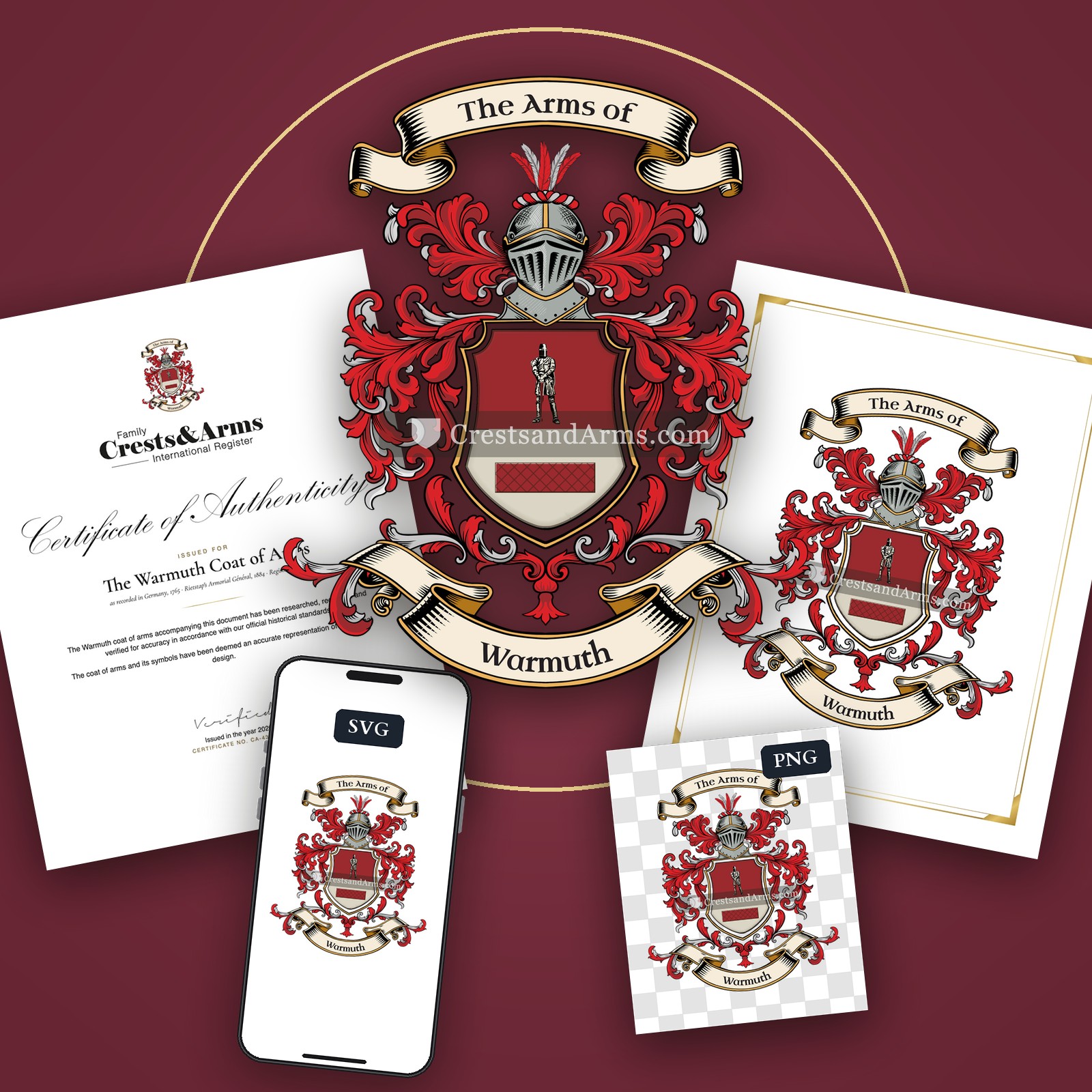
Digital archive packCoat of arms PNG, gold border print PDF, vector SVG and the certificate of authenticity. Sent to your email in minutes.
Map of Germany showing where the Warmuth arms are recorded
The Warmuth arms were recorded in Nuremberg, c. 1765.
This is where the arms were entered in the register. Families often moved to other parts of the country, so the same name can turn up in more than one region.
The body that granted and recorded arms in Germany in this period.
Francis I, Holy Roman Emperor
Sovereign of the period
Francis I, Holy Roman Emperor
1745–1765
Reigning in Germany when the Warmuth arms are first recorded.
How Arms Worked in Germany
In the Holy Roman Empire, coats of arms were often granted to individuals by the Emperor or his representatives. These arms were then passed down through the generations to all legitimate descendants of the original holder. Younger branches of a family usually kept the same shield design without needing to change it, as the arms belonged to the entire lineage.
Granting authority
The Holy Roman Emperor held the sole power to grant new coats of arms throughout his vast imperial territories.
How they got arms
Families typically obtained their coats of arms through a formal imperial grant or by proving their noble status to the authorities.
Where arms were recorded
These grants were officially recorded in the Imperial Chancery registers, which began keeping formal records of such honors during the Middle Ages.
The family's standing
Recorded among the armigerous families of Germany.
Origin & History of the Warmuth Family in Germany
The surname Warmuth finds its roots in the German-speaking regions of Central Europe, evolving from the Old High German name Warimunt. This name combines the elements "wari," meaning protection or defense, and "munt," meaning guardian or protector. By the mid-18th century, the family had established a notable presence in the city of Nuremberg. During this period, Nuremberg served as a major hub for trade and craftsmanship, which likely influenced the family's social and professional standing. Records confirm that members of the Warmuth family were living and working in this bustling urban center by 1765. As residents of such a prominent city, they were part of a society defined by strict guilds and a growing merchant class, which suggests that early family members were likely integrated into the skilled labor or commercial networks that defined Nuremberg’s economy at the time.
Warmuth Meaning & Related Branches
Root word
Warmund
Derived from the Germanic elements for warm or protective and protection.
This name
WarmuthA patronymic surname originating from a personal name signifying a protective guardian.
also spelled
Warmut
Varmuth
Warmoot
Related arms
Bonsignorisimilar arms
Documented Sources
J. B. Rietstap, Armorial Général, Gouda: G. B. van Goor Zonen, 1884–87
Bahlow, Hans, Deutsches Namenlexikon: Familien- und Vornamen nach Ursprung und Sinn erklärt, 1967
Stadtarchiv Nürnberg, Bürgerbücher der Stadt Nürnberg, 1765
Heintze, Albert, Die deutschen Familiennamen: geschichtlich, geographisch, sprachlich, 1903
Digital archive packCoat of arms PNG, gold border print PDF, vector SVG and the certificate of authenticity. Sent to your email in minutes.


 fessThe military belt, and readiness to serve
 knightChivalry and service in arms
 fessThe military belt, and readiness to serve
 knightChivalry and service in arms