A record of documented arms, meaning and origin, researched for the Warner family lines. Documented in 2 countries.
Reg. 0750 · English, W–Z
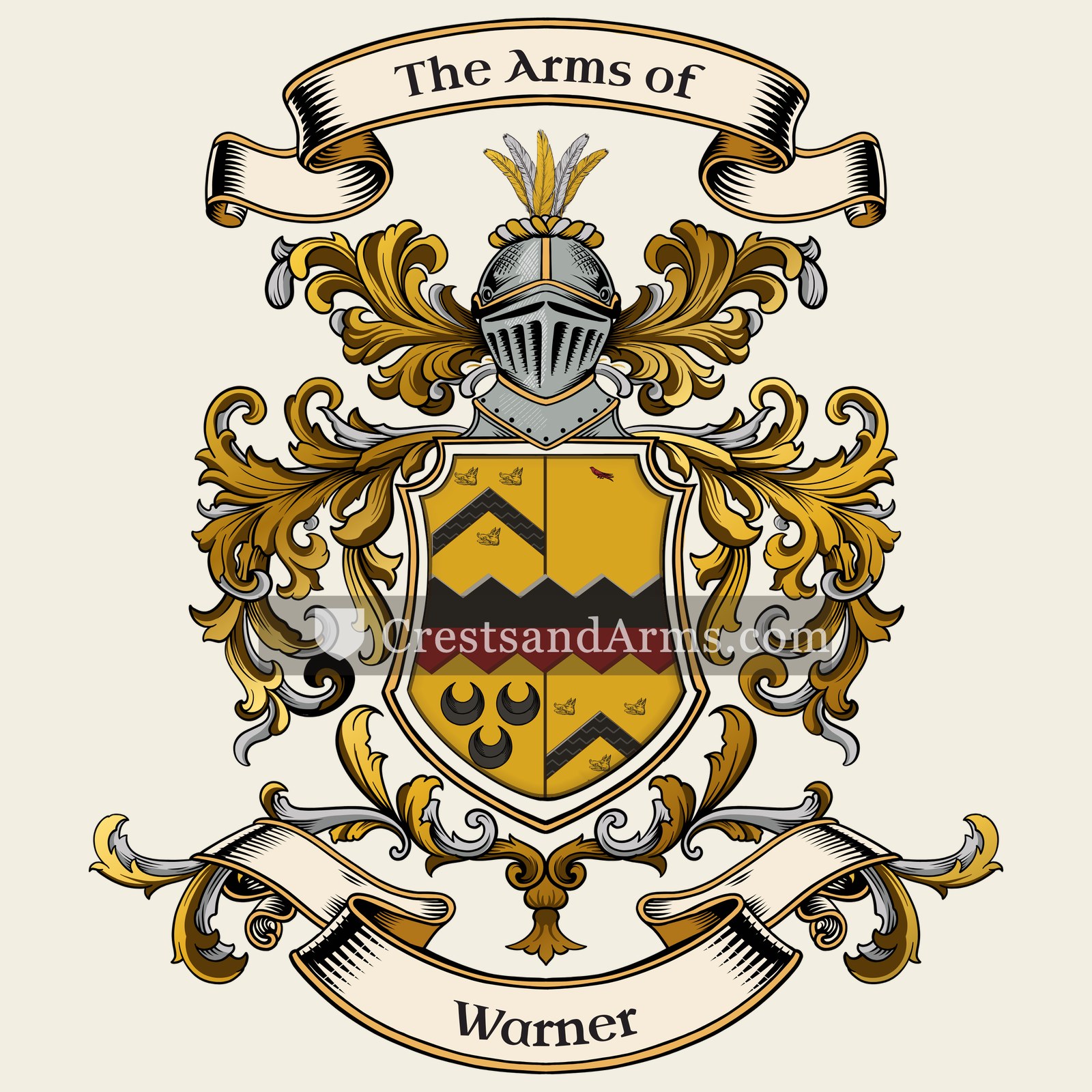
Coat of Arms & Family Crest Details
Symbols on this shield
chevronProtection, and faithful service completed
fessThe military belt, and readiness to serve
ermineDignity and rank
boars headA fierce fighter who battles to the end
martletA younger son, who must win his own land
crescentHonour by the sovereign, and the second son
Colours
Gold (Or)Means: Generosity
Black (Sable)Means: Constancy
Red (Gules)Means: Military strength
Counter-ermine (Ermines)Means: Dignity
Historical info
Source
Sir Bernard Burke, The General Armory of England, Scotland, Ireland and Wales, London: Harrison & Sons, 1884
Blazon (the actual original written record)
“Quarterly, 1st and 4th, or, a chev. betw. three boars' heads couped sa.; 2nd, or, a fess dancettée sa. in chief a martlet gu., for VAVASOUR; 3rd, per pale or and ar. three crescents ermines”
MiddlesexStrowd · Middlesex, c. 1568
Digital archive packCoat of arms PNG, gold border print PDF, vector SVG and the certificate of authenticity. Sent to your email in minutes.
Map of England showing where the Warner arms are recorded
The Warner arms were recorded in Middlesex, c. 1568.
Middlesex was the county around London, and City money flowed straight into it. Merchants and officials bought estates within reach of the capital, and a new estate brought a coat of arms with it.
This is where the arms were entered in the register. Families often moved to other parts of the country, so the same name can turn up in more than one region.
The body that granted and recorded arms in England in this period.
Elizabeth I of England
Sovereign of the period
Elizabeth I of England
1558–1603
Reigning in England when the Warner arms are first recorded.
How Arms Worked in England
English heraldry allowed arms to be shared by all legitimate descendants of the original owner. These symbols were treated as personal property that moved through the generations to all children. While the eldest son kept the original design, other family members could use the same shield without needing to change it or register their own unique versions.
Granting authority
The College of Arms in London has regulated the use of coats of arms throughout England and Wales since 1484.
How they got arms
Families typically obtained their coats of arms through a formal grant from the Crown or by proving their ancient right to them.
Where arms were recorded
All official coats of arms are recorded in the registers kept at the College of Arms, which date back to the fifteenth century.
The family's standing
Recorded among the armigerous families of Middlesex.
Origin & History of the Warner Family in England
The surname Warner has deep roots in England, originating as an occupational name for a warrener. In the medieval period, a warrener was a person responsible for managing and protecting a tract of land known as a warren, which was specifically designated for the breeding of small game like rabbits and hares. By the time the family appeared in Middlesex records in 1568, the name had already been established across various English counties for several centuries. These early Warners were often landowners or local officials who played a vital role in the rural economy of their time. As the population moved and shifted during the sixteenth century, families like those in Middlesex helped to solidify the name as a common fixture in English society. The history of the name reflects the transition from a specific job title to a hereditary family name that persisted through generations of English life.
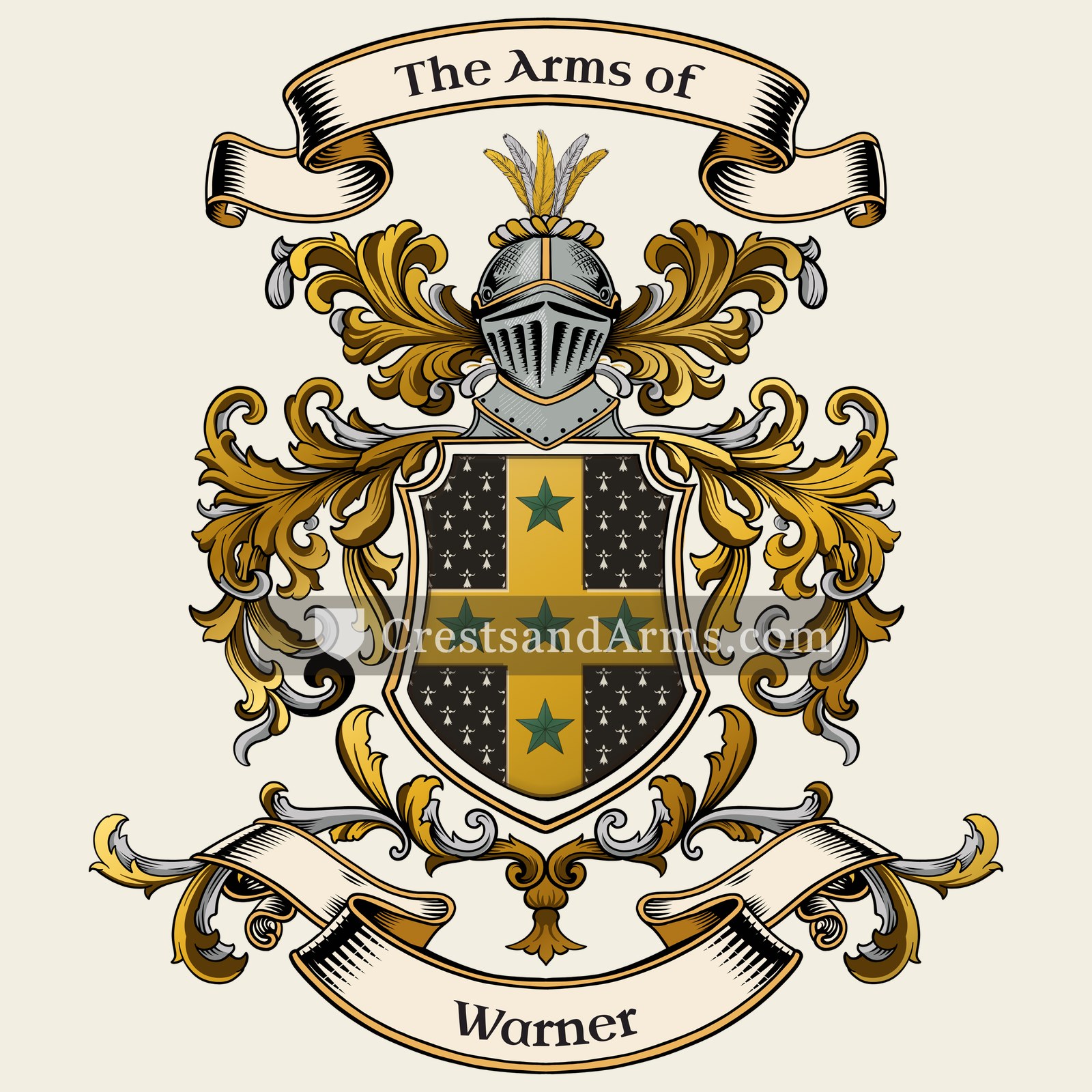
Coat of Arms & Family Crest Details
Symbols on this shield
ermineDignity and rank
cross symbolChristian faith and service
mulletThe third son, and a divine quality from above
Colours
Counter-ermine (Ermines)Means: Dignity
Gold (Or)Means: Generosity
Green (Vert)Means: Hope
Historical info
Source
Sir Bernard Burke, The General Armory of England, Scotland, Ireland and Wales, London: Harrison & Sons, 1884
Blazon (the actual original written record)
“Ermines on a cross engr. or, five mullets vert”
CorkHigh Sheriff · Cork, c. 1813
Digital archive packCoat of arms PNG, gold border print PDF, vector SVG and the certificate of authenticity. Sent to your email in minutes.
Map of Ireland showing where the Warner arms are recorded
The Warner arms were recorded in Cork, c. 1813.
Cork was the largest county in Ireland, with a great harbour and a wide farming hinterland. Both English settlers and older Irish families held land there, and holding land is what brought a family into the records.
This is where the arms were entered in the register. Families often moved to other parts of the country, so the same name can turn up in more than one region.
The body that granted and recorded arms in Ireland in this period.
George III of Great Britain
Sovereign of the period
George III of Great Britain
1801–1820
Reigning in England when the Warner arms are first recorded.
How Arms Worked in Ireland
The Ulster King of Arms granted coats of arms to individuals who proved their social standing and good character. These symbols were typically inherited by all legitimate descendants of the original holder. If a family branch wanted a unique look, they could apply for a specific change to their design through the office to ensure their identity remained distinct.
Granting authority
The Ulster King of Arms acted as the official body that regulated and issued all coats of arms throughout Ireland.
How they got arms
Families obtained their arms through formal grants issued by the office after proving their eligibility and paying the required fees.
Where arms were recorded
All official grants were recorded in the registers held by the Ulster King of Arms starting from the year 1552.
The family's standing
Recorded among the armigerous families of Cork.
Origin & History of the Warner Family in Ireland
The surname Warner arrived in Ireland primarily through English migration during the period of colonial expansion. While the name originates from Germanic roots meaning "guarding warrior," its presence in County Cork by 1813 reflects the broader pattern of families settling in southern Ireland to manage land and participate in local commerce. By the early nineteenth century, members of the Warner family were established as part of the growing middle class in Cork, often working in trade or as landholders. These early settlers integrated into the local economy while maintaining the cultural ties associated with their ancestral origins. The family’s presence in Cork during this time highlights how individuals with English surnames became a fixed part of the Irish social landscape long before the major demographic shifts of the mid-nineteenth century.
Warner Meaning & Related Branches
Root word
Warin
A Germanic personal name derived from the word for guard or protection.
This name
WarnerA surname denoting a descendant of someone who served as a guard or watchman.
also spelled
Warnar
Related arms
Warnarvariant spelling
Berthonrecorded with Warner, same area
Brownerecorded with Warner, same area
Cozensrecorded with Warner, same area
Documented Sources
Sir Bernard Burke, The General Armory of England, Scotland, Ireland and Wales, London: Harrison & Sons, 1884
Bardsley, Charles Wareing, A Dictionary of English and Welsh Surnames, 1901
Reaney, Percy Hide, A Dictionary of British Surnames, 1958
The National Archives, State Papers Domestic, Elizabeth I, 1568
Digital archive packCoat of arms PNG, gold border print PDF, vector SVG and the certificate of authenticity. Sent to your email in minutes.


 chevronProtection, and faithful service completed
 fessThe military belt, and readiness to serve
 ermineDignity and rank
 boars headA fierce fighter who battles to the end
 martletA younger son, who must win his own land
 crescentHonour by the sovereign, and the second son
 chevronProtection, and faithful service completed
 fessThe military belt, and readiness to serve
 ermineDignity and rank
 boars headA fierce fighter who battles to the end
 martletA younger son, who must win his own land
 crescentHonour by the sovereign, and the second son


 cross symbolChristian faith and service
 mulletThe third son, and a divine quality from above