Map of Germany showing where the Watkinson arms are recorded
The Watkinson arms were recorded in Hambourg, c. 1724.
This is where the arms were entered in the register. Families often moved to other parts of the country, so the same name can turn up in more than one region.
The body that granted and recorded arms in Germany in this period.
Charles VI, Holy Roman Emperor
Sovereign of the period
Charles VI, Holy Roman Emperor
1711–1740
Reigning in Germany when the Watkinson arms are first recorded.
How Arms Worked in Germany
In the Holy Roman Empire, coats of arms were often granted to individuals by the Emperor or his representatives. These arms were then passed down through the generations to all legitimate descendants of the original holder. Younger branches of a family usually kept the same shield design without needing to change it, as the arms belonged to the entire lineage.
Granting authority
The Holy Roman Emperor held the sole power to grant new coats of arms throughout his vast imperial territories.
How they got arms
Families typically obtained their coats of arms through a formal imperial grant or by proving their noble status to the authorities.
Where arms were recorded
These grants were officially recorded in the Imperial Chancery registers, which began keeping formal records of such honors during the Middle Ages.
The family's standing
Recorded among the armigerous families of Germany.
Origin & History of the Watkinson Family in Germany
The surname Watkinson is traditionally associated with English origins, but its presence in Hamburg by 1724 highlights the movement of families across Northern Europe during the eighteenth century. At that time, Hamburg served as a major center for international trade, attracting merchants and skilled laborers from across the North Sea. Families like the Watkinsons likely settled in this bustling port city to participate in the thriving maritime economy or to work within the city's established merchant networks. By integrating into the local German society, these individuals often adapted their naming conventions and professional lives to fit the customs of their new home. This migration pattern reflects a period of significant cultural exchange, where families moved between England and the German states to seek new economic opportunities in growing urban hubs.
Meaning of the Watkinson family crest colors & symbols
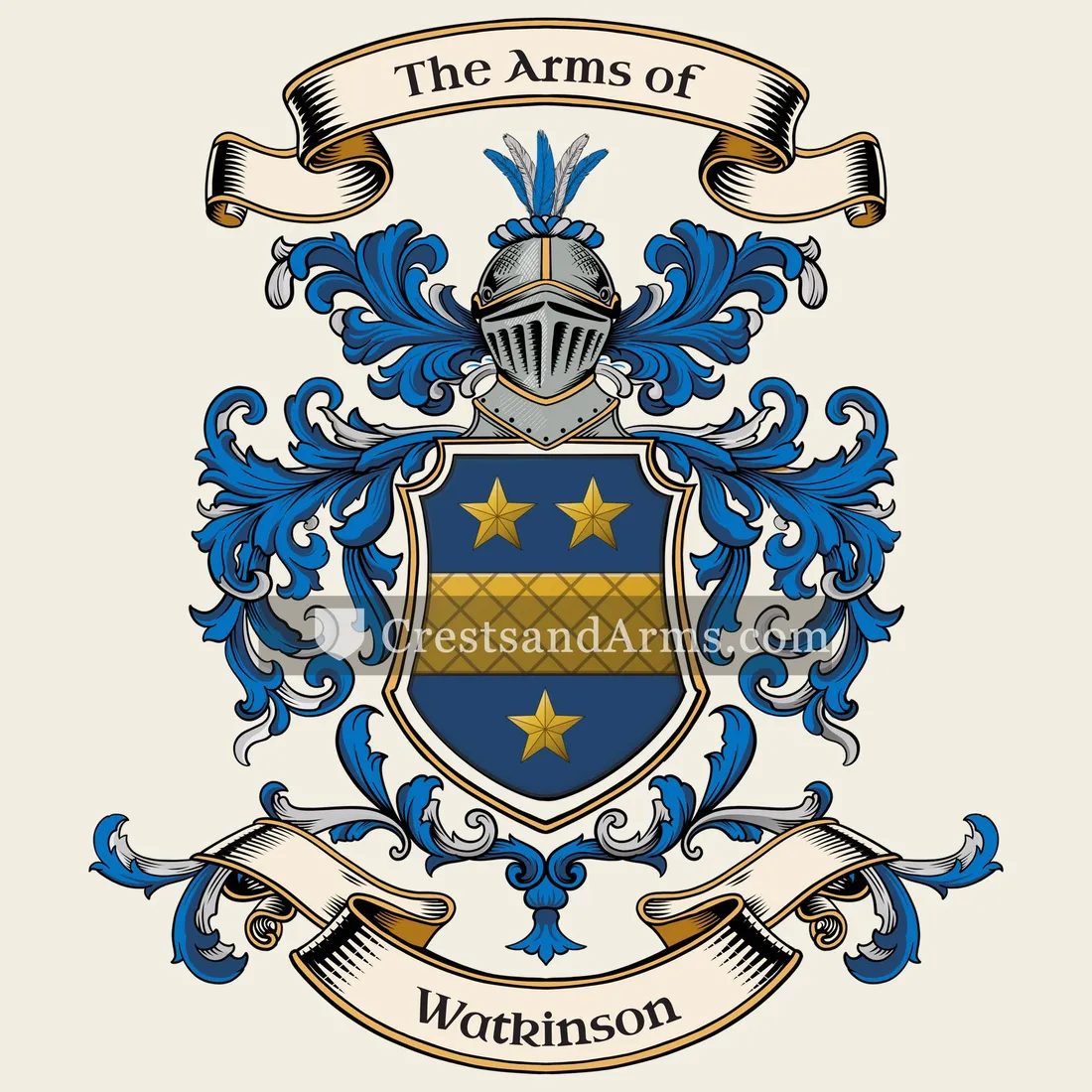
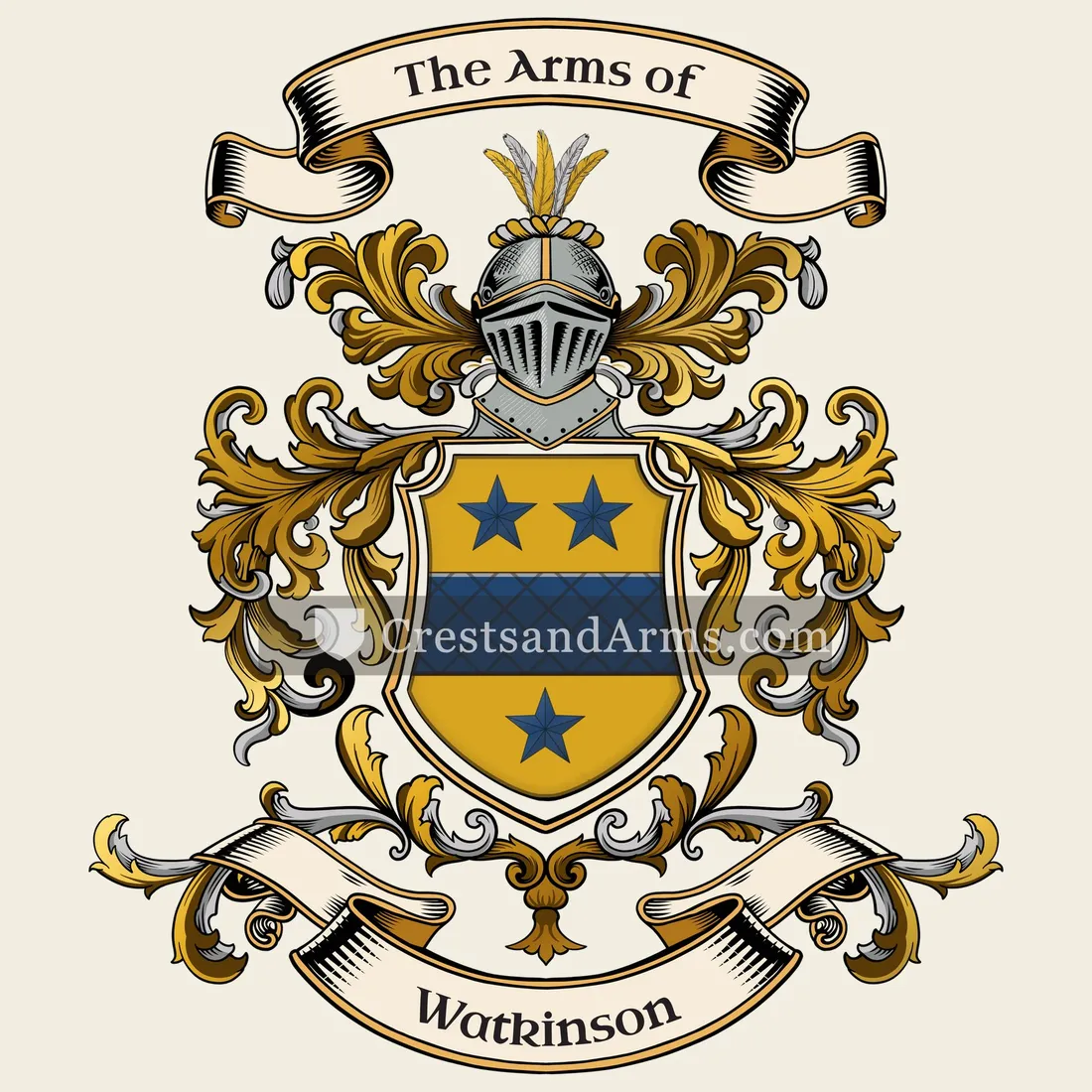
Symbols on this shield
fessThe military belt, and readiness to serve
mulletThe third son, and a divine quality from above
Colours
Gold (Or)Means: Generosity
Blue (Azure)Means: Loyalty and truth
Historical info
Source
Sir Bernard Burke, The General Armory of England, Scotland, Ireland and Wales, London: Harrison & Sons, 1884
Blazon (the actual original written record)
“Or, a fess betw. three mullets az”
NottinghamBeeston · Nottingham, c. 1620
Digital archive packCoat of arms PNG, gold border print PDF, vector SVG and the certificate of authenticity. Sent to your email in minutes.
Map of England showing where the Watkinson arms are recorded
The Watkinson arms were recorded in Nottingham, c. 1620.
Nottinghamshire had coal under it and forest across it, and both were worth money. Families who profited bought manors, and a manor was the ordinary reason for a family to take a coat of arms.
This is where the arms were entered in the register. Families often moved to other parts of the country, so the same name can turn up in more than one region.
The body that granted and recorded arms in England in this period.
James VI and I
Sovereign of the period
James VI and I
1603–1625
Reigning in Germany when the Watkinson arms are first recorded.
How Arms Worked in England
English heraldry allowed arms to be shared by all legitimate descendants of the original owner. These symbols were treated as personal property that moved through the generations to all children. While the eldest son kept the original design, other family members could use the same shield without needing to change it or register their own unique versions.
Granting authority
The College of Arms in London has regulated the use of coats of arms throughout England and Wales since 1484.
How they got arms
Families typically obtained their coats of arms through a formal grant from the Crown or by proving their ancient right to them.
Where arms were recorded
All official coats of arms are recorded in the registers kept at the College of Arms, which date back to the fifteenth century.
The family's standing
Recorded among the armigerous families of Nottingham.
Origin & History of the Watkinson Family in England
The surname Watkinson is a patronymic name, which means it was originally created to identify a person as the son of someone named Wat. In medieval England, Wat was a very common nickname for the name Walter. As surnames began to formalize in the late Middle Ages, families often adopted these names to distinguish themselves within their local communities. By the early 17th century, the name was well-established in the East Midlands, with clear records placing the family in Nottingham by 1620. During this period, families like the Watkinsons were often part of the growing merchant or artisan classes in English market towns. They lived through a time of significant social change as England transitioned from a feudal society into a more modern economy. The presence of the family in Nottingham suggests they were settled members of the community who participated in the local trade and civic life that defined the region during the reign of King James I.
Watkinson Meaning & Related Branches
Root word
Walter
Germanic name meaning powerful ruler of the army.
This name
WatkinsonPatronymic surname indicating son of little Walter or son of Wat.
also spelled
Watkynson
Watkineson
Watkyneson
Related arms
Watkingsonvariant spelling
Cæsarrecorded with Watkinson, same area
Dixonrecorded with Watkinson, same area
Micklethwaitrecorded with Watkinson, same area
Documented Sources
J. B. Rietstap, Armorial Général, Gouda: G. B. van Goor Zonen, 1884–87
Evans, Richard J., Death in Hamburg: Society and Politics in the Cholera Years 1830–1910, 1987
Prak, Maarten, The Dutch Republic in the Seventeenth Century: The Golden Age, 2005. (Contextual information on North Sea migration patterns)


 fessThe military belt, and readiness to serve
 mulletThe third son, and a divine quality from above
 fessThe military belt, and readiness to serve
 mulletThe third son, and a divine quality from above