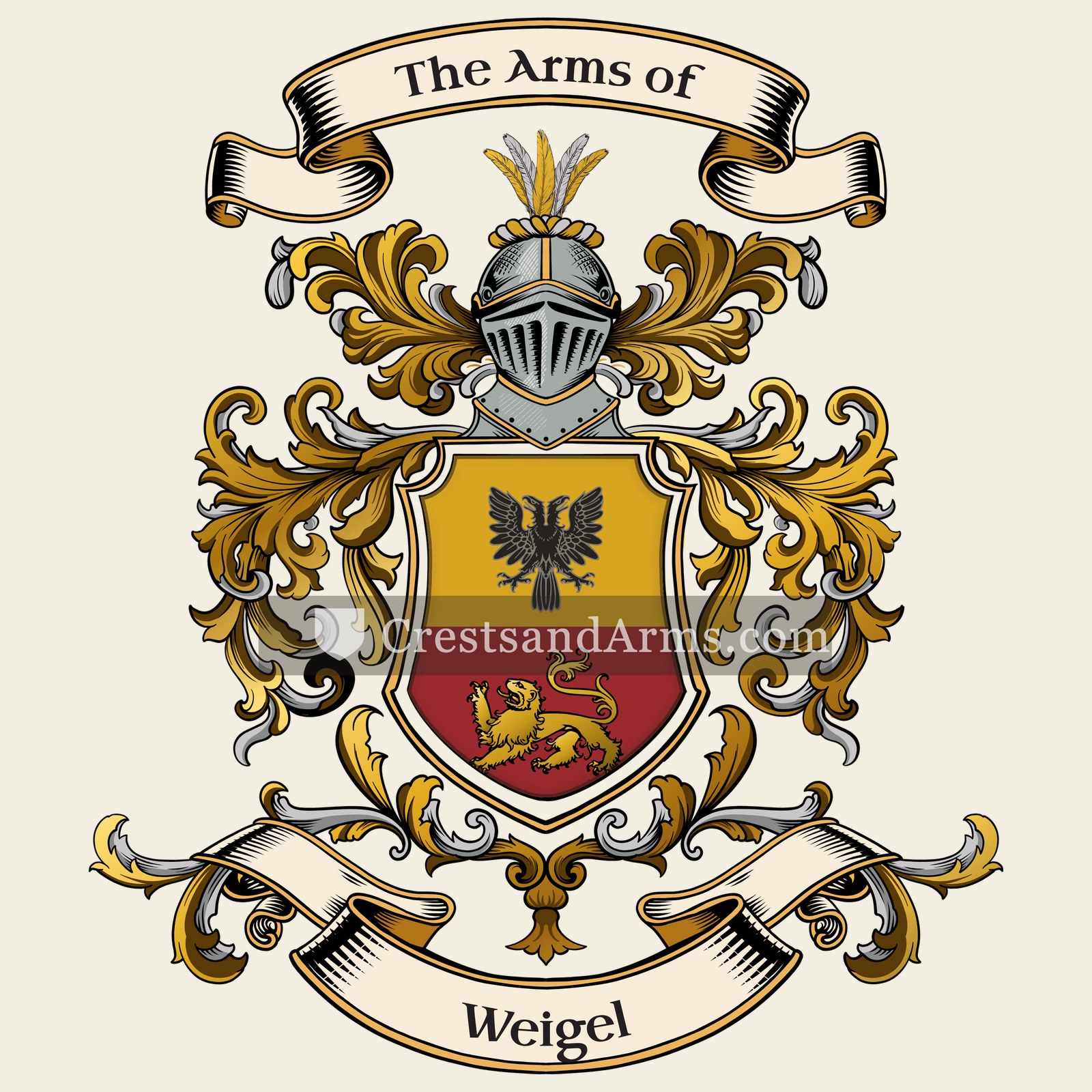
A record of documented arms, meaning and origin, researched for the Weigel family lines. Documented in 2 countries.
Reg. 0206 · Swedish, W–Z
Coat of Arms & Family Crest Details
Symbols on this shield
paleMilitary strength, and a fortified defence
Colours
Blue (Azure)Means: Loyalty and truth
Gold (Or)Means: Generosity
Historical info
Source
J. B. Rietstap, Armorial Général, Gouda: G. B. van Goor Zonen, 1884–87
Blazon (the actual original written record)
“D'azur à un pal d'or déjoint au milieu, la moitié supérieure à dextre et la moitié inférieure à sen., les moitiés se touchant par les angles. Deux cq. cour. C.: 1° deux C affr. et entrelacés d'or, adextrés du chiffre XIII d'or et senestrés du chiffre XIV du même; 2° une couleuvre ondoyante en pal d'arg.”
Swedenc. 1837
Digital archive packCoat of arms PNG, gold border print PDF, vector SVG and the certificate of authenticity. Sent to your email in minutes.
Map of Sweden showing where the Weigel arms are recorded
The Weigel arms were recorded in Sweden, c. 1837.
Arms such as these were typically recorded in Stockholm.
Stockholm held the Swedish court and the House of Nobility, where every noble family's arms were entered and kept. Families ennobled for service registered there, which is why so many are recorded around the city.
This is where the arms were entered in the register. Families often moved to other parts of the country, so the same name can turn up in more than one region.
The body that granted and recorded arms in Sweden in this period.
Charles XIV John of Sweden
Sovereign of the period
Charles XIV John of Sweden
1818–1844
Reigning in Sweden when the Weigel arms are first recorded.
How Arms Worked in Sweden
In Sweden, a coat of arms belonged to a noble family as a whole rather than just one individual. These arms were passed down through the generations to all legitimate descendants. Younger branches of the family used the same shield without needing to change it. This system ensured that the entire lineage shared the same identity and status under the law.
Granting authority
The Riddarhuset, or House of Nobility, regulated all noble coats of arms in Sweden under royal authority.
How they got arms
Families received their coats of arms through royal grants of nobility which were then officially registered with the House.
Where arms were recorded
Coats of arms were officially recorded in the Swedish House of Nobility register starting in the year 1626.
The family's standing
Recorded among the armigerous families of Sweden.
Origin & History of the Weigel Family in Sweden
The surname Weigel carries a distinct history that reflects the movement of people across Northern Europe during the nineteenth century. While the name has roots in German-speaking regions, its presence in Sweden became firmly established by the early 1800s. Official records confirm that members of the Weigel family were living and working in Stockholm by 1837. During this era, Stockholm was a growing center of trade and craftsmanship, attracting skilled individuals from abroad who sought new opportunities in the Swedish capital. These early family members likely integrated into the local urban economy, contributing to the professional life of the city as it transitioned into a modern industrial hub. By settling in Stockholm, the family became part of the diverse social fabric that defined the city’s expansion during the mid-nineteenth century.
Coat of Arms & Family Crest Details
Symbols on this shield
eagleNobility, strength and a keen mind
lionCourage, strength and royalty
Colours
Gold (Or)Means: Generosity
Red (Gules)Means: Military strength
Black (Sable)Means: Constancy
Historical info
Source
J. B. Rietstap, Armorial Général, Gouda: G. B. van Goor Zonen, 1884–87
Blazon (the actual original written record)
“Coupé: au 1 d'or à l'aigle naiss. de sa., mouv. du coupé; au 2 de gu. au lion léopardé d'or. C.: un chien braque iss. d'arg.”
GermanyNuremberg, c. 1765
Digital archive packCoat of arms PNG, gold border print PDF, vector SVG and the certificate of authenticity. Sent to your email in minutes.
Map of Germany showing where the Weigel arms are recorded
The Weigel arms were recorded in Nuremberg, c. 1765.
This is where the arms were entered in the register. Families often moved to other parts of the country, so the same name can turn up in more than one region.
The body that granted and recorded arms in Germany in this period.
Francis I, Holy Roman Emperor
Sovereign of the period
Francis I, Holy Roman Emperor
1745–1765
Reigning in Sweden when the Weigel arms are first recorded.
How Arms Worked in Germany
In the Holy Roman Empire, coats of arms were often granted to individuals by the Emperor or his representatives. These arms were then passed down through the generations to all legitimate descendants of the original holder. Younger branches of a family usually kept the same shield design without needing to change it, as the arms belonged to the entire lineage.
Granting authority
The Holy Roman Emperor held the sole power to grant new coats of arms throughout his vast imperial territories.
How they got arms
Families typically obtained their coats of arms through a formal imperial grant or by proving their noble status to the authorities.
Where arms were recorded
These grants were officially recorded in the Imperial Chancery registers, which began keeping formal records of such honors during the Middle Ages.
The family's standing
Recorded among the armigerous families of Germany.
Origin & History of the Weigel Family in Germany
The surname Weigel finds its roots in the German-speaking regions of Central Europe, where it evolved as a diminutive form of the name Wigand or Wigo. These names were derived from Old High German words relating to battle or war, suggesting that the earliest ancestors were likely associated with the warrior class or local defense. By the mid-18th century, the family had established a notable presence in the imperial city of Nuremberg. During this period, Nuremberg served as a major hub for trade, metalworking, and craftsmanship, which provided a stable environment for families to grow and specialize in various guilds. The records from 1765 indicate that the Weigel family was well-integrated into the urban life of this influential city, likely participating in the vibrant economic and social structures that defined Nuremberg during the Enlightenment. As the family name spread from these urban centers, it became a marker of the industrious spirit that characterized many middle-class families in the Holy Roman Empire.
Related Branches & Arms
Root word
Wig
Old High German word for war or battle.
This name
WeigelA diminutive form referring to a warrior or one involved in battle.
also spelled
Weygel
Wygul
Vygul
Wigal
Related arms
Fraislichsimilar arms
Geuschmidtsimilar arms
Härdsimilar arms
Documented Sources
J. B. Rietstap, Armorial Général, Gouda: G. B. van Goor Zonen, 1884–87
Stockholm City Archives (Stockholms stadsarkiv), Mantalslängder för Stockholms stad (Taxation and census records for the city of Stockholm)
Digital archive packCoat of arms PNG, gold border print PDF, vector SVG and the certificate of authenticity. Sent to your email in minutes.


 paleMilitary strength, and a fortified defence
 paleMilitary strength, and a fortified defence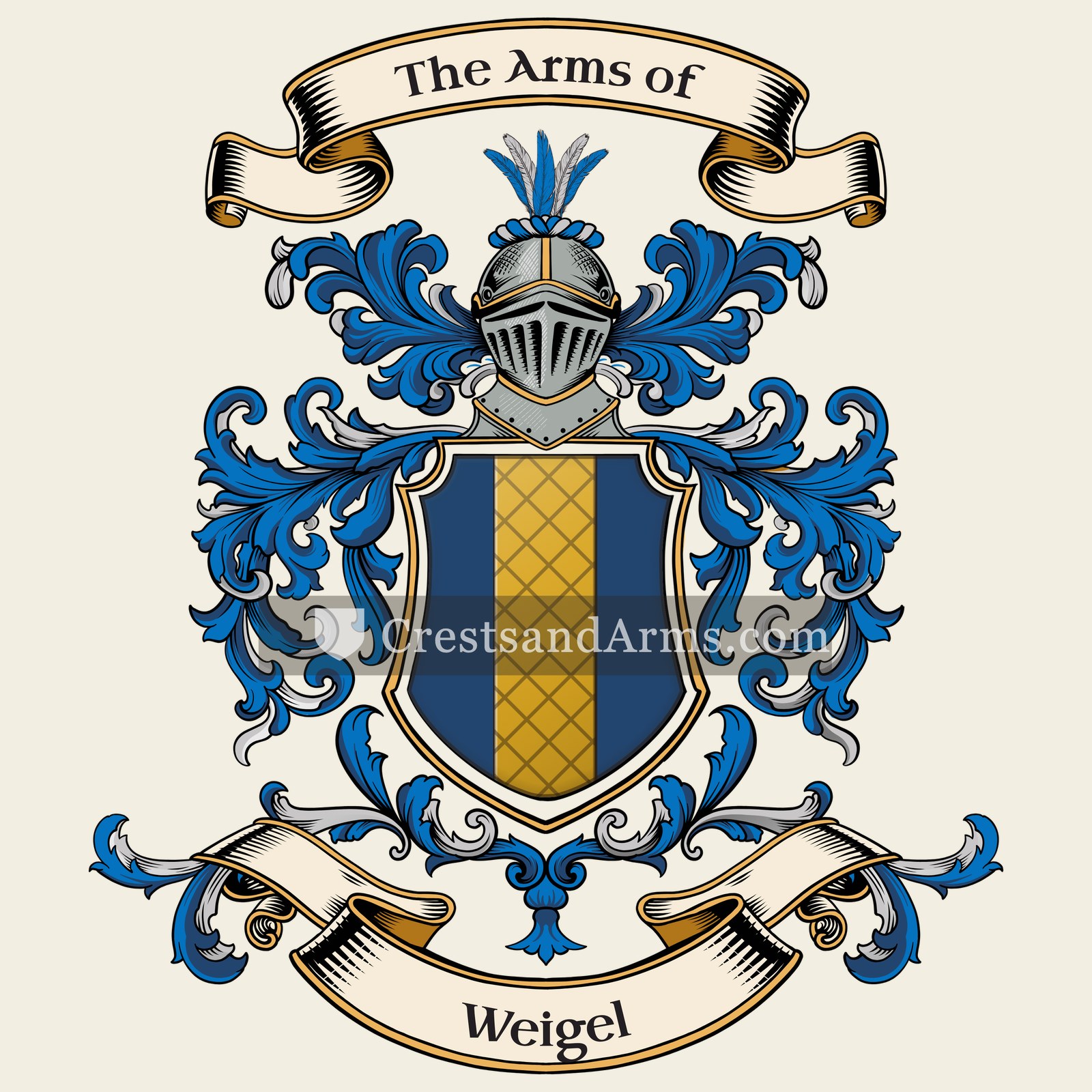


 eagleNobility, strength and a keen mind
 lionCourage, strength and royalty