A record of documented arms, meaning and origin, researched for the Welsch family lines. Documented in 2 countries.
Reg. 7038 · Austrian, W–Z
Coat of Arms & Family Crest Details
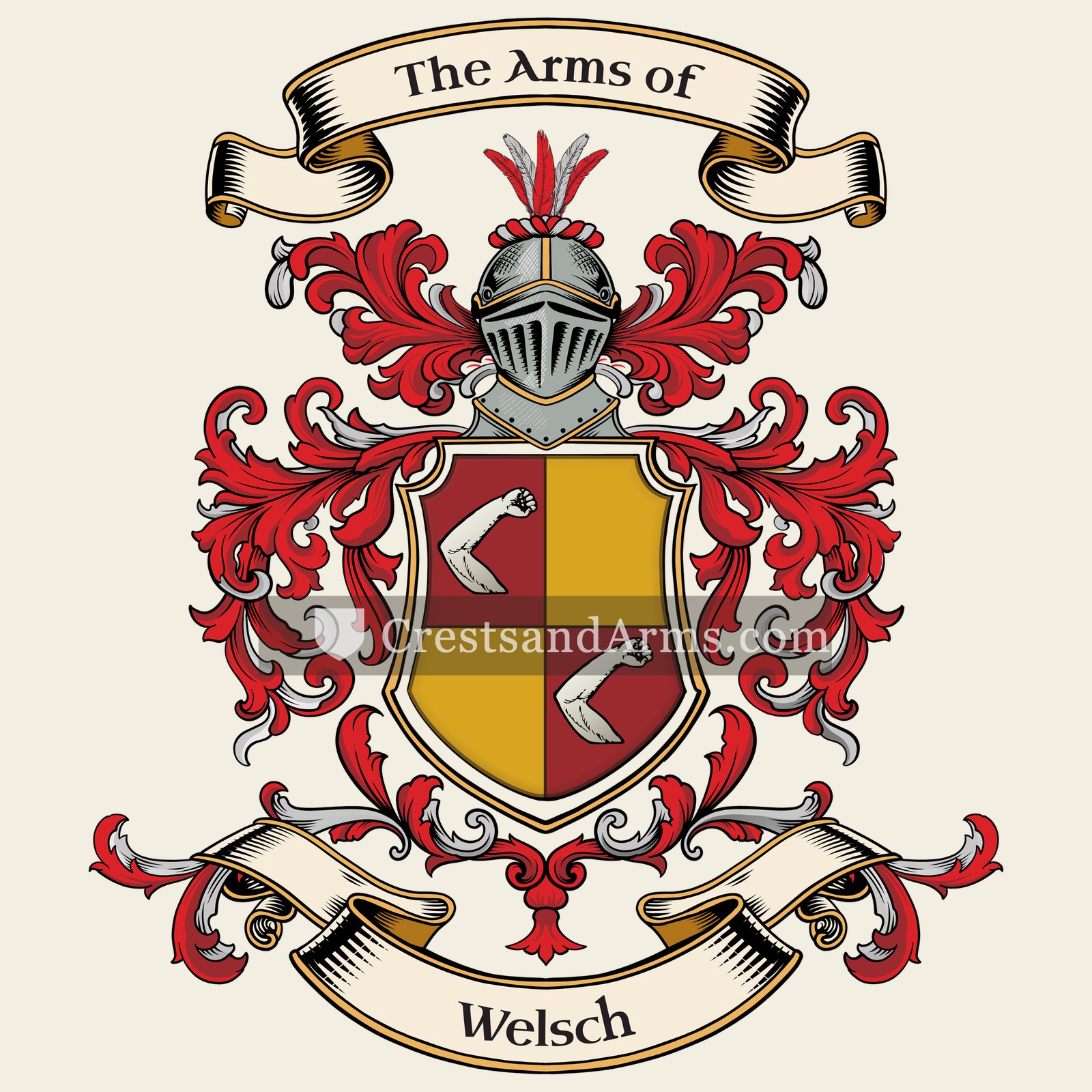
Symbols on this shield
armA person of action, industrious and laborious
Colours
Red (Gules)Means: Military strength
Gold (Or)Means: Generosity
Historical info
Source
J. B. Rietstap, Armorial Général, Gouda: G. B. van Goor Zonen, 1884–87
Blazon (the actual original written record)
“Ec.: aux 1 et 4 de gu. à un senestrochère, arm. au nat., tenant une épée et mouv. du flanc; aux 2 et 3 d'or à un livre fermé, relié de gu. Cq. cour. C.: un chevalier, iss. par les genoux, tenant de sa main dextre une épée et de sa sen. le livre du 2. L.: à dextre d'arg. et de gu., à sen. d'or et de gu.”
BavariaBavaria, c. 1714
Digital archive packCoat of arms PNG, gold border print PDF, vector SVG and the certificate of authenticity. Sent to your email in minutes.
Map of Austria showing where the Welsch arms are recorded
The Welsch arms were recorded in Bavaria, c. 1714.
Bavaria was a country of old landed families and walled market towns. Estates passed down the same line for centuries, and both the landowners and the leading townsmen kept arms, which is why so many Bavarian names sit in the registers.
This is where the arms were entered in the register. Families often moved to other parts of the country, so the same name can turn up in more than one region.
Region
Bavaria
First recorded
1714
Granting Authority for the Welsch Arms
Imperial and Royal chancery
Sodacan · CC BY-SA 3.0
The body that granted and recorded arms in Austria in this period.
Charles VI, Holy Roman Emperor
Sovereign of the period
Charles VI, Holy Roman Emperor
1711–1740
Reigning in Austria when the Welsch arms are first recorded.
How Arms Worked in Austria
Austrian coats of arms were often linked directly to noble titles granted by the Emperor. These symbols belonged to the entire family line rather than just one individual. When a family grew, new branches kept the original design without needing to change it. This system allowed all members of a noble house to share the same identity across many generations.
Granting authority
The Imperial and Royal chancery managed all heraldic matters and controlled the official granting of arms throughout the Austrian lands.
How they got arms
Families typically received their arms through a formal imperial decree that often accompanied the elevation of a person to noble status.
Where arms were recorded
Official records of these grants were kept in the Imperial Register of Nobility which began its formal documentation process in 1453.
The family's standing
Recorded among the armigerous families of Bavaria.
Origin & History of the Welsch Family in Austria
The surname Welsch originated as a descriptive term used by Germanic tribes to identify people who spoke Romance languages, such as neighbors from Italy or France. By the early 18th century, families carrying this name were well-established in the regions surrounding Bavaria and the Austrian borderlands. Because the name functioned as a label for outsiders or foreigners, it often appeared in local church registries and tax documents when families moved into new alpine communities. As these families settled in the Austrian territories, they integrated into the local agricultural and trade economies. They often lived in small villages where their name served as a historical reminder of their ancestral connections to the broader cultural crossroads of Central Europe. Over time, the name transitioned from a simple nickname for a stranger into a permanent family identifier that persisted through generations of Austrian history.
Coat of Arms & Family Crest Details
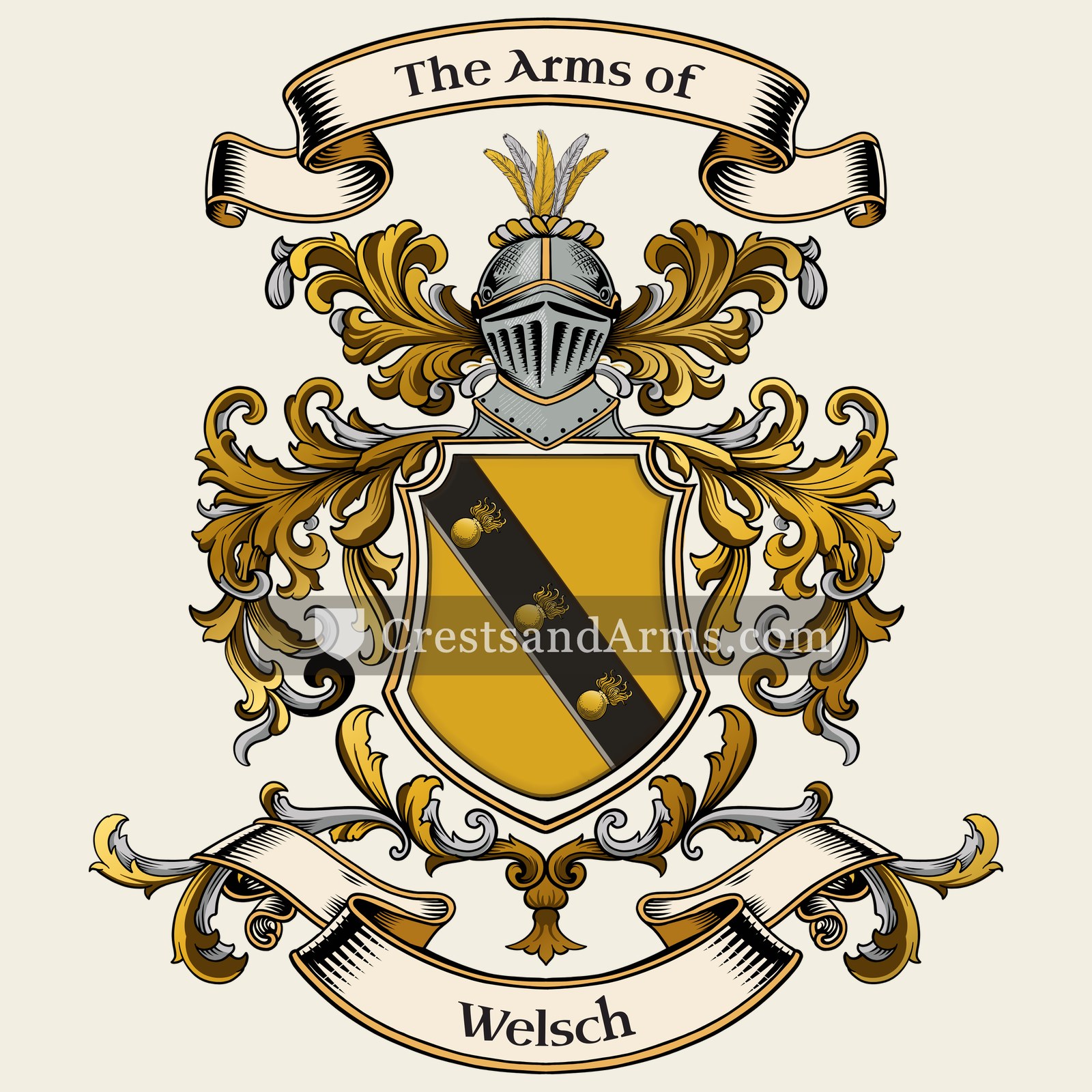
Symbols on this shield
bendDefence, and the scarf of a commander
bombOne who has faced a great siege
Colours
Gold (Or)Means: Generosity
Black (Sable)Means: Constancy
Historical info
Source
J. B. Rietstap, Armorial Général, Gouda: G. B. van Goor Zonen, 1884–87
Blazon (the actual original written record)
“D'or à la bande de sa., ch. de trois grenades d'or, ouv. de gu., posées dans le sens de la bande, les queues en bas. C.: un homme iss., hab. d'un parti de sa. et d'or, tenant de sa main dextre une branche de trois grenades mal-ordonnées d'or, ouv. de gu., la sen. appuyée sur sa hanche. L.: d'or et de sa.”
GermanyNördlingen Bav, c. 1765
Digital archive packCoat of arms PNG, gold border print PDF, vector SVG and the certificate of authenticity. Sent to your email in minutes.
Map of Germany showing where the Welsch arms are recorded
The Welsch arms were recorded in Nördlingen Bav, c. 1765.
This is where the arms were entered in the register. Families often moved to other parts of the country, so the same name can turn up in more than one region.
The body that granted and recorded arms in Germany in this period.
Francis I, Holy Roman Emperor
Sovereign of the period
Francis I, Holy Roman Emperor
1745–1765
Reigning in Austria when the Welsch arms are first recorded.
How Arms Worked in Germany
In the Holy Roman Empire, coats of arms were often granted to individuals by the Emperor or his representatives. These arms were then passed down through the generations to all legitimate descendants of the original holder. Younger branches of a family usually kept the same shield design without needing to change it, as the arms belonged to the entire lineage.
Granting authority
The Holy Roman Emperor held the sole power to grant new coats of arms throughout his vast imperial territories.
How they got arms
Families typically obtained their coats of arms through a formal imperial grant or by proving their noble status to the authorities.
Where arms were recorded
These grants were officially recorded in the Imperial Chancery registers, which began keeping formal records of such honors during the Middle Ages.
The family's standing
Recorded among the armigerous families of Germany.
Origin & History of the Welsch Family in Germany
The surname Welsch originated in medieval Germany as a descriptive term used by Germanic speakers to identify people who spoke Romance languages, such as French or Italian. Over time, this label evolved from a general nickname into a formal family name as populations became more settled. By the mid-18th century, the name was firmly established in the Bavarian town of Nördlingen. During this era, Nördlingen was a significant center for trade and craftsmanship, and families like the Welsches were often integrated into the local guild systems or agricultural life of the region. Living in a town with a rich history of commerce, early family members likely navigated the social and economic shifts of the Holy Roman Empire while maintaining their distinct identity within the local community.
Welsch Meaning & Related Branches
Root word
Walhaz
Proto-Germanic term for a foreigner or a speaker of Celtic languages.
This name
WelschAn ethnonym used by Germanic peoples to describe people of Roman or Celtic descent.
also spelled
Welsche
Welsh
Wels
Documented Sources
J. B. Rietstap, Armorial Général, Gouda: G. B. van Goor Zonen, 1884–87
Bahlow, Hans, Deutsches Namenlexikon: Familien- und Vornamen nach Ursprung und Sinn erklärt, 1967
Heintze, Albert, Die deutschen Familien-Namen: geschichtlich, geographisch, sprachlich, 1903


 armA person of action, industrious and laborious
 armA person of action, industrious and laborious


 bendDefence, and the scarf of a commander
 bombOne who has faced a great siege