A record of documented arms, meaning and origin, researched for the Welser family lines. Documented in 2 countries.
Reg. 1426 · Austrian, W–Z
Coat of Arms & Family Crest Details
Symbols on this shield
mountThe ground held, and steadfastness upon it
lionCourage, strength and royalty
Colours
Black (Sable)Means: Constancy
Red (Gules)Means: Military strength
Historical info
Source
J. B. Rietstap, Armorial Général, Gouda: G. B. van Goor Zonen, 1884–87
Blazon (the actual original written record)
“De sa. à un leopard naiss. au nat., mouv. d'un tertre parti de gu. et d'arg. Cq. cour. C.: le léopard iss. L.: à dextre d'or et de sa., à sen. d'arg. et de gu.”
CarinthiaCarinthia, c. 1609
Digital archive packCoat of arms PNG, gold border print PDF, vector SVG and the certificate of authenticity. Sent to your email in minutes.
Map of Austria showing where the Welser arms are recorded
The Welser arms were recorded in Carinthia, c. 1609.
Carinthia was Alpine country in southern Austria with iron and lead in its mountains. Mining and landholding both made money, and families who held either kind of property took arms.
This is where the arms were entered in the register. Families often moved to other parts of the country, so the same name can turn up in more than one region.
Region
Carinthia
First recorded
1609
Granting Authority for the Welser Arms
Imperial and Royal chancery
Sodacan · CC BY-SA 3.0
The body that granted and recorded arms in Austria in this period.
Emperor Rudolf II
Sovereign of the period
Emperor Rudolf II
1576–1612
Reigning in Austria when the Welser arms are first recorded.
How Arms Worked in Austria
Austrian coats of arms were often linked directly to noble titles granted by the Emperor. These symbols belonged to the entire family line rather than just one individual. When a family grew, new branches kept the original design without needing to change it. This system allowed all members of a noble house to share the same identity across many generations.
Granting authority
The Imperial and Royal chancery managed all heraldic matters and controlled the official granting of arms throughout the Austrian lands.
How they got arms
Families typically received their arms through a formal imperial decree that often accompanied the elevation of a person to noble status.
Where arms were recorded
Official records of these grants were kept in the Imperial Register of Nobility which began its formal documentation process in 1453.
The family's standing
Recorded among the armigerous families of Carinthia.
Origin & History of the Welser Family in Austria
The Welser family name holds a significant place in the history of the Alpine regions, with records confirming their presence in Carinthia as early as 1609. While the family is most famous for their immense wealth and influence in southern Germany, their movement into Austrian territories reflects the broader patterns of trade and social mobility during the seventeenth century. By establishing themselves in Carinthia, members of the family integrated into the local administrative and economic structures of the Habsburg lands. They often served as intermediaries between the powerful merchant networks of the north and the growing markets of the southeast. This migration allowed the family to secure land and social status within the Austrian provinces, ensuring that the Welser name became synonymous with both commercial success and regional political stability.
Coat of Arms & Family Crest Details
Symbols on this shield
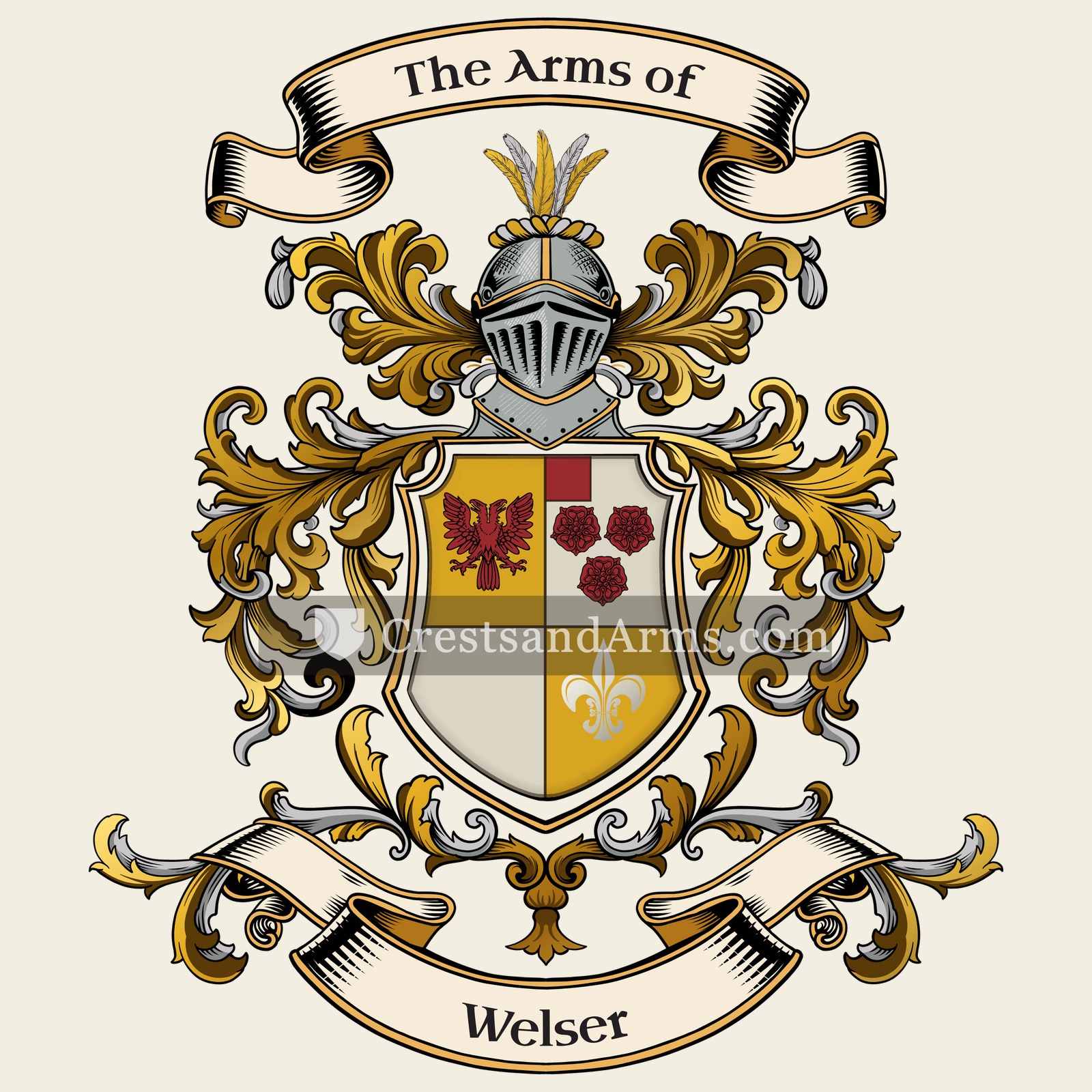
cantonA mark of honour granted by the sovereign
eagleNobility, strength and a keen mind
roseThe seventh son, and beauty with grace
fleur de lisPurity, light, and the sixth son
Colours
Gold (Or)Means: Generosity
Silver (Argent)Means: Peace and sincerity
Red (Gules)Means: Military strength
Historical info
Source
J. B. Rietstap, Armorial Général, Gouda: G. B. van Goor Zonen, 1884–87
Blazon (the actual original written record)
“Ec.: au 1 d'or à l'aigle de gu.; au 2 d'arg. à trois roses de gu., rangées en fasce, et deux cantons senestres de gu., l'un en chef et l'autre en p. (Grandner); au 3 d'arg. à trois fasces brét. et c.-brét. de gu. (Zinnenberg); au 4 parti d'arg. et de gu., à une fleur-de-lis de l'un en l'autre (Welser). Deux cq. cour. C.: 1° un demi-vol cont., aux armes de l'écu entier: l. d'or et de gu.; 2° un bras, arm. d'arg., sortant de la couronne, la main de carn. tenant une épée en barre; le bras br sur un panache de quatre pl. d'aut., les deux ext. d'azur, les deux autres de gu.; l. d'arg. et de gu. S.: deux lions d'or, cour. du même.”
Germanyc. 1713
Digital archive packCoat of arms PNG, gold border print PDF, vector SVG and the certificate of authenticity. Sent to your email in minutes.
Map of Germany showing where the Welser arms are recorded
The Welser arms were recorded in Germany, c. 1713.
Arms such as these were typically recorded in Bavaria.
Bavaria was a country of old landed families and walled market towns. Estates passed down the same line for centuries, and both the landowners and the leading townsmen kept arms, which is why so many Bavarian names sit in the registers.
This is where the arms were entered in the register. Families often moved to other parts of the country, so the same name can turn up in more than one region.
The body that granted and recorded arms in Germany in this period.
Charles VI, Holy Roman Emperor
Sovereign of the period
Charles VI, Holy Roman Emperor
1711–1740
Reigning in Austria when the Welser arms are first recorded.
How Arms Worked in Germany
In the Holy Roman Empire, coats of arms were often granted to individuals by the Emperor or his representatives. These arms were then passed down through the generations to all legitimate descendants of the original holder. Younger branches of a family usually kept the same shield design without needing to change it, as the arms belonged to the entire lineage.
Granting authority
The Holy Roman Emperor held the sole power to grant new coats of arms throughout his vast imperial territories.
How they got arms
Families typically obtained their coats of arms through a formal imperial grant or by proving their noble status to the authorities.
Where arms were recorded
These grants were officially recorded in the Imperial Chancery registers, which began keeping formal records of such honors during the Middle Ages.
The family's standing
Recorded among the armigerous families of Germany.
Origin & History of the Welser Family in Germany
The Welser family name has deep roots in the southern German region of Bavaria, where the family established a significant presence by the early 18th century. While the name is most famously associated with the powerful merchant dynasties of Augsburg during the Renaissance, the branch documented in Bavaria by 1713 reflects the broader movement of families across German lands during this era. These early ancestors were often involved in trade, local administration, or skilled craftsmanship, which allowed them to build stable lives in growing towns. As the family settled into these communities, they became part of the social fabric that defined Bavarian life before the industrial age. By maintaining records of their births, marriages, and property, these early Welsers helped preserve their family identity through generations of change in the German states.
Related Branches & Arms
Root word
Wels
A reference to the Austrian city of Wels or the Wels river.
This name
WelserA habitational name for someone who originated from the town of Wels.
also spelled
Welsere
Welsar
Welsir
Related arms
Flushartsimilar arms
Littrowsimilar arms
Marbachsimilar arms
Sarsfieldsimilar arms
Documented Sources
J. B. Rietstap, Armorial Général, Gouda: G. B. van Goor Zonen, 1884–87
Häberlein, Mark, Die Welser: Erfolgsgeschichte einer europäischen Kaufmannsfamilie, 2014
Kellenbenz, Hermann, Die Welser und ihr Wirken in Übersee, 1970
Kärntner Landesarchiv, Personenstandsunterlagen und Adelsakten
Österreichisches Staatsarchiv, Reichskanzlei: Adels- und Wappenbriefe
Digital archive packCoat of arms PNG, gold border print PDF, vector SVG and the certificate of authenticity. Sent to your email in minutes.


 mountThe ground held, and steadfastness upon it
 lionCourage, strength and royalty
 mountThe ground held, and steadfastness upon it
 lionCourage, strength and royalty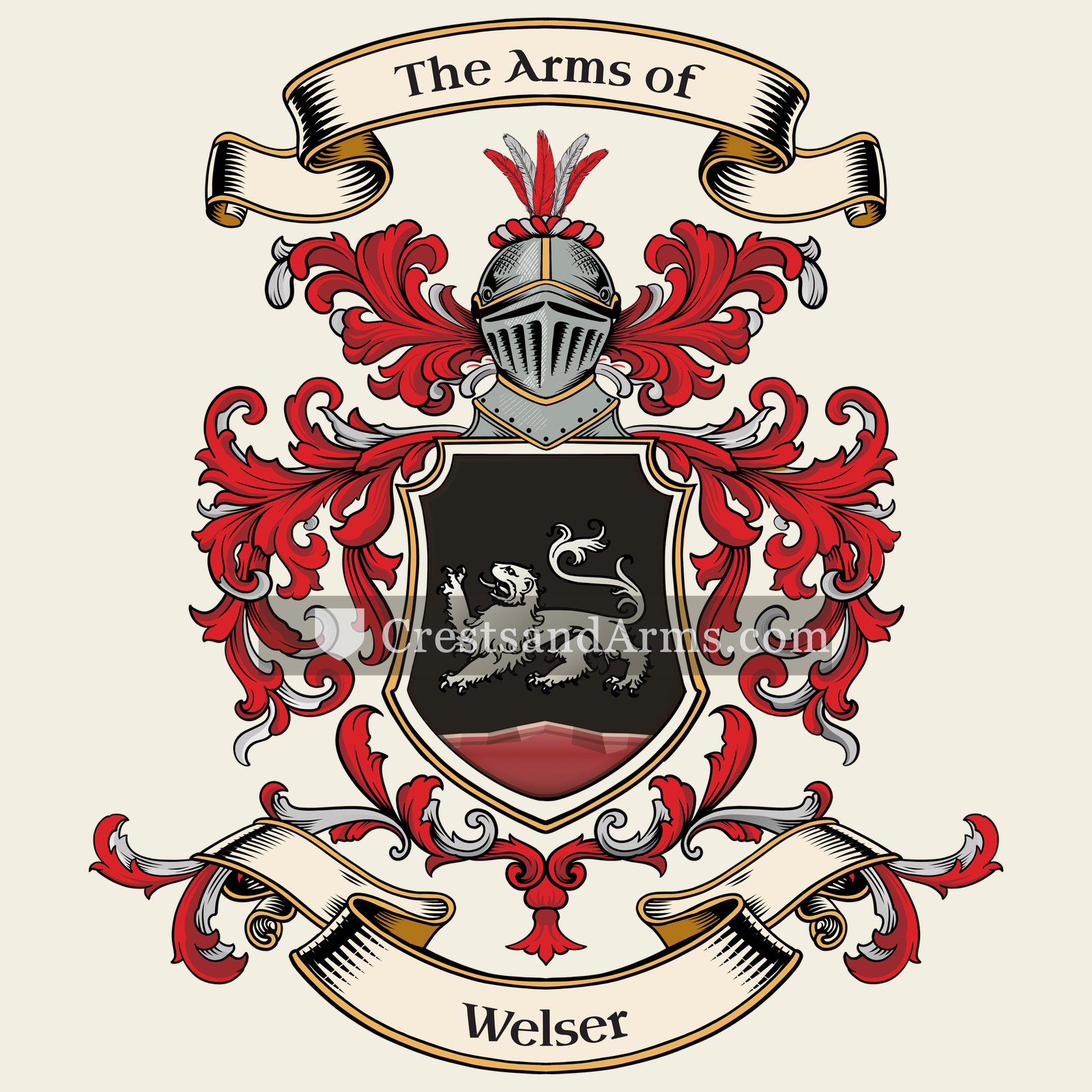


 cantonA mark of honour granted by the sovereign
 eagleNobility, strength and a keen mind
 roseThe seventh son, and beauty with grace
 fleur de lisPurity, light, and the sixth son