A record of documented arms, meaning and origin, researched for the Welter family lines. Documented in 3 countries.
Reg. 7092 · Dutch, W–Z
Coat of Arms & Family Crest Details
Symbols on this shield
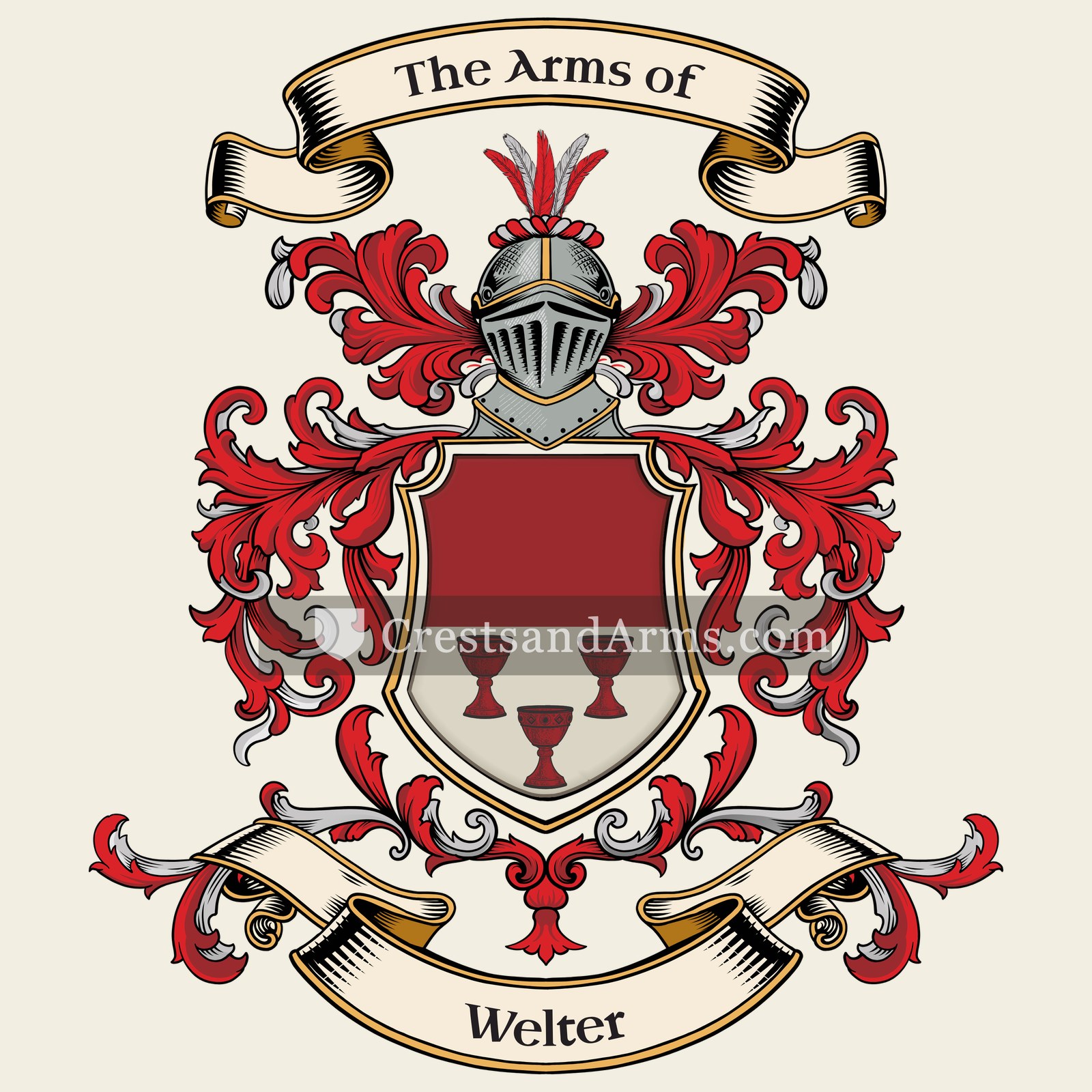
cupFaith, office, and a trust discharged
Colours
Red (Gules)Means: Military strength
Silver (Argent)Means: Peace and sincerity
Historical info
Source
J. B. Rietstap, Armorial Général, Gouda: G. B. van Goor Zonen, 1884–87
Blazon (the actual original written record)
“Coupé: au 1 de gu. à une tige englantée en bas de deux pièces et feuillée à sen. d'une seule pièce, le tout d'or; au 2 d'arg. à trois pignates de gu., l'anse à dextre.”
Netherlandsc. 1815
Digital archive packCoat of arms PNG, gold border print PDF, vector SVG and the certificate of authenticity. Sent to your email in minutes.
Map of Netherlands showing where the Welter arms are recorded
The Welter arms were recorded in Netherlands, c. 1815.
Arms such as these were typically recorded in Friesland.
Friesland was low, wet country on the northern coast of the Netherlands, farmed by families who had held the same land for centuries. Free landholders were unusually common there, and a free landholder could carry arms.
This is where the arms were entered in the register. Families often moved to other parts of the country, so the same name can turn up in more than one region.
Region
Friesland
First recorded
1815
Granting Authority for the Welter Arms
Hoge Raad van Adel
Photograph made by me · CC BY-SA 3.0
The body that granted and recorded arms in Netherlands in this period.
William I of the Netherlands
Sovereign of the period
William I of the Netherlands
1815–1840
Reigning in Netherlands when the Welter arms are first recorded.
How Arms Worked in Netherlands
In the Netherlands, coats of arms were often used by noble families and those who held specific public offices. These arms were passed down through the generations to legitimate descendants. Younger branches of a family usually kept the original design without needing to add special marks. This system ensured that the family identity remained clear and consistent over many years.
Granting authority
The Hoge Raad van Adel is the official body that regulates and manages noble titles and coats of arms in the Netherlands.
How they got arms
Families typically obtained their coats of arms through official royal grants or by proving their long-standing historical use of the symbols.
Where arms were recorded
Coats of arms are officially recorded in the registers held by the Hoge Raad van Adel, which began its work in 1814.
The family's standing
Recorded among the armigerous families of Netherlands.
Origin & History of the Welter Family in Netherlands
The surname Welter has deep roots in the northern regions of the Netherlands, particularly within the province of Friesland. By the early nineteenth century, the name was firmly established among families living in this coastal area. The name itself is thought to be a variation of the Germanic name Walter, which translates roughly to a ruler of an army or a powerful leader. During the early 1800s, families bearing this name were often integrated into the local agricultural and maritime communities that defined Frisian life. As the Netherlands underwent significant administrative changes during this period, such as the introduction of mandatory civil registration in 1811, families like the Welters became more formally documented in official records. These records show that the family was part of the steady social fabric of the region, contributing to the local economy and community development long before the modern era of migration.
Coat of Arms & Family Crest Details
Symbols on this shield
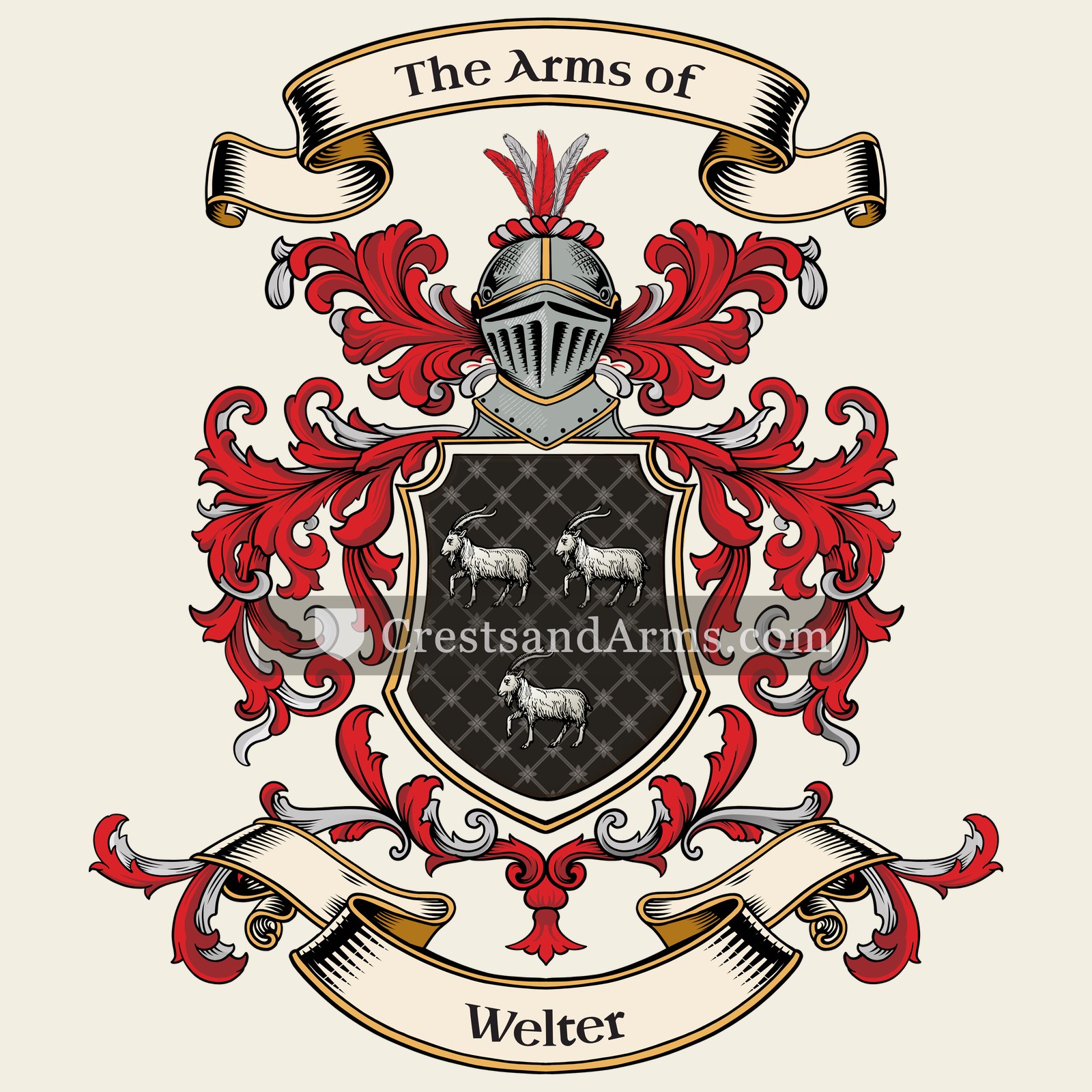
goatOne who wins by diplomacy rather than force
Colours
Black (Sable)Means: Constancy
Silver (Argent)Means: Peace and sincerity
Historical info
Source
J. B. Rietstap, Armorial Général, Gouda: G. B. van Goor Zonen, 1884–87
Blazon (the actual original written record)
“De sa. à trois bouquetins arrêtés d'arg. C.: un bouquetin de l'écu.”
SwitzerlandThurgovie, c. 1745
Digital archive packCoat of arms PNG, gold border print PDF, vector SVG and the certificate of authenticity. Sent to your email in minutes.
Map of Switzerland showing where the Welter arms are recorded
The Welter arms were recorded in Thurgovie, c. 1745.
This is where the arms were entered in the register. Families often moved to other parts of the country, so the same name can turn up in more than one region.
The body that granted and recorded arms in Switzerland in this period.
How Arms Worked in Switzerland
In Switzerland, coats of arms were not restricted to the nobility and were often adopted by common citizens and families. These symbols were passed down through generations to show family identity. When branches of a family grew, they often changed small details of the design to distinguish their own line from the original group.
Granting authority
Cantonal and civic authorities managed the use of coats of arms within their specific regions and local jurisdictions.
How they got arms
Families typically assumed their own coats of arms based on local custom rather than receiving them from a central monarch.
Where arms were recorded
Arms were recorded in various cantonal and civic registers starting from the fourteenth century throughout the Swiss region.
The family's standing
Recorded among the armigerous families of Switzerland.
Origin & History of the Welter Family in Switzerland
The surname Welter has deep roots in the German-speaking regions of Europe, and its presence in the Swiss canton of Thurgau by 1745 reflects the movement of families across the Rhine valley during the eighteenth century. The name itself is a variation of the Old High German name Walther, which translates to a ruler of an army or a powerful leader. In the rural landscape of Thurgau, families bearing this name were often integrated into the local agricultural society, where they contributed to the development of the region’s distinct village communities. During this period, the Swiss cantons were organized into a loose confederation, and families like the Welters were typically recorded in parish registers that tracked births, marriages, and deaths. These early records suggest that the family was part of the steady social fabric of northeastern Switzerland, living through a time of relative stability before the major political shifts that transformed the region at the end of the century.
Coat of Arms & Family Crest Details
Symbols on this shield
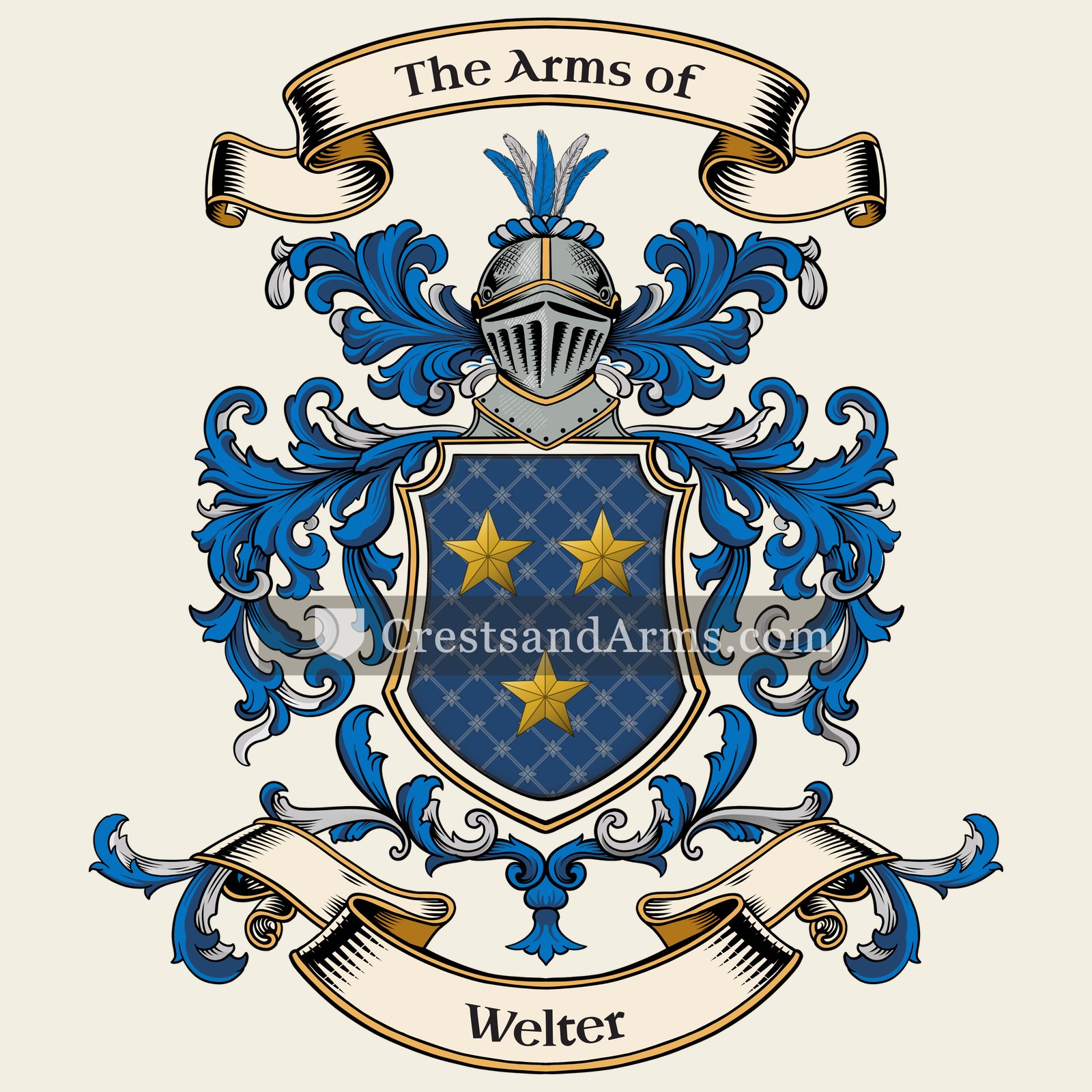
mulletThe third son, and a divine quality from above
Colours
Blue (Azure)Means: Loyalty and truth
Gold (Or)Means: Generosity
Historical info
Source
J. B. Rietstap, Armorial Général, Gouda: G. B. van Goor Zonen, 1884–87
Blazon (the actual original written record)
“D'azur à trois étoiles d'or. Cq. cour. C.: un homme iss., hab. d'azur, supp. de ses mains au-dessus de sa tête un monde d'azur, cintré et croisé d'or.”
Francec. 1663
Digital archive packCoat of arms PNG, gold border print PDF, vector SVG and the certificate of authenticity. Sent to your email in minutes.
Map of France showing where the Welter arms are recorded
The Welter arms were recorded in France, c. 1663.
Arms such as these were typically recorded in Bretagne.
More families held coats of arms in Bretagne than anywhere else in France. The land was divided into many small estates rather than a few large ones, so far more households counted as gentry, and each needed a shield of its own to be told apart.
This is where the arms were entered in the register. Families often moved to other parts of the country, so the same name can turn up in more than one region.
The body that granted and recorded arms in France in this period.
Louis XIV of France
Sovereign of the period
Louis XIV of France
1643–1715
Reigning in Netherlands when the Welter arms are first recorded.
How Arms Worked in France
In France, a coat of arms was a mark of honor that passed down through the male line to all legitimate descendants. Families often used the same shield without changes to show their shared heritage. If a branch wanted to stand out, they could add a small mark to their shield to show their specific place in the family tree.
Granting authority
The Juge d'armes de France acted as the official authority that regulated and verified coats of arms across the country.
How they got arms
Families typically inherited their arms from ancestors, though they could also receive them through royal grants or by proving their noble status.
Where arms were recorded
Coats of arms were officially recorded in the Armorial Général de France, which began its main collection in the year 1696.
The family's standing
Recorded among the armigerous families of France.
Origin & History of the Welter Family in France
The family name Welter has deep roots that connect to the linguistic and cultural shifts of northern Europe, eventually finding a home in the region of Bretagne by the mid-seventeenth century. The name itself is a variation of the Germanic name Walter, which translates to a ruler of the army. As families moved across borders during the Middle Ages, this name spread from Germanic territories into the French-speaking regions. By 1663, records confirm that members of the Welter family were established in Bretagne. This period was a time of significant social change in the province, as families often settled in rural parishes to work the land or engage in local trade. The presence of the family in this coastal region suggests they were part of the steady migration of people who integrated their heritage into the unique cultural fabric of western France. Over time, the name became a permanent part of the local identity in Bretagne, reflecting a long history of adaptation and endurance within the French landscape.
Welter Meaning & Related Branches
Root word
Waldhari
Derived from Germanic elements meaning ruler or commander of the army.
This name
WelterA patronymic or occupational name signifying a powerful leader or army commander.
also spelled
Weltere
Welther
Welttre
Documented Sources
J. B. Rietstap, Armorial Général, Gouda: G. B. van Goor Zonen, 1884–87
AlleFriezen, Burgerlijke Stand (Civil Registration) 1811–1950


 cupFaith, office, and a trust discharged
 cupFaith, office, and a trust discharged


 goatOne who wins by diplomacy rather than force

 mulletThe third son, and a divine quality from above