Map of England showing where the Whitaker arms are recorded
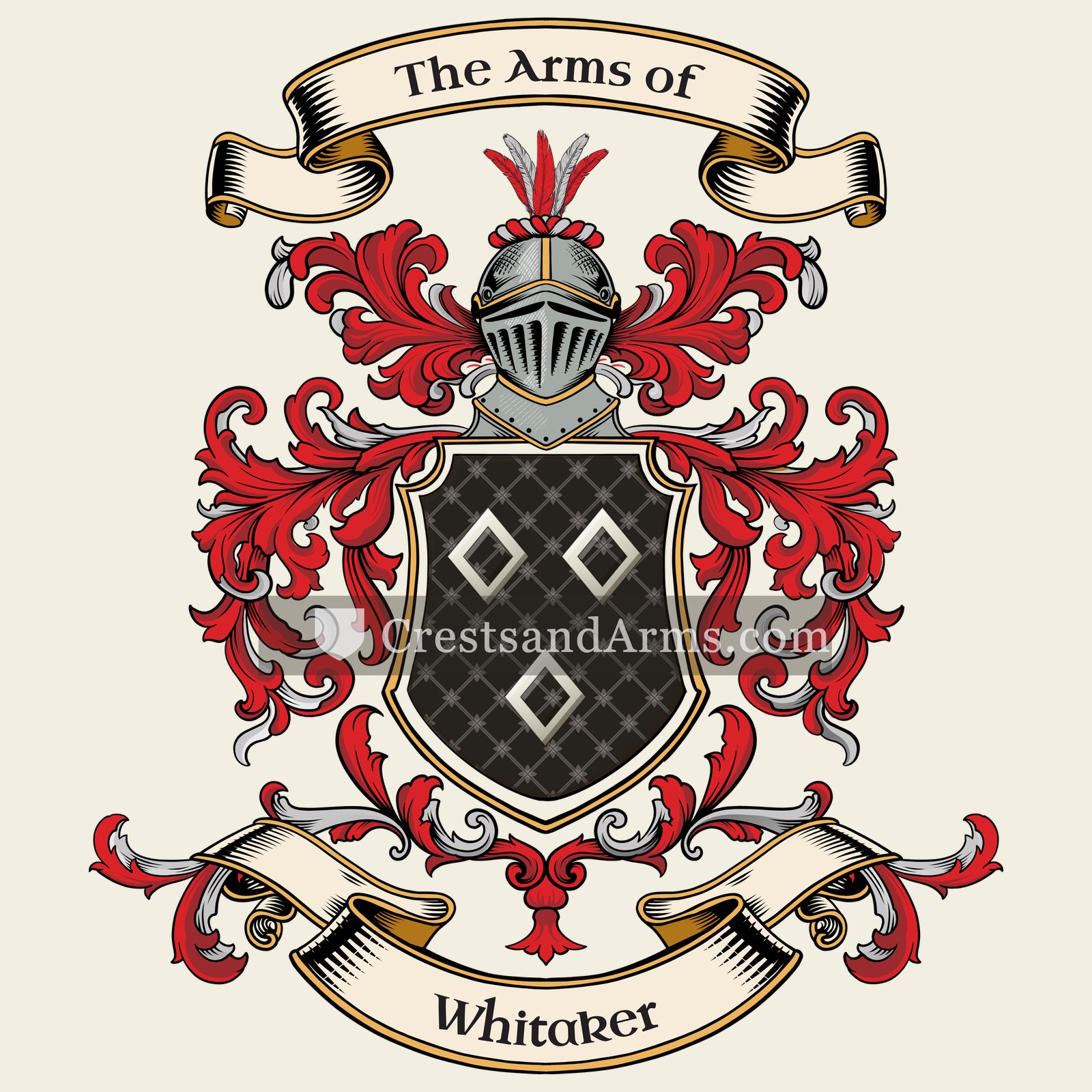
The Whitaker arms were recorded in Lancaster, c. 1431.
Lancashire was divided among a great many small landed families, more than most northern counties. Estates were passed down whole rather than split up, so the same names hold the same ground for centuries in the records.
This is where the arms were entered in the register. Families often moved to other parts of the country, so the same name can turn up in more than one region.
The body that granted and recorded arms in England in this period.
Henry VI of England
Sovereign of the period
Henry VI of England
1422–1461
Reigning in England when the Whitaker arms are first recorded.
How Arms Worked in England
English heraldry allowed arms to be shared by all legitimate descendants of the original owner. These symbols were treated as personal property that moved through the generations to all children. While the eldest son kept the original design, other family members could use the same shield without needing to change it or register their own unique versions.
Granting authority
The College of Arms in London has regulated the use of coats of arms throughout England and Wales since 1484.
How they got arms
Families typically obtained their coats of arms through a formal grant from the Crown or by proving their ancient right to them.
Where arms were recorded
All official coats of arms are recorded in the registers kept at the College of Arms, which date back to the fifteenth century.
The family's standing
Recorded among the armigerous families of Lancaster.
Origin & History of the Whitaker Family in England
The surname Whitaker is a locative name, meaning it was originally used to describe where a person lived. It comes from the Old English words "hwit," meaning white, and "acer," meaning field or acre. This suggests that the earliest families bearing this name likely lived near a prominent white field or a piece of land with light-colored soil. By the early 15th century, the family had established a notable presence in the county of Lancashire. Records from 1431 confirm that members of the Whitaker family were settled in this region, where they were often involved in local land management and agricultural life. Over time, the name spread from these northern roots across England, evolving from a simple description of a landscape into a permanent family identity passed down through generations.
Whitaker Meaning & Related Branches
Root word
hwit + acer
Old English words for white and field or cultivated land.
This name
WhitakerRefers to someone who lived near a white field or a piece of white land.
also spelled
Whitacre
Related arms
Whitacrevariant spelling
Bloboldrecorded with Whitaker, same area
Frestonrecorded with Whitaker, same area
Middletonrecorded with Whitaker, same area
Documented Sources
Sir Bernard Burke, The General Armory of England, Scotland, Ireland and Wales, London: Harrison & Sons, 1884
Bardsley, Charles Wareing, A Dictionary of English and Welsh Surnames, 1901
Reaney, P.H., A Dictionary of British Surnames, 1958
The National Archives, Feudal Aids, 1284-1431, 1908
Digital archive packCoat of arms PNG, gold border print PDF, vector SVG and the certificate of authenticity. Sent to your email in minutes.


 masclePersuasion and the mail of a knight's coat
 masclePersuasion and the mail of a knight's coat