Map of England showing where the Whitcher arms are recorded
The Whitcher arms were recorded in Hants, c. 1620.
Hampshire had the naval dockyards at Portsmouth on one side and good farmland on the other. Sea money and land money both bought estates, and an estate was what brought a family its coat of arms.
This is where the arms were entered in the register. Families often moved to other parts of the country, so the same name can turn up in more than one region.
The body that granted and recorded arms in England in this period.
James VI and I
Sovereign of the period
James VI and I
1603–1625
Reigning in England when the Whitcher arms are first recorded.
How Arms Worked in England
English heraldry allowed arms to be shared by all legitimate descendants of the original owner. These symbols were treated as personal property that moved through the generations to all children. While the eldest son kept the original design, other family members could use the same shield without needing to change it or register their own unique versions.
Granting authority
The College of Arms in London has regulated the use of coats of arms throughout England and Wales since 1484.
How they got arms
Families typically obtained their coats of arms through a formal grant from the Crown or by proving their ancient right to them.
Where arms were recorded
All official coats of arms are recorded in the registers kept at the College of Arms, which date back to the fifteenth century.
The family's standing
Recorded among the armigerous families of Hants.
Origin & History of the Whitcher Family in England
The surname Whitcher originated in the southern counties of England, with a particularly strong historical presence in Hampshire. The name is classified as a locative surname, meaning it likely identified individuals who lived near a specific landmark or within a particular settlement. Linguists suggest the name evolved from Old English roots, potentially referring to someone who lived near a white-colored feature, such as a chalky stream or a prominent white building. By the early 17th century, the family was well-established in the rural landscapes of Hampshire. These early ancestors were often tied to the land as yeoman farmers or tradespeople, living through a period of significant social and agricultural change in England. Their presence in the region by 1620 reflects a long-standing connection to the local community, where the family name became deeply woven into the parish records and the regional identity of the English countryside.
Meaning of the Whitcher family crest colors & symbols
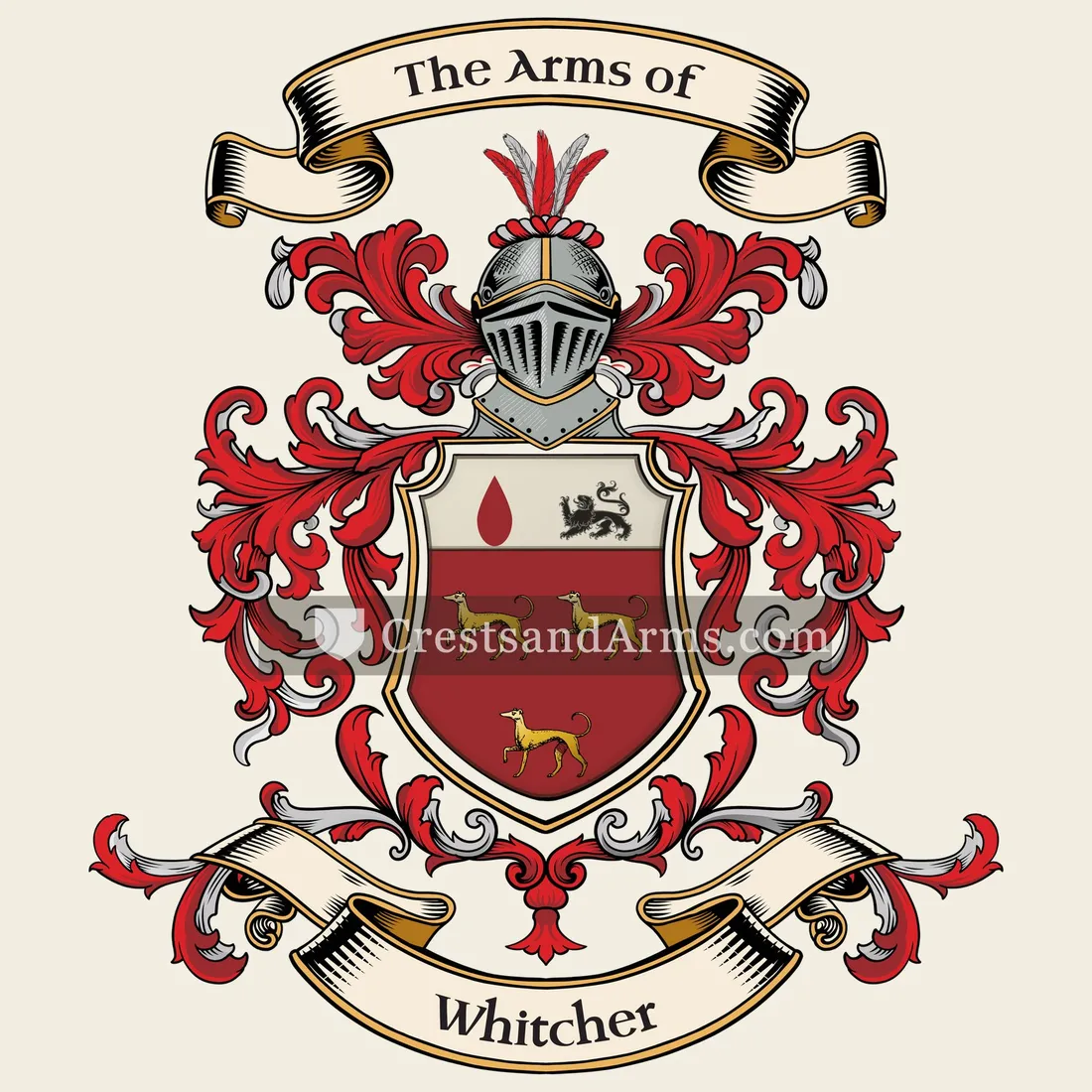
Symbols on this shield
chiefAuthority, wisdom and dominion
greyhoundCourage, vigilance and loyalty
dropletsTears, and grief borne with patience
lionCourage, strength and royalty
Colours
Red (Gules)Means: Military strength
Silver (Argent)Means: Peace and sincerity
Gold (Or)Means: Generosity
Black (Sable)Means: Constancy
Historical info
Source
Sir Bernard Burke, The General Armory of England, Scotland, Ireland and Wales, London: Harrison & Sons, 1884
Blazon (the actual original written record)
“Gu. three talbots' heads erased or, langued az. on a chief ar. guttée de sang a lion pass. sa. Crest (Reg. Ulster's Office)—A talbot's head erased or, collared az. betw. two wings expanded ar. guttée de sang”
DownLoughbrickland · Down, c. 1655
Digital archive packCoat of arms PNG, gold border print PDF, vector SVG and the certificate of authenticity. Sent to your email in minutes.
Map of Ireland showing where the Whitcher arms are recorded
The Whitcher arms were recorded in Down, c. 1655.
Down was north-eastern Irish country settled from Scotland in the seventeenth century. The new landowners took grants and had them recorded, which is why so many Down families carry documented shields.
This is where the arms were entered in the register. Families often moved to other parts of the country, so the same name can turn up in more than one region.
The body that granted and recorded arms in Ireland in this period.
How Arms Worked in Ireland
The Ulster King of Arms granted coats of arms to individuals who proved their social standing and good character. These symbols were typically inherited by all legitimate descendants of the original holder. If a family branch wanted a unique look, they could apply for a specific change to their design through the office to ensure their identity remained distinct.
Granting authority
The Ulster King of Arms acted as the official body that regulated and issued all coats of arms throughout Ireland.
How they got arms
Families obtained their arms through formal grants issued by the office after proving their eligibility and paying the required fees.
Where arms were recorded
All official grants were recorded in the registers held by the Ulster King of Arms starting from the year 1552.
The family's standing
Recorded among the armigerous families of Down.
Origin & History of the Whitcher Family in Ireland
The Whitcher name arrived in Ireland during a period of significant political and social upheaval in the mid-seventeenth century. Historical records confirm that members of the family were established in County Down by 1655, a time when the region was undergoing major land redistribution and settlement changes following the Cromwellian conquest. The name itself is of English origin, likely derived from a place name meaning a dweller at a white orchard or a white farmstead. As these early settlers moved into the Irish landscape, they integrated into the local administrative and agricultural systems of the northern counties. Over the following generations, the family became part of the complex social fabric of Ulster, transitioning from newcomers into a settled part of the local community. Their presence in County Down reflects the broader patterns of migration that shaped the demographic history of the region during the seventeenth century.
Whitcher Meaning & Related Branches
Root word
Wicce
Old English term for a wizard, sorcerer, or wise person.
This name
WhitcherAn occupational name for a wizard or a person thought to possess magical or wise knowledge.
also spelled
Whytchurch
Documented Sources
Sir Bernard Burke, The General Armory of England, Scotland, Ireland and Wales, London: Harrison & Sons, 1884
Bardsley, Charles Wareing, A Dictionary of English and Welsh Surnames, 1901
Reaney, P.H., A Dictionary of British Surnames, 1958
Hampshire Archives and Local Studies, Bishop’s Transcripts of Parish Registers, 1620
Digital archive packCoat of arms PNG, gold border print PDF, vector SVG and the certificate of authenticity. Sent to your email in minutes.


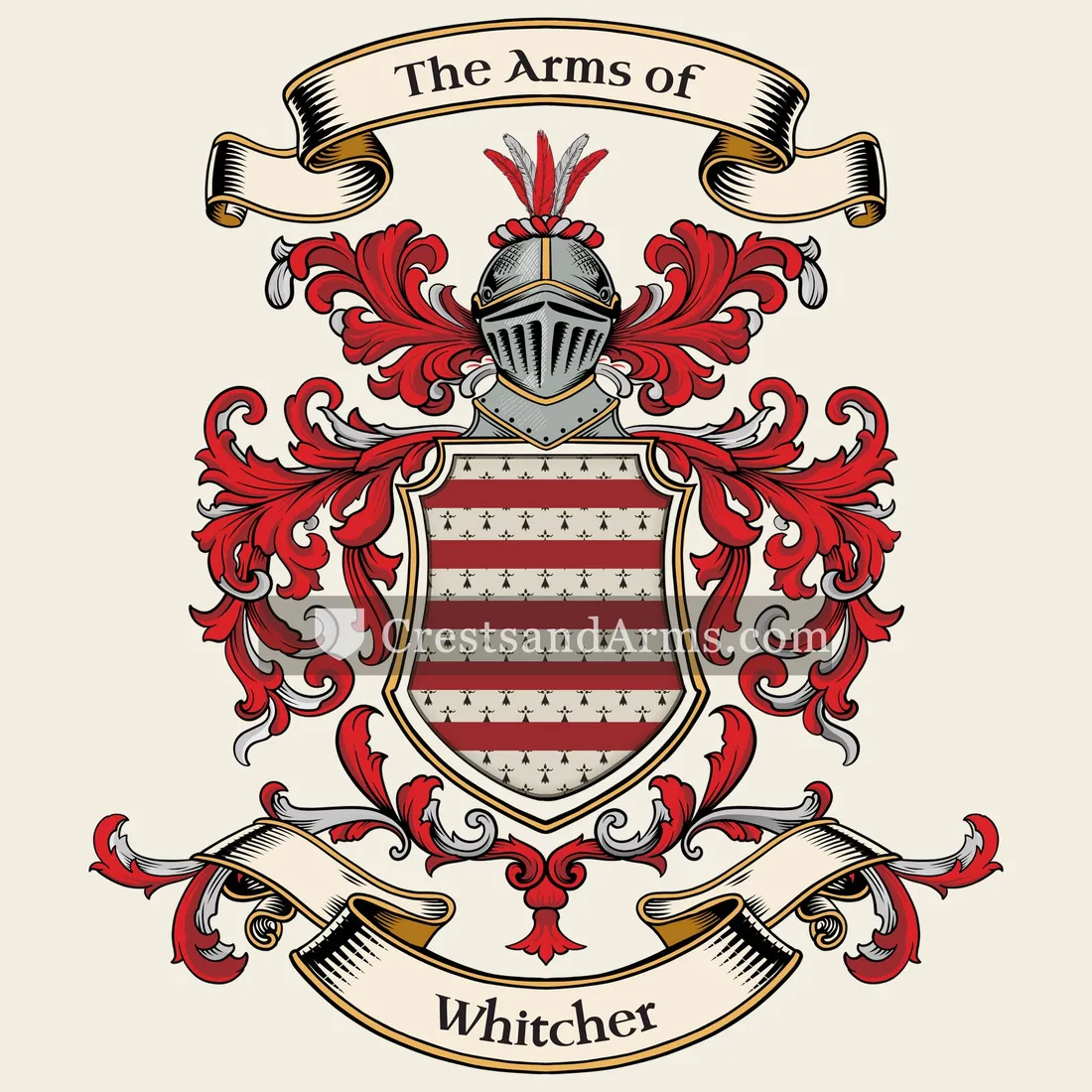


 chiefAuthority, wisdom and dominion
 greyhoundCourage, vigilance and loyalty
 dropletsTears, and grief borne with patience
 lionCourage, strength and royalty