Map of France showing where the Wicker arms are recorded
The Wicker arms were recorded in Strasbourg, c. 1663.
This is where the arms were entered in the register. Families often moved to other parts of the country, so the same name can turn up in more than one region.
The body that granted and recorded arms in France in this period.
Louis XIV of France
Sovereign of the period
Louis XIV of France
1643–1715
Reigning in France when the Wicker arms are first recorded.
How Arms Worked in France
In France, a coat of arms was a mark of honor that passed down through the male line to all legitimate descendants. Families often used the same shield without changes to show their shared heritage. If a branch wanted to stand out, they could add a small mark to their shield to show their specific place in the family tree.
Granting authority
The Juge d'armes de France acted as the official authority that regulated and verified coats of arms across the country.
How they got arms
Families typically inherited their arms from ancestors, though they could also receive them through royal grants or by proving their noble status.
Where arms were recorded
Coats of arms were officially recorded in the Armorial Général de France, which began its main collection in the year 1696.
The family's standing
Recorded among the armigerous families of France.
Origin & History of the Wicker Family in France
The Wicker family name has deep roots in the Alsace region of France, where the city of Strasbourg served as a prominent home for the family by the mid-seventeenth century. During this era, Strasbourg was a crossroads of culture and trade, sitting at the intersection of French and Germanic influences. The name itself likely originated from occupational or geographic descriptions common in the Rhine valley, reflecting the family’s integration into the local urban economy. By 1663, records confirm that members of the Wicker family were established residents within the city, participating in the daily life and social structures of the region. Their presence in Strasbourg suggests they were part of the growing middle class that helped define the city during a period of significant political transition. As the family navigated the shifting borders of the time, they maintained a consistent presence in the local parish and civil registers that tracked the growth of the community.
Coat of Arms & Family Crest Details
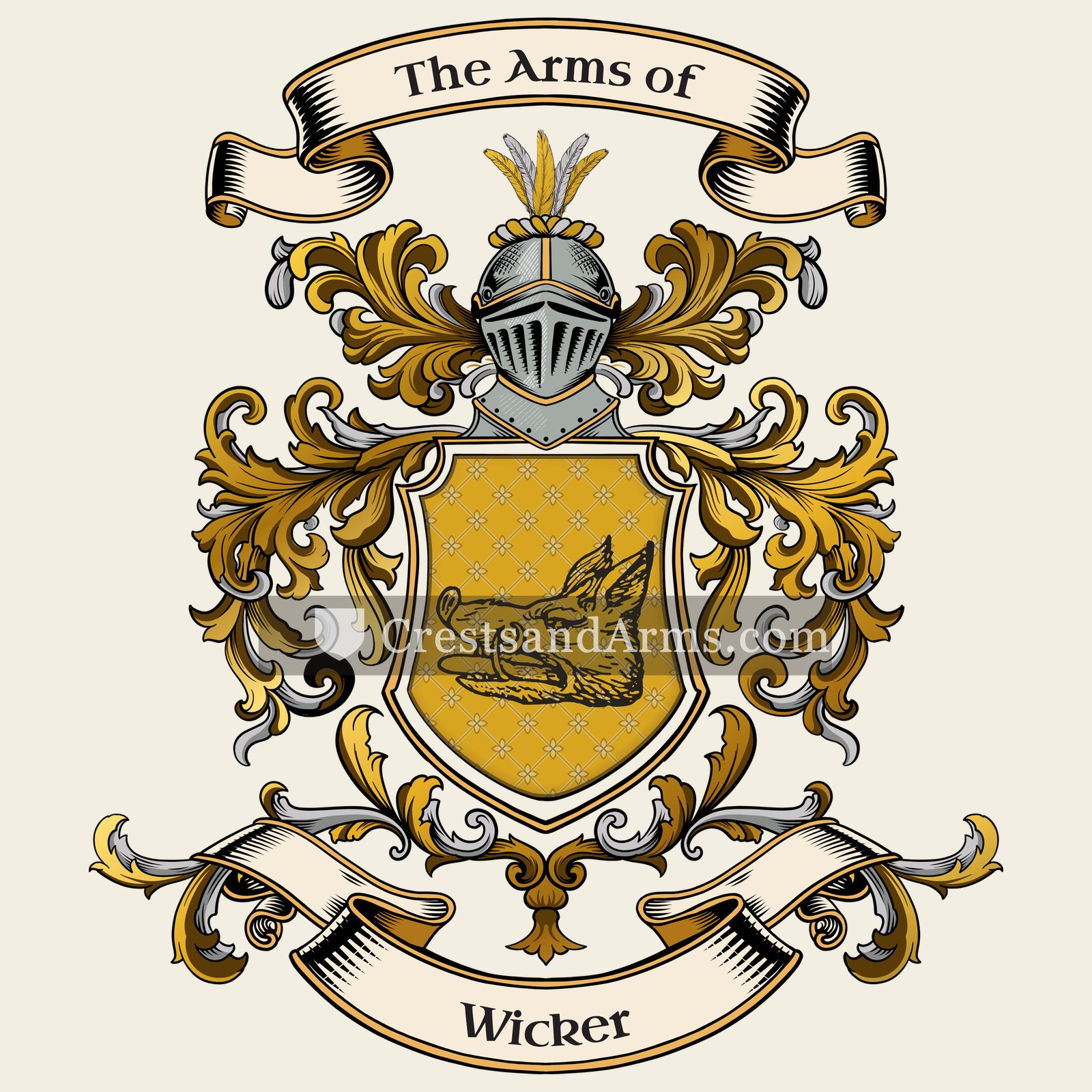
Symbols on this shield
boars headA fierce fighter who battles to the end
Colours
Gold (Or)Means: Generosity
Black (Sable)Means: Constancy
Historical info
Source
J. B. Rietstap, Armorial Général, Gouda: G. B. van Goor Zonen, 1884–87
Blazon (the actual original written record)
“D'or à une hure de sanglier de sa., défendue d'arg., la machoire inférieure garnie d'un rang de grelots du même.”
Austriac. 1772
Digital archive packCoat of arms PNG, gold border print PDF, vector SVG and the certificate of authenticity. Sent to your email in minutes.
Map of Austria showing where the Wicker arms are recorded
The Wicker arms were recorded in Austria, c. 1772.
Arms such as these were typically recorded in Tyrol.
Tyrol was mountain country in western Austria, where the valleys were held by families who had been there a very long time. Old tenure counted for more than money, and old families carried arms.
This is where the arms were entered in the register. Families often moved to other parts of the country, so the same name can turn up in more than one region.
Region
Tyrol
First recorded
1772
Granting Authority for the Wicker Arms
Imperial and Royal chancery
Sodacan · CC BY-SA 3.0
The body that granted and recorded arms in Austria in this period.
Joseph II, Holy Roman Emperor
Sovereign of the period
Joseph II, Holy Roman Emperor
1765–1790
Reigning in France when the Wicker arms are first recorded.
How Arms Worked in Austria
Austrian coats of arms were often linked directly to noble titles granted by the Emperor. These symbols belonged to the entire family line rather than just one individual. When a family grew, new branches kept the original design without needing to change it. This system allowed all members of a noble house to share the same identity across many generations.
Granting authority
The Imperial and Royal chancery managed all heraldic matters and controlled the official granting of arms throughout the Austrian lands.
How they got arms
Families typically received their arms through a formal imperial decree that often accompanied the elevation of a person to noble status.
Where arms were recorded
Official records of these grants were kept in the Imperial Register of Nobility which began its formal documentation process in 1453.
The family's standing
Recorded among the armigerous families of Austria.
Origin & History of the Wicker Family in Austria
The Wicker family name has deep roots in the mountainous landscape of Tyrol, where records confirm their presence as early as 1772. During this period, the region was part of the Habsburg Monarchy, and families like the Wickers were often integrated into the local agricultural and alpine economy. The name itself likely evolved from older Germanic terms related to trade or specific local occupations, reflecting the practical nature of life in the high valleys. Living in Tyrol required resilience, as families had to navigate both the harsh climate and the complex political shifts of the eighteenth century. By settling in this region, the Wicker family became part of a long tradition of mountain dwellers who shaped the cultural identity of the Austrian Alps through their work and community ties.
Related Branches & Arms
Root word
vicus
Latin term for a village, district, or row of houses.
This name
WickerDerived from a topographic name for someone who lived in a village or a specialized street.
also spelled
Wickar
Wickerr
Wickere
Vicker
Documented Sources
J. B. Rietstap, Armorial Général, Gouda: G. B. van Goor Zonen, 1884–87
Archives de la Ville et de l'Eurométropole de Strasbourg, Registres paroissiaux et d'état civil
Kintz, Jean-Pierre, La vie à Strasbourg au XVIIe siècle, 1983
Livet, Georges, Histoire de Strasbourg des origines à nos jours, 1980
Digital archive packCoat of arms PNG, gold border print PDF, vector SVG and the certificate of authenticity. Sent to your email in minutes.


 grapesPlenty, and the labour of the vine
 grapesPlenty, and the labour of the vine


 boars headA fierce fighter who battles to the end