A record of documented arms, meaning and origin, researched for the Wieland family lines. Documented in 2 countries.
Reg. 2203 · Austrian, W–Z
Coat of Arms & Family Crest Details
Symbols on this shield
chevronProtection, and faithful service completed
ramLeadership and authority
eagleNobility, strength and a keen mind
trefoilPerpetuity, and the Trinity
Colours
Gold (Or)Means: Generosity
Red (Gules)Means: Military strength
Silver (Argent)Means: Peace and sincerity
Black (Sable)Means: Constancy
Green (Vert)Means: Hope
Historical info
Source
J. B. Rietstap, Armorial Général, Gouda: G. B. van Goor Zonen, 1884–87
Blazon (the actual original written record)
“Ec.: aux 1 et 4 d'or à l'aigle de sa., cour. du champ, celle du 1 cont.; aux 2 et 3 de gu. au chev. d'arg., ch. de trois trèfles de sin. Sur le tout de Wiederhold. qui est parti d'or et d'azur; à un bélier sautant d'arg., br. sur le parti. Deux cq. cour. C.: 1º un bras, arm. au nat., la main de carn. tenant une épée d'arg., garnie d'or, en barre; entre un vol, coupé alt. d'or et de sa.; l. d'or et de sa.; 2º le bélier iss., tenant entre ses dents un trèfle de sin.; entre deux prob., coupées alt. d'or et d'azur; l. d'or et d'azur.”
Austriac. 1824
Digital archive packCoat of arms PNG, gold border print PDF, vector SVG and the certificate of authenticity. Sent to your email in minutes.
Map of Austria showing where the Wieland arms are recorded
The Wieland arms were recorded in Austria, c. 1824.
Arms such as these were typically recorded in Tyrol.
Tyrol was mountain country in western Austria, where the valleys were held by families who had been there a very long time. Old tenure counted for more than money, and old families carried arms.
This is where the arms were entered in the register. Families often moved to other parts of the country, so the same name can turn up in more than one region.
Region
Tyrol
First recorded
1824
Granting Authority for the Wieland Arms
Imperial and Royal chancery
Sodacan · CC BY-SA 3.0
The body that granted and recorded arms in Austria in this period.
Francis II, Holy Roman Emperor
Sovereign of the period
Francis II, Holy Roman Emperor
1804–1835
Reigning in Austria when the Wieland arms are first recorded.
How Arms Worked in Austria
Austrian coats of arms were often linked directly to noble titles granted by the Emperor. These symbols belonged to the entire family line rather than just one individual. When a family grew, new branches kept the original design without needing to change it. This system allowed all members of a noble house to share the same identity across many generations.
Granting authority
The Imperial and Royal chancery managed all heraldic matters and controlled the official granting of arms throughout the Austrian lands.
How they got arms
Families typically received their arms through a formal imperial decree that often accompanied the elevation of a person to noble status.
Where arms were recorded
Official records of these grants were kept in the Imperial Register of Nobility which began its formal documentation process in 1453.
The family's standing
Recorded among the armigerous families of Austria.
Origin & History of the Wieland Family in Austria
The surname Wieland has deep roots in the German-speaking regions of Europe, with its origins tied to the Old High German name Wigand, which translates to warrior or battle-ready. By the early 19th century, the family established a notable presence in the mountainous region of Tyrol, Austria. Records confirm that members of the Wieland family were living in this area by 1824, likely working within the traditional trades and agricultural communities that defined the Tyrolean landscape at the time. Because Tyrol served as a vital crossroads for trade between northern and southern Europe, families like the Wielands were often influenced by the shifting political borders and cultural exchanges of the Austrian Empire. Over many generations, the name became firmly associated with the rugged, independent spirit of the Alpine people who navigated the challenges of living in such a demanding environment.
Coat of Arms & Family Crest Details
Symbols on this shield
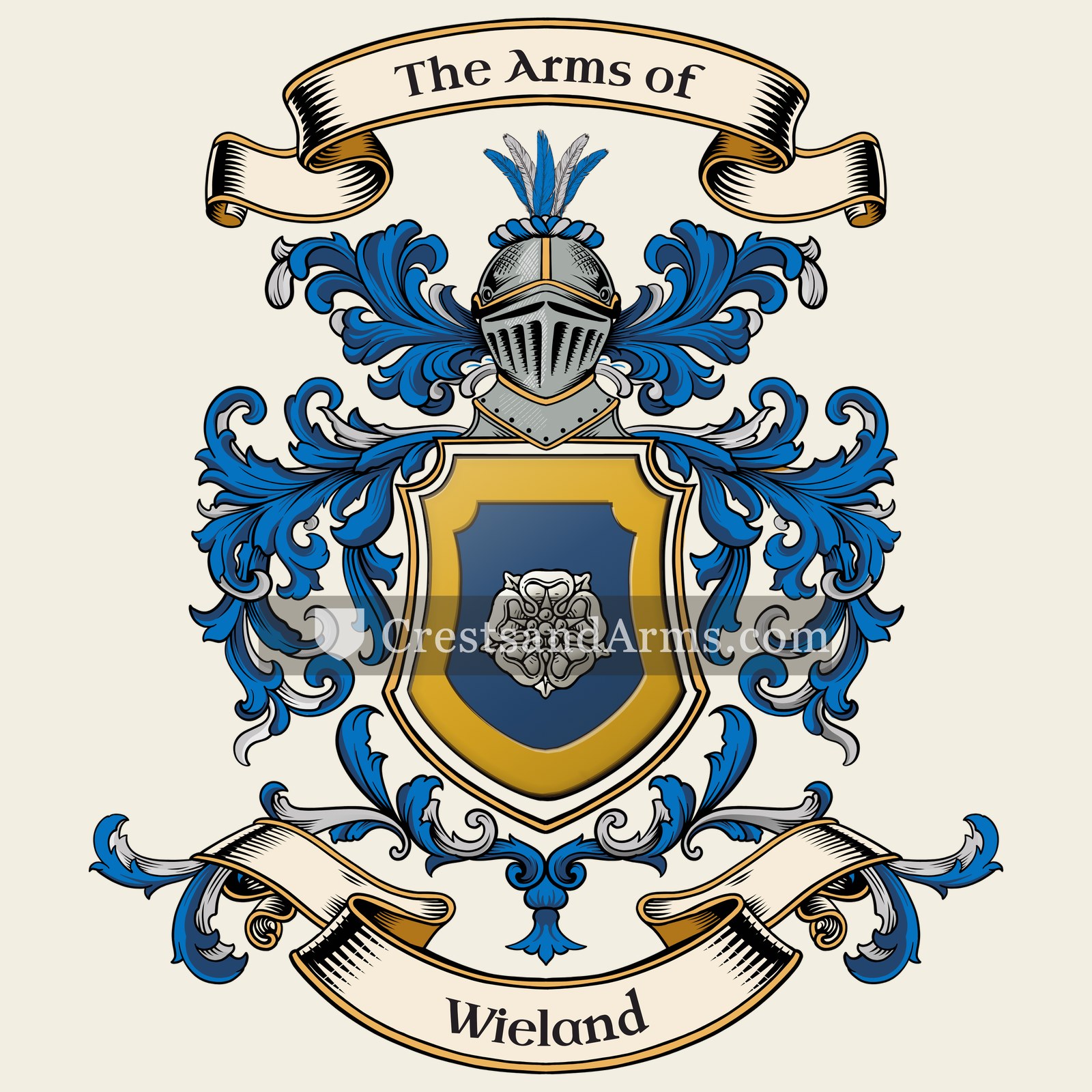
roseThe seventh son, and beauty with grace
Colours
Blue (Azure)Means: Loyalty and truth
Gold (Or)Means: Generosity
Historical info
Source
J. B. Rietstap, Armorial Général, Gouda: G. B. van Goor Zonen, 1884–87
Blazon (the actual original written record)
“D'azur à une rose héraldique de la couleur d'une rose naturelle, barbée de sin.; à la bord. d'or. Cq. cour. C.: la rose, entre deux prob. d'azur. L.: à dextre d'or et de gu., à sen. d'or et d'azur.”
SwitzerlandBâle, c. 1745
Digital archive packCoat of arms PNG, gold border print PDF, vector SVG and the certificate of authenticity. Sent to your email in minutes.
Map of Switzerland showing where the Wieland arms are recorded
The Wieland arms were recorded in Bâle, c. 1745.
This is where the arms were entered in the register. Families often moved to other parts of the country, so the same name can turn up in more than one region.
The body that granted and recorded arms in Switzerland in this period.
How Arms Worked in Switzerland
In Switzerland, coats of arms were not restricted to the nobility and were often adopted by common citizens and families. These symbols were passed down through generations to show family identity. When branches of a family grew, they often changed small details of the design to distinguish their own line from the original group.
Granting authority
Cantonal and civic authorities managed the use of coats of arms within their specific regions and local jurisdictions.
How they got arms
Families typically assumed their own coats of arms based on local custom rather than receiving them from a central monarch.
Where arms were recorded
Arms were recorded in various cantonal and civic registers starting from the fourteenth century throughout the Swiss region.
The family's standing
Recorded among the armigerous families of Switzerland.
Origin & History of the Wieland Family in Switzerland
The surname Wieland has deep roots in the German-speaking regions of Europe, originating from the Old High German name Wigland, which combines words meaning "war" and "courageous." By the time the family became established in the city of Basel during the mid-18th century, they had already integrated into the professional and civic life of the Swiss Confederation. In 1745, the Wielands were recognized as established citizens of Basel, a city known for its strong tradition of trade, scholarship, and printing. Members of the family often pursued careers in law, medicine, and the arts, reflecting the high value placed on education within the urban centers of Switzerland at that time. As the family grew, they became deeply connected to the social and political fabric of the region, contributing to the intellectual development of Basel as it transitioned into the modern era.
Related Branches & Arms
Root word
Wigand
Derived from the Germanic elements for war and bold or brave.
This name
WielandA name historically associated with a legendary smith figure, signifying a skilled warrior.
also spelled
Wyland
Wielandt
Wielant
Veeland
Related arms
Wielantvariant spelling
Documented Sources
J. B. Rietstap, Armorial Général, Gouda: G. B. van Goor Zonen, 1884–87
Heintze, Albert. Die deutschen Familiennamen: geschichtlich, geographisch, sprachlich. 1903
Tiroler Landesarchiv, Standesbücher (Tauf-, Trauungs- und Sterbebücher), 1824
Digital archive packCoat of arms PNG, gold border print PDF, vector SVG and the certificate of authenticity. Sent to your email in minutes.


 chevronProtection, and faithful service completed
 ramLeadership and authority
 eagleNobility, strength and a keen mind
 trefoilPerpetuity, and the Trinity
 chevronProtection, and faithful service completed
 ramLeadership and authority
 eagleNobility, strength and a keen mind
 trefoilPerpetuity, and the Trinity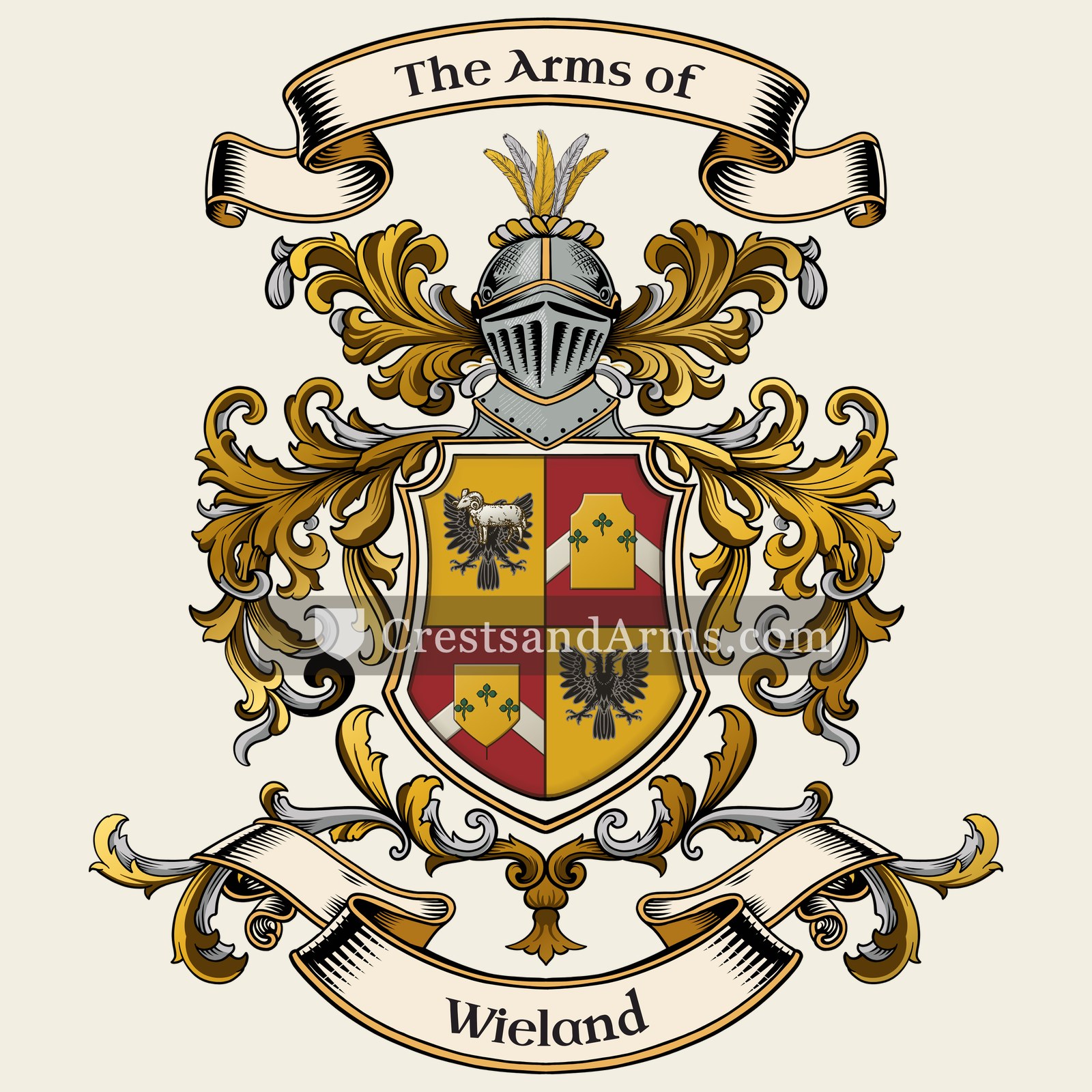


 roseThe seventh son, and beauty with grace