Map of Switzerland showing where the Wiener arms are recorded
The Wiener arms were recorded in Switzerland, c. 1745.
Arms such as these were typically recorded in Bern.
Bern was the largest of the Swiss cantons and ran itself, with its own council and its own courts. Its governing families held office for generations, and office of that kind carried a shield with it.
This is where the arms were entered in the register. Families often moved to other parts of the country, so the same name can turn up in more than one region.
The body that granted and recorded arms in Switzerland in this period.
How Arms Worked in Switzerland
In Switzerland, coats of arms were not restricted to the nobility and were often adopted by common citizens and families. These symbols were passed down through generations to show family identity. When branches of a family grew, they often changed small details of the design to distinguish their own line from the original group.
Granting authority
Cantonal and civic authorities managed the use of coats of arms within their specific regions and local jurisdictions.
How they got arms
Families typically assumed their own coats of arms based on local custom rather than receiving them from a central monarch.
Where arms were recorded
Arms were recorded in various cantonal and civic registers starting from the fourteenth century throughout the Swiss region.
The family's standing
Recorded among the armigerous families of Switzerland.
Origin & History of the Wiener Family in Switzerland
The surname Wiener is rooted in the German language and historically identifies a person who originated from the city of Vienna. By the mid-eighteenth century, members of the Wiener family had established a notable presence in the city of Bern, Switzerland. During this era, Bern functioned as a powerful city-state where families often settled to participate in the growing trade and administrative networks of the Swiss Confederation. Records from 1745 confirm that the family was integrated into the local social fabric, likely navigating the complex citizenship laws that defined life in the Old Swiss Confederacy. As they settled in the region, the family name served as a link to their geographic origins while they adapted to the unique political and cultural environment of the Bernese canton. Their presence in the city suggests they were part of the steady movement of people across German-speaking lands during the Enlightenment period.
Coat of Arms & Family Crest Details
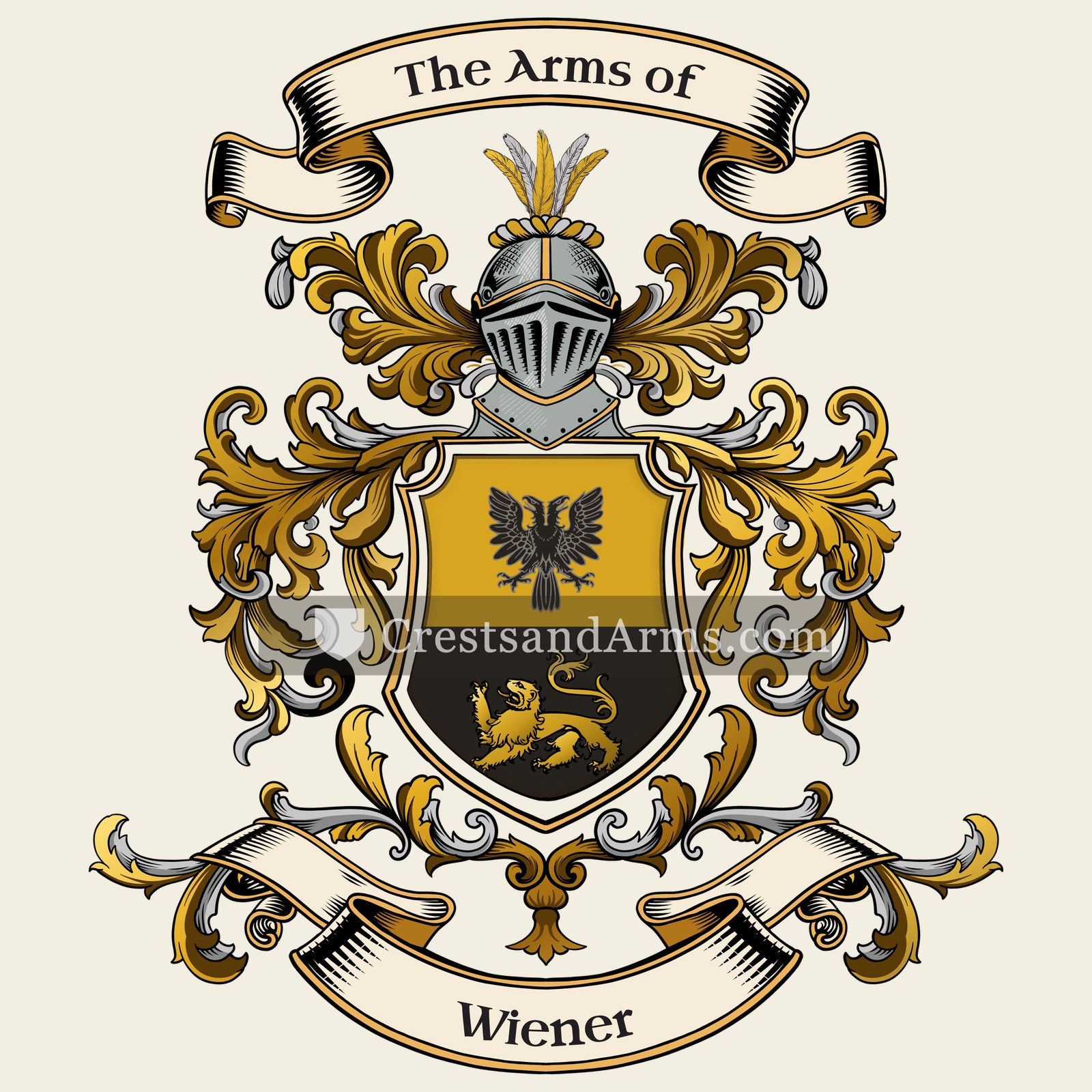
Symbols on this shield
eagleNobility, strength and a keen mind
lionCourage, strength and royalty
Colours
Gold (Or)Means: Generosity
Black (Sable)Means: Constancy
Historical info
Source
J. B. Rietstap, Armorial Général, Gouda: G. B. van Goor Zonen, 1884–87
Blazon (the actual original written record)
“Coupé: au 1 d'or à l'aigle ép. naiss. de sa., mouv. du coupé; au 2 de sa. au lion léopardé d'or. C.: un lion iss. d'or.”
AustriaVienne, c. 1772
Digital archive packCoat of arms PNG, gold border print PDF, vector SVG and the certificate of authenticity. Sent to your email in minutes.
Map of Austria showing where the Wiener arms are recorded
The Wiener arms were recorded in Vienne, c. 1772.
This is where the arms were entered in the register. Families often moved to other parts of the country, so the same name can turn up in more than one region.
Region
Vienne
Town
Vienne
First recorded
1772
Granting Authority for the Wiener Arms
Imperial and Royal chancery
Sodacan · CC BY-SA 3.0
The body that granted and recorded arms in Austria in this period.
Joseph II, Holy Roman Emperor
Sovereign of the period
Joseph II, Holy Roman Emperor
1765–1790
Reigning in Switzerland when the Wiener arms are first recorded.
How Arms Worked in Austria
Austrian coats of arms were often linked directly to noble titles granted by the Emperor. These symbols belonged to the entire family line rather than just one individual. When a family grew, new branches kept the original design without needing to change it. This system allowed all members of a noble house to share the same identity across many generations.
Granting authority
The Imperial and Royal chancery managed all heraldic matters and controlled the official granting of arms throughout the Austrian lands.
How they got arms
Families typically received their arms through a formal imperial decree that often accompanied the elevation of a person to noble status.
Where arms were recorded
Official records of these grants were kept in the Imperial Register of Nobility which began its formal documentation process in 1453.
The family's standing
Recorded among the armigerous families of Austria.
Origin & History of the Wiener Family in Austria
The surname Wiener is a classic example of a topographic name, which was historically given to individuals based on the place where they lived. In the context of Austria, the name identifies a person who originated from or resided in the city of Vienna, known in German as Wien. By the year 1772, records confirm that families bearing this name were already established within the capital, likely as part of the growing urban middle class during the reign of Empress Maria Theresa. At this time, the city was a bustling center of trade and administration, and families with the name Wiener were often integrated into the local economy as merchants, artisans, or civil servants. Because the name simply pointed to one’s connection to the city, it became a common way to distinguish families who had moved from the provinces into the capital or who had lived in the city for generations. This history reflects the broader movement of people toward Vienna as it evolved into the cultural and political heart of the Habsburg Empire.
Related Branches & Arms
Root word
Wien
A Germanic term referring to a meadow or a settlement.
This name
WienerAn occupational or habitational name for someone originating from the city of Vienna.
also spelled
Wyner
Wienner
Veener
Weiner
Related arms
Buchensteinsimilar arms
Wiennervariant spelling
Documented Sources
J. B. Rietstap, Armorial Général, Gouda: G. B. van Goor Zonen, 1884–87
Familiennamenbuch der Schweiz, Familiennamenbuch der Schweiz, 1989
Dubler, Anne-Marie, Stadt und Land in der Schweiz des 18. Jahrhunderts, 1999
Staatsarchiv des Kantons Bern, Bürgerrodel der Stadt Bern
Digital archive packCoat of arms PNG, gold border print PDF, vector SVG and the certificate of authenticity. Sent to your email in minutes.


 hunting horn stringedOne who delights in the chase
 hunting horn stringedOne who delights in the chase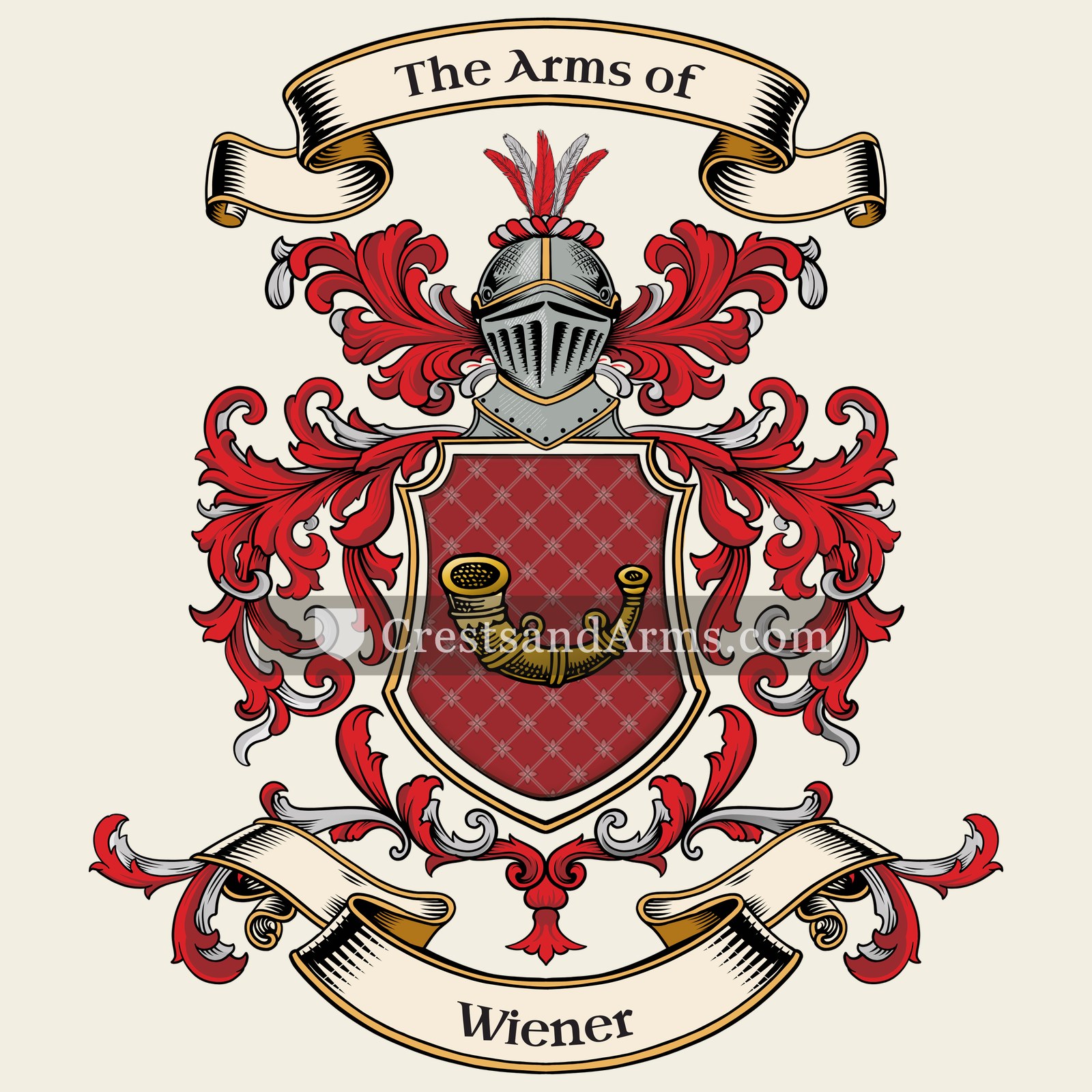

 eagleNobility, strength and a keen mind
 lionCourage, strength and royalty