Map of Germany showing where the Wild arms are recorded
The Wild arms were recorded in Franconia, c. 1765.
Franconia was a patchwork of small territories in central Germany, full of minor landowners and prosperous market towns. So many separate households held land there that the region produced a great many coats of arms.
This is where the arms were entered in the register. Families often moved to other parts of the country, so the same name can turn up in more than one region.
The body that granted and recorded arms in Germany in this period.
Francis I, Holy Roman Emperor
Sovereign of the period
Francis I, Holy Roman Emperor
1745–1765
Reigning in Germany when the Wild arms are first recorded.
How Arms Worked in Germany
In the Holy Roman Empire, coats of arms were often granted to individuals by the Emperor or his representatives. These arms were then passed down through the generations to all legitimate descendants of the original holder. Younger branches of a family usually kept the same shield design without needing to change it, as the arms belonged to the entire lineage.
Granting authority
The Holy Roman Emperor held the sole power to grant new coats of arms throughout his vast imperial territories.
How they got arms
Families typically obtained their coats of arms through a formal imperial grant or by proving their noble status to the authorities.
Where arms were recorded
These grants were officially recorded in the Imperial Chancery registers, which began keeping formal records of such honors during the Middle Ages.
The family's standing
Recorded among the armigerous families of Franconia.
Origin & History of the Wild Family in Germany
The surname Wild originated as a descriptive nickname in the German-speaking regions of Europe during the Middle Ages. In the German language, the word *wild* refers to untamed nature, forests, or the wilderness. It was likely first given to individuals who lived in remote woodland areas or to those known for having a fierce and spirited personality. By the time members of the family were documented in the Franconia region in 1765, the name had become a stable hereditary surname passed down through generations. During this period, Franconia was a diverse territory within the Holy Roman Empire, and families with this name were often involved in agriculture or forestry. These early ancestors were part of a long tradition of rural life where a person’s name often reflected their deep connection to the local landscape and their specific environment.
Meaning of the Wild family crest colors & symbols
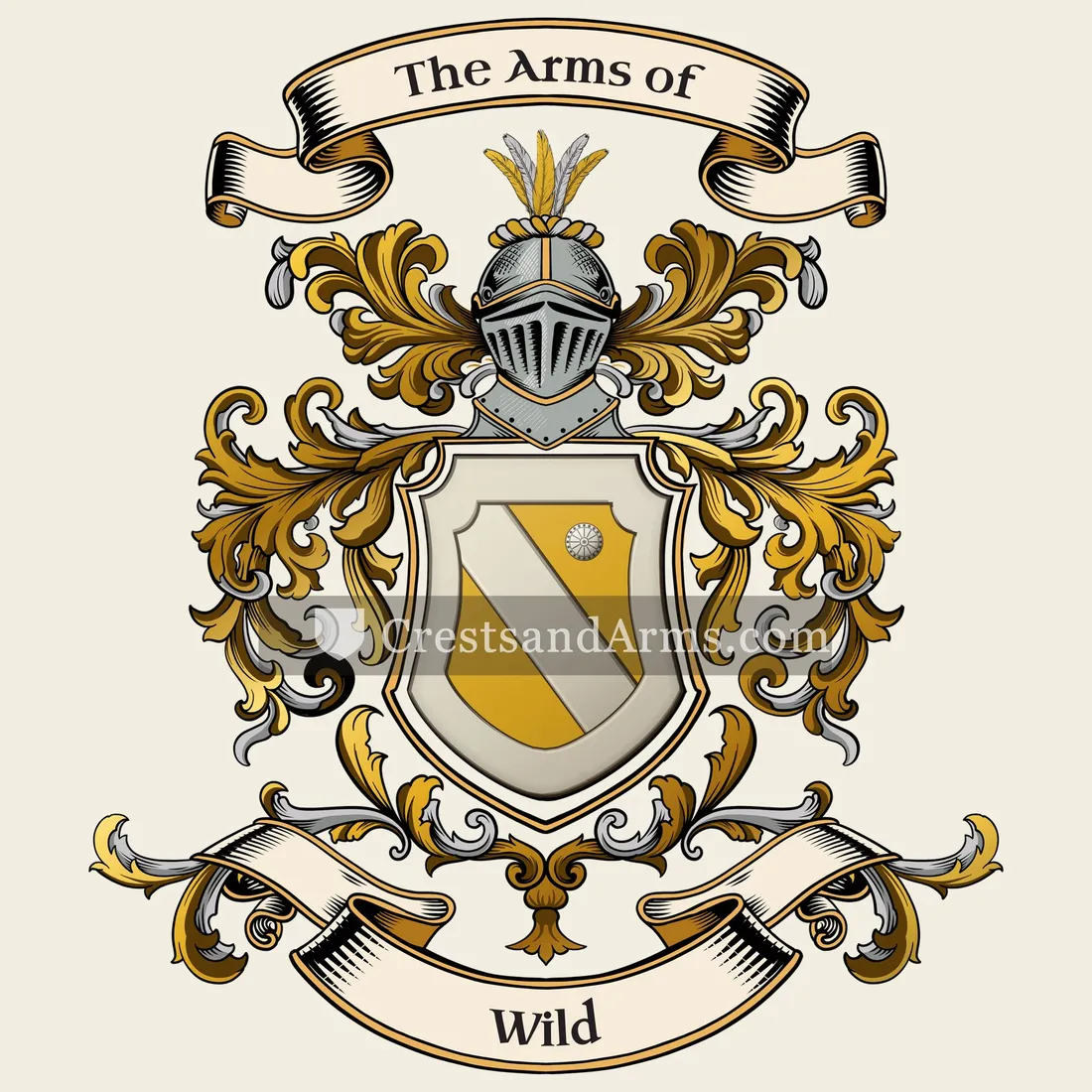
Symbols on this shield
bendDefence, and the scarf of a commander
roundelA coin, and one who has been to the crusades
Colours
Gold (Or)Means: Generosity
Silver (Argent)Means: Peace and sincerity
Historical info
Source
J. B. Rietstap, Armorial Général, Gouda: G. B. van Goor Zonen, 1884–87
Blazon (the actual original written record)
“D'or à la bande d'arg., acc. en chef d'une boule du même; à la bord. aussi d'arg. C.: un buste d'homme barbu, hab. aux armes de l'écu (moins la bord.), cour. de feuillage de sin. L. d'arg. et d'or.”
SwitzerlandBâle, c. 1745
Digital archive packCoat of arms PNG, gold border print PDF, vector SVG and the certificate of authenticity. Sent to your email in minutes.
Map of Switzerland showing where the Wild arms are recorded
The Wild arms were recorded in Bâle, c. 1745.
This is where the arms were entered in the register. Families often moved to other parts of the country, so the same name can turn up in more than one region.
The body that granted and recorded arms in Switzerland in this period.
How Arms Worked in Switzerland
In Switzerland, coats of arms were not restricted to the nobility and were often adopted by common citizens and families. These symbols were passed down through generations to show family identity. When branches of a family grew, they often changed small details of the design to distinguish their own line from the original group.
Granting authority
Cantonal and civic authorities managed the use of coats of arms within their specific regions and local jurisdictions.
How they got arms
Families typically assumed their own coats of arms based on local custom rather than receiving them from a central monarch.
Where arms were recorded
Arms were recorded in various cantonal and civic registers starting from the fourteenth century throughout the Swiss region.
The family's standing
Recorded among the armigerous families of Switzerland.
Origin & History of the Wild Family in Switzerland
The surname Wild is deeply rooted in the Germanic linguistic traditions of Switzerland, where it functioned as a descriptive nickname for individuals perceived as untamed, fierce, or living in close proximity to the wilderness. By the mid-eighteenth century, the family had established a notable presence in the city of Basel, a major center for trade and scholarship along the Rhine River. In 1745, records indicate that members of the Wild family were active participants in the urban life of Basel, likely contributing to the city's thriving guild system or its growing textile and banking industries. During this era, the family name reflected a transition from rural origins to the structured environment of a Swiss city-state. Their presence in Basel suggests they were part of a mobile population that moved between the Swiss cantons and neighboring regions to pursue economic opportunities. This history illustrates how a simple descriptive name evolved into a stable family identity within the complex social hierarchy of eighteenth-century Switzerland.
Meaning of the Wild family crest colors & symbols
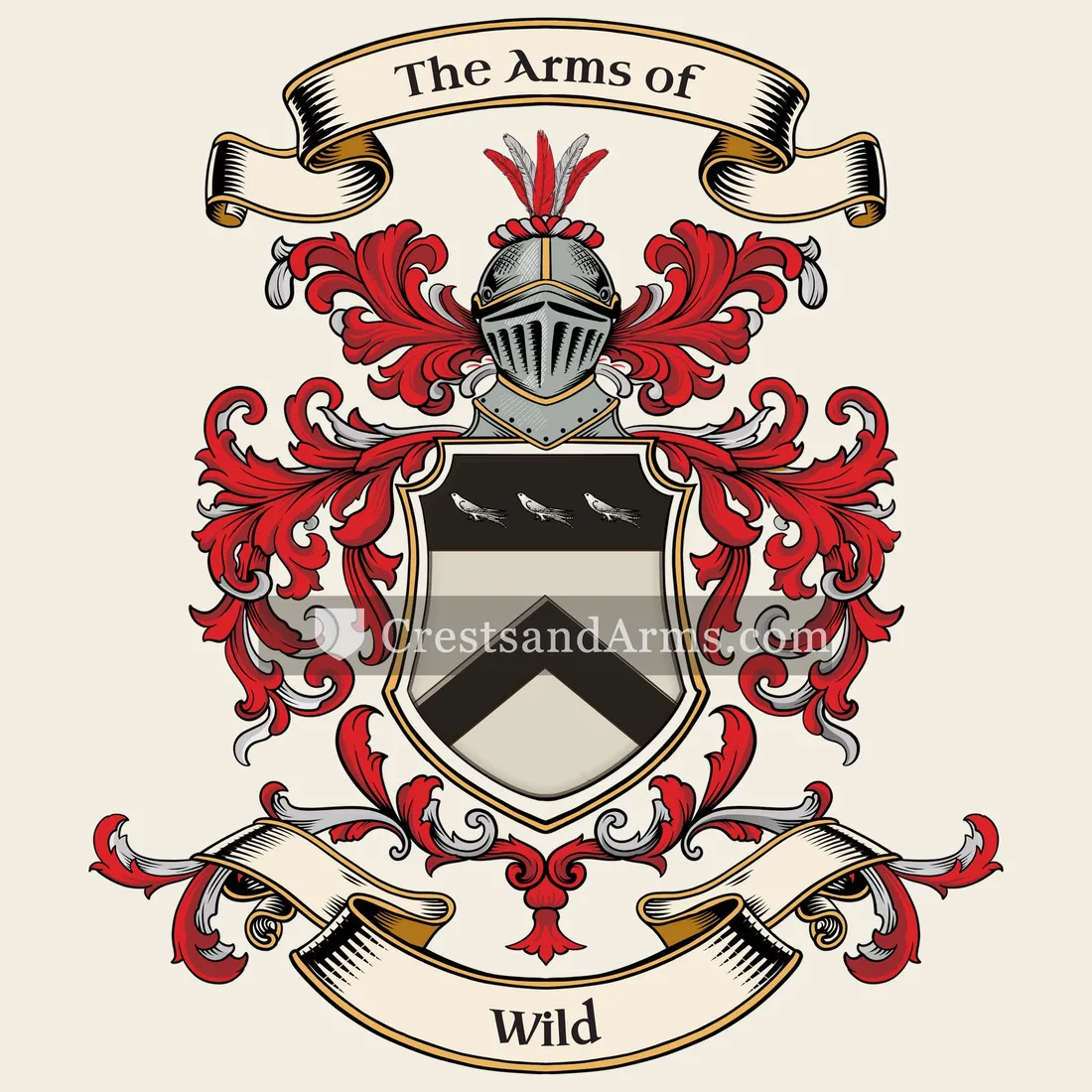
Symbols on this shield
chevronProtection, and faithful service completed
chiefAuthority, wisdom and dominion
martletA younger son, who must win his own land
Colours
Silver (Argent)Means: Peace and sincerity
Black (Sable)Means: Constancy
Historical info
Source
Sir Bernard Burke, The General Armory of England, Scotland, Ireland and Wales, London: Harrison & Sons, 1884
Blazon (the actual original written record)
“Ar. a chev. sa. on a chief of the second three martlets of the first”
KentCanterbury · Kent, c. 1583
Digital archive packCoat of arms PNG, gold border print PDF, vector SVG and the certificate of authenticity. Sent to your email in minutes.
Map of England showing where the Wild arms are recorded
The Wild arms were recorded in Kent, c. 1583.
Kent sits between London and the short crossing to Europe, and the trade passing through made it wealthy. Merchant families bought land with that money, and it was landowners who took coats of arms.
This is where the arms were entered in the register. Families often moved to other parts of the country, so the same name can turn up in more than one region.
The body that granted and recorded arms in England in this period.
Elizabeth I of England
Sovereign of the period
Elizabeth I of England
1558–1603
Reigning in Germany when the Wild arms are first recorded.
How Arms Worked in England
English heraldry allowed arms to be shared by all legitimate descendants of the original owner. These symbols were treated as personal property that moved through the generations to all children. While the eldest son kept the original design, other family members could use the same shield without needing to change it or register their own unique versions.
Granting authority
The College of Arms in London has regulated the use of coats of arms throughout England and Wales since 1484.
How they got arms
Families typically obtained their coats of arms through a formal grant from the Crown or by proving their ancient right to them.
Where arms were recorded
All official coats of arms are recorded in the registers kept at the College of Arms, which date back to the fifteenth century.
The family's standing
Recorded among the armigerous families of Kent.
Origin & History of the Wild Family in England
The surname Wild is rooted in the Old English word *wilde*, which was historically used to describe someone who lived in an untamed or uncultivated area. In the context of medieval England, this name often served as a topographic descriptor for individuals residing near wild forests or desolate heaths. By the late 16th century, the family had established a notable presence in the county of Kent. Records from 1583 confirm that members of the Wild family were active in this region, likely working as farmers or tradespeople who were deeply connected to the local landscape. As the family grew, they became part of the social fabric of southeastern England, passing the name down through generations as a reflection of their ancestral ties to the rugged countryside.
Wild Meaning & Related Branches
Root word
wild
Old High German term for untamed, uncultivated, or savage.
This name
WildA descriptive nickname for a person who lived in the wilderness or possessed a fierce, untamed personality.
also spelled
Wyld
Vild
Wylde
Related arms
Wyldesame arms
Ehrensteinsimilar arms
Kolbesimilar arms
Wyldvariant spelling
Documented Sources
J. B. Rietstap, Armorial Général, Gouda: G. B. van Goor Zonen, 1884–87
Bahlow, Hans. Deutsches Namenlexikon: Familien- und Vornamen nach Ursprung und Sinn erklärt. 1967
Heintze, Albert. Die deutschen Familiennamen, geschichtlich, geographisch, sprachlich. 1903
Staatsarchiv Bamberg. Standesamtliche Unterlagen und Kirchenbücher der Region Franken. 1765
Digital archive packCoat of arms PNG, gold border print PDF, vector SVG and the certificate of authenticity. Sent to your email in minutes.


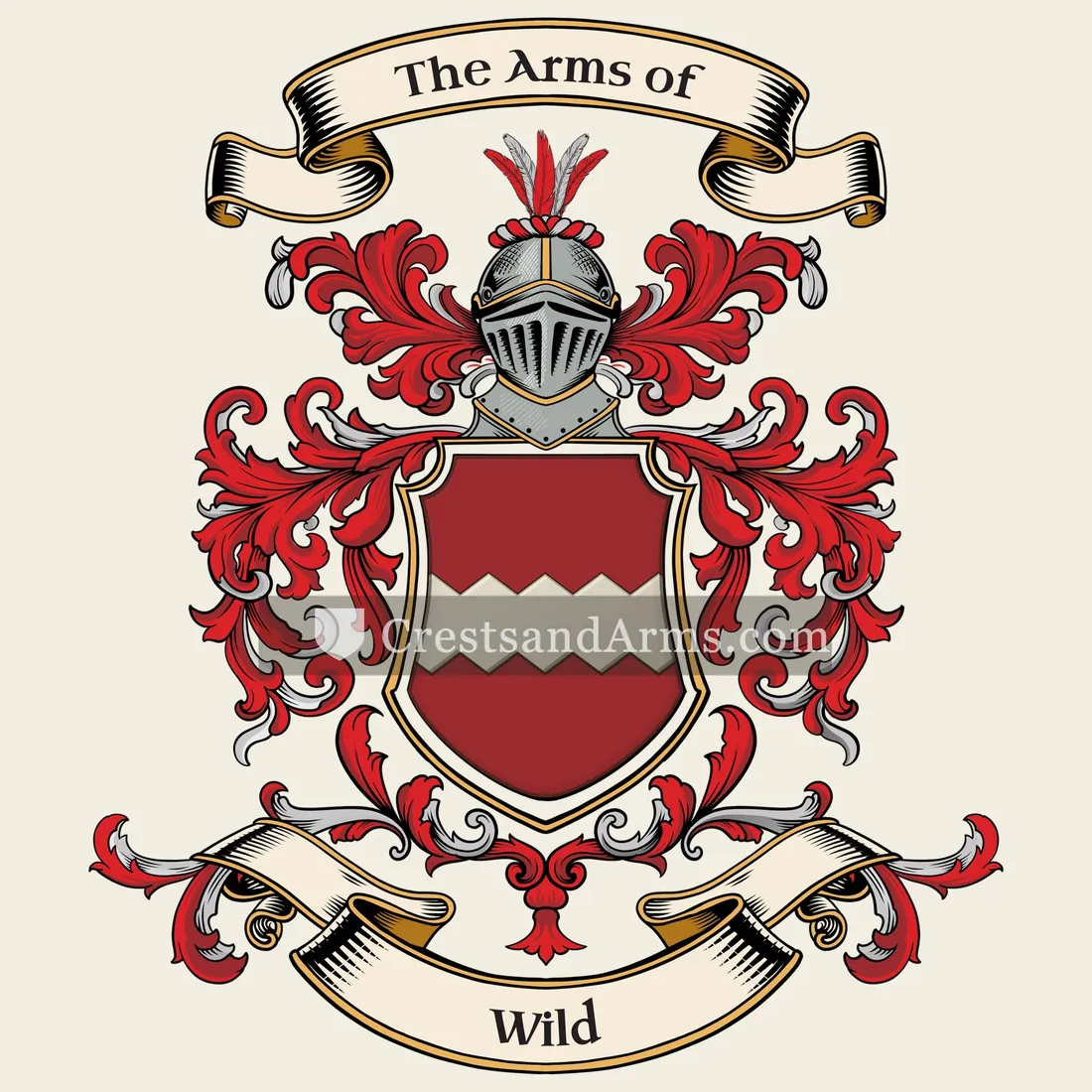
 fessThe military belt, and readiness to serve
 fessThe military belt, and readiness to serve


 bendDefence, and the scarf of a commander
 roundelA coin, and one who has been to the crusades

 chevronProtection, and faithful service completed
 chiefAuthority, wisdom and dominion
 martletA younger son, who must win his own land