A record of documented arms, meaning and origin, researched for the Wilk family lines. Documented in 2 countries.
Reg. 9380 · Polish, W–Z
Coat of Arms & Family Crest Details
Symbols on this shield
cantonA mark of honour granted by the sovereign
wolfReward from long service and hard work
roseThe seventh son, and beauty with grace
Colours
Blue (Azure)Means: Loyalty and truth
Red (Gules)Means: Military strength
Historical info
Source
J. B. Rietstap, Armorial Général, Gouda: G. B. van Goor Zonen, 1884–87
Blazon (the actual original written record)
“D'azur à un loup naiss. au nat., mouv. d'une couronne d'or, tenant entre ses pattes une croix pattée du même, acc. d'une rose de gu. au canton dextre du chef. Cq. cour. C.: le loup iss., tenant de ses pattes la croix et de ses dents la rose.”
Polandc. 1772
Digital archive packCoat of arms PNG, gold border print PDF, vector SVG and the certificate of authenticity. Sent to your email in minutes.
Map of Poland showing where the Wilk arms are recorded
The Wilk arms were recorded in Poland, c. 1772.
Arms such as these were typically recorded in Mazovia.
Mazovia held Warsaw, the Polish court and the assemblies where the szlachta met. Poland's nobles were unusually numerous and every one of them bore arms, and Warsaw is where those arms were argued over and recorded.
This is where the arms were entered in the register. Families often moved to other parts of the country, so the same name can turn up in more than one region.
Region
Mazovia
First recorded
1772
Granting Authority for the Wilk Arms
Ennoblement by the Sejm
Author: Olek Remesz · CC BY-SA 3.0
The body that granted and recorded arms in Poland in this period.
Stanisław August Poniatowski
Sovereign of the period
Stanisław August Poniatowski
1764–1795
Reigning in Poland when the Wilk arms are first recorded.
How Arms Worked in Poland
Polish noble families shared a single coat of arms across many different surnames, creating large clans rather than individual designs. These symbols were held collectively by all members of the clan regardless of their specific family name. When a new family joined the nobility, they were adopted into an existing clan and began using that group's established shield.
Granting authority
The Sejm, which was the Polish parliament, held the power to grant noble status and the right to bear arms.
How they got arms
Families typically received their coat of arms through a formal act of ennoblement granted by the Sejm for distinguished service.
Where arms were recorded
These grants were officially recorded in the Crown Metrica, which served as the central archive for state documents starting in the sixteenth century.
The family's standing
Recorded among the armigerous families of Poland.
Origin & History of the Wilk Family in Poland
The surname Wilk is a classic example of a name derived from a nickname, as the word translates directly to "wolf" in Polish. In the context of the Mazovia region, where the family was established by at least 1772, the name likely originated from a descriptive trait or a symbolic association with the animal that was common in the local folklore and dense forests of the area. During the eighteenth century, Mazovia was a central hub for the Polish nobility and landowning peasants, and families like the Wilks were often tied to the agricultural rhythms of the Vistula River basin. Because the name is based on a common animal, it was frequently adopted by families across different social classes, reflecting a deep connection to the wild landscape of central Poland. By the time records place the family in the region during the late 1700s, the name had already become a stable identifier that linked the family to the specific cultural and linguistic traditions of the Mazovian people.
Coat of Arms & Family Crest Details
Symbols on this shield
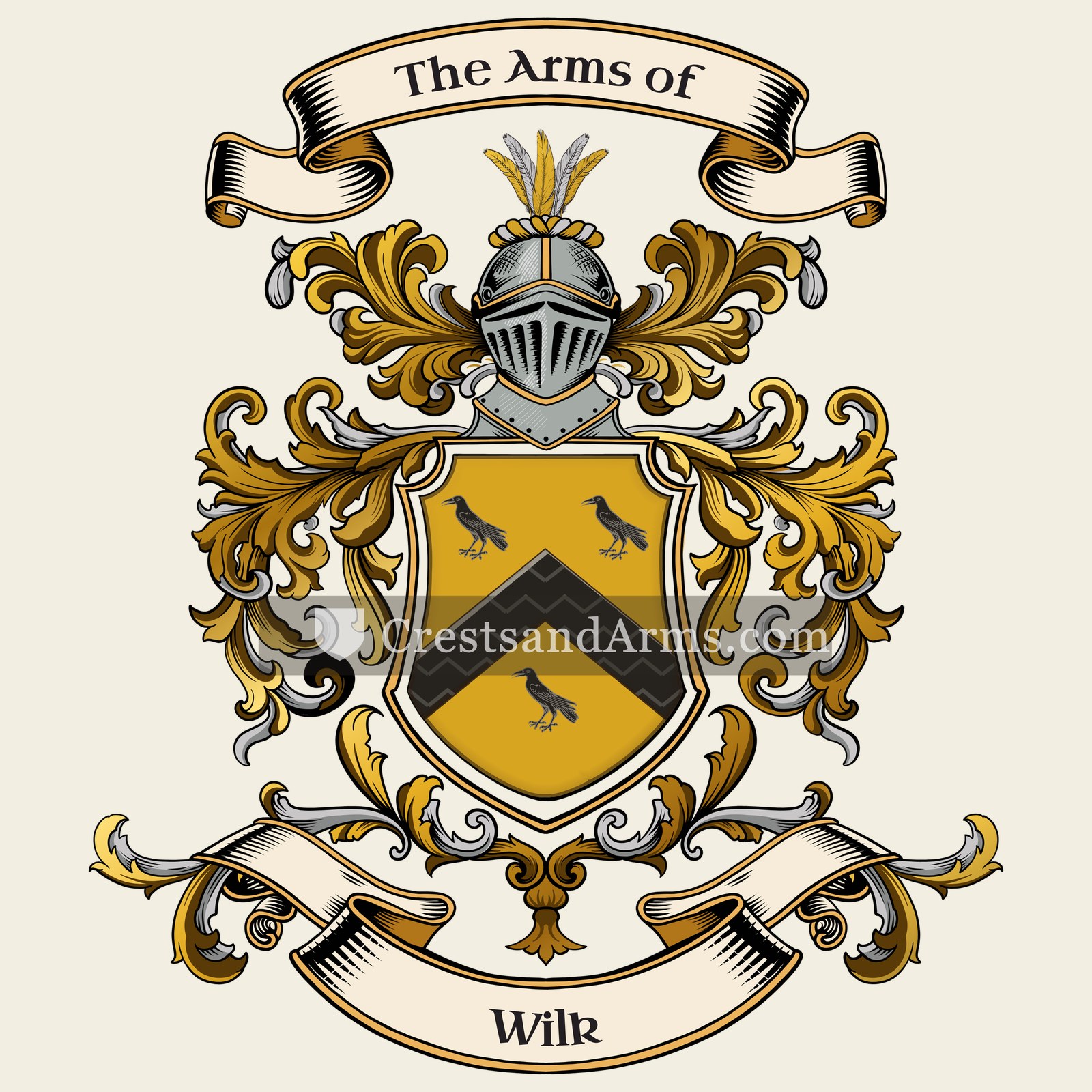
chevronProtection, and faithful service completed
ravenConstancy and divine providence
Colours
Gold (Or)Means: Generosity
Black (Sable)Means: Constancy
Historical info
Source
Sir Bernard Burke, The General Armory of England, Scotland, Ireland and Wales, London: Harrison & Sons, 1884
Blazon (the actual original written record)
“Or, a chev. betw. three ravens' heads erased sa”
Englandc. 1620
Digital archive packCoat of arms PNG, gold border print PDF, vector SVG and the certificate of authenticity. Sent to your email in minutes.
Map of England showing where the Wilk arms are recorded
The Wilk arms were recorded in England, c. 1620.
Arms such as these were typically recorded in York.
Yorkshire is the largest of the English counties, and it held more gentry families than any other. Land there was split among a great many households rather than a few, so a great many of them carried arms.
This is where the arms were entered in the register. Families often moved to other parts of the country, so the same name can turn up in more than one region.
The body that granted and recorded arms in England in this period.
James VI and I
Sovereign of the period
James VI and I
1603–1625
Reigning in Poland when the Wilk arms are first recorded.
How Arms Worked in England
English heraldry allowed arms to be shared by all legitimate descendants of the original owner. These symbols were treated as personal property that moved through the generations to all children. While the eldest son kept the original design, other family members could use the same shield without needing to change it or register their own unique versions.
Granting authority
The College of Arms in London has regulated the use of coats of arms throughout England and Wales since 1484.
How they got arms
Families typically obtained their coats of arms through a formal grant from the Crown or by proving their ancient right to them.
Where arms were recorded
All official coats of arms are recorded in the registers kept at the College of Arms, which date back to the fifteenth century.
The family's standing
Recorded among the armigerous families of England.
Origin & History of the Wilk Family in England
The surname Wilk emerged in England as a patronymic name, which means it was originally derived from the given name of a father or ancestor. It is a shortened form of the name William, which became incredibly popular in England following the Norman Conquest. By the early 17th century, the name had established a firm presence in the northern city of York. Records from 1620 confirm that families bearing this name were active members of the local community during this period. Life in York at that time was defined by the city’s role as a major regional hub for trade and administration. Families like the Wilks often lived in close-knit neighborhoods near the city center, where they participated in the local economy and contributed to the social fabric of the historic walled city.
Related Branches & Arms
Root word
wilk
A carnivorous mammal of the dog family.
This name
WilkA topographic or occupational surname referring to a person with wolf-like traits.
also spelled
Wilke
Wilck
Wilckh
Wylk
Documented Sources
J. B. Rietstap, Armorial Général, Gouda: G. B. van Goor Zonen, 1884–87
Brückner, Aleksander, Słownik etymologiczny języka polskiego, 1927
Rymut, Kazimierz, Nazwiska Polaków: Słownik historyczno-etymologiczny, 1999
Archiwum Główne Akt Dawnych w Warszawie, Księgi metrykalne parafii rzymskokatolickich z terenu Mazowsza, 1772
Digital archive packCoat of arms PNG, gold border print PDF, vector SVG and the certificate of authenticity. Sent to your email in minutes.


 cantonA mark of honour granted by the sovereign
 wolfReward from long service and hard work
 roseThe seventh son, and beauty with grace
 cantonA mark of honour granted by the sovereign
 wolfReward from long service and hard work
 roseThe seventh son, and beauty with grace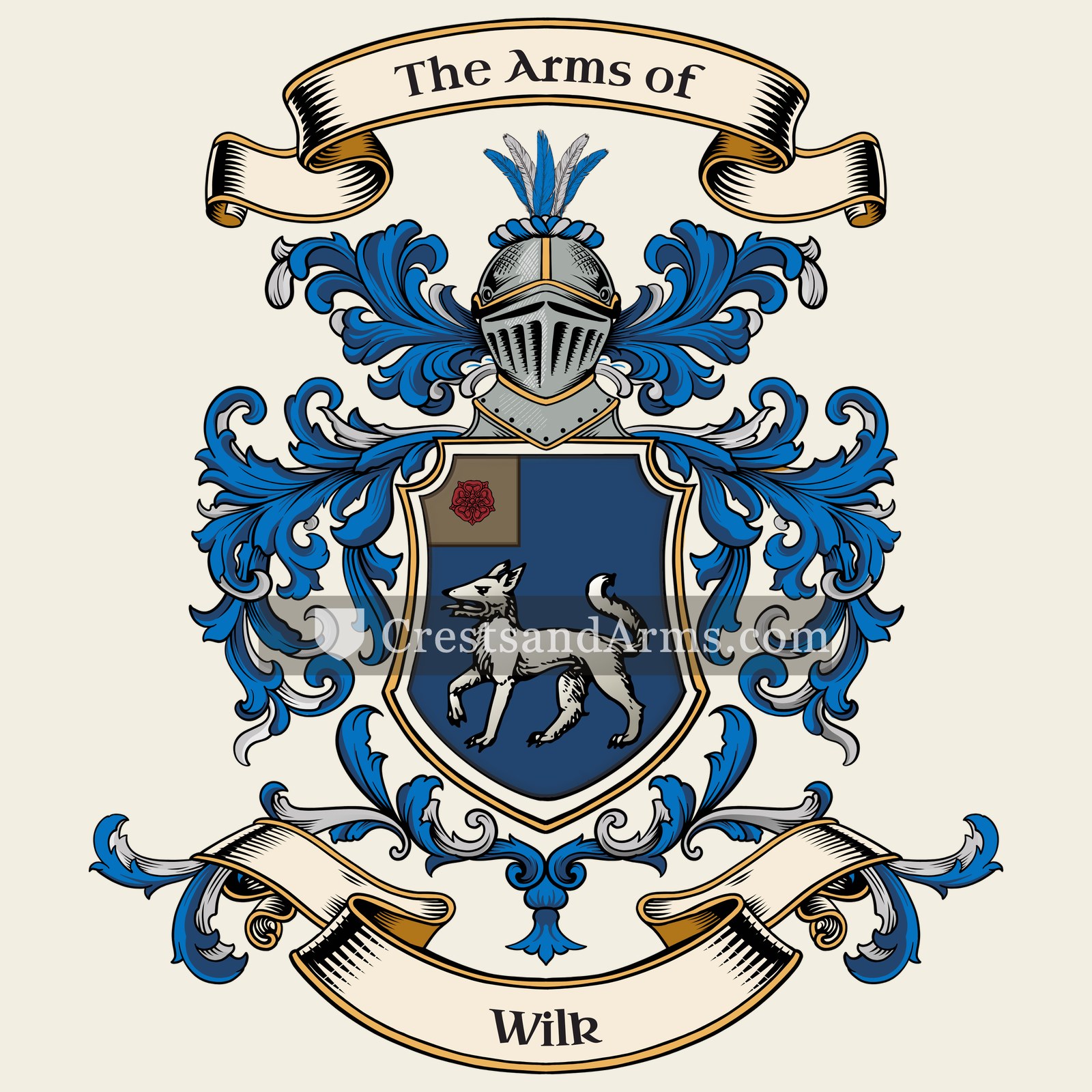


 chevronProtection, and faithful service completed
 ravenConstancy and divine providence