A record of documented arms, meaning and origin, researched for the Willauer family lines. Documented in 2 countries.
Reg. 0804 · Dutch, W–Z
Coat of Arms & Family Crest Details
Symbols on this shield
chevronProtection, and faithful service completed
chiefAuthority, wisdom and dominion
cockCourage, vigilance and readiness for battle
mulletThe third son, and a divine quality from above
Colours
Red (Gules)Means: Military strength
Gold (Or)Means: Generosity
Silver (Argent)Means: Peace and sincerity
Blue (Azure)Means: Loyalty and truth
Black (Sable)Means: Constancy
Historical info
Source
J. B. Rietstap, Armorial Général, Gouda: G. B. van Goor Zonen, 1884–87
Blazon (the actual original written record)
“de gu. sur or; l'or ch. d'un coq de sa.; au chev. d'arg. br. sur la division; et au chef d'azur, ch. de deux étoiles d'or. C.: une étoile d'or, entre un vol d'azur. L. d'or et d'azur.”
Netherlandsc. 1815
Digital archive packCoat of arms PNG, gold border print PDF, vector SVG and the certificate of authenticity. Sent to your email in minutes.
Map of Netherlands showing where the Willauer arms are recorded
The Willauer arms were recorded in Netherlands, c. 1815.
Arms such as these were typically recorded in Friesland.
Friesland was low, wet country on the northern coast of the Netherlands, farmed by families who had held the same land for centuries. Free landholders were unusually common there, and a free landholder could carry arms.
This is where the arms were entered in the register. Families often moved to other parts of the country, so the same name can turn up in more than one region.
Region
Friesland
First recorded
1815
Granting Authority for the Willauer Arms
Hoge Raad van Adel
Photograph made by me · CC BY-SA 3.0
The body that granted and recorded arms in Netherlands in this period.
William I of the Netherlands
Sovereign of the period
William I of the Netherlands
1815–1840
Reigning in Netherlands when the Willauer arms are first recorded.
How Arms Worked in Netherlands
In the Netherlands, coats of arms were often used by noble families and those who held specific public offices. These arms were passed down through the generations to legitimate descendants. Younger branches of a family usually kept the original design without needing to add special marks. This system ensured that the family identity remained clear and consistent over many years.
Granting authority
The Hoge Raad van Adel is the official body that regulates and manages noble titles and coats of arms in the Netherlands.
How they got arms
Families typically obtained their coats of arms through official royal grants or by proving their long-standing historical use of the symbols.
Where arms were recorded
Coats of arms are officially recorded in the registers held by the Hoge Raad van Adel, which began its work in 1814.
The family's standing
Recorded among the armigerous families of Netherlands.
Origin & History of the Willauer Family in Netherlands
The history of the Willauer name in the Netherlands is deeply connected to the northern province of Friesland, where records confirm the family was established by the early nineteenth century. During this period, the Netherlands underwent a significant transition as it moved from the Napoleonic era toward the formation of the United Kingdom of the Netherlands in 1815. Families in Friesland often lived in close-knit agricultural communities where surnames were becoming increasingly formalized for tax and census purposes. The name Willauer likely reflects the linguistic patterns of the region, where Germanic and Frisian naming traditions often blended together. As the family settled into this landscape, they became part of the local social fabric, contributing to the rural economy and the distinct cultural identity that defines the Frisian people. By 1815, the presence of the Willauer name in official records suggests that the family had already integrated into the administrative life of the Dutch state during a time of great national change.
Coat of Arms & Family Crest Details
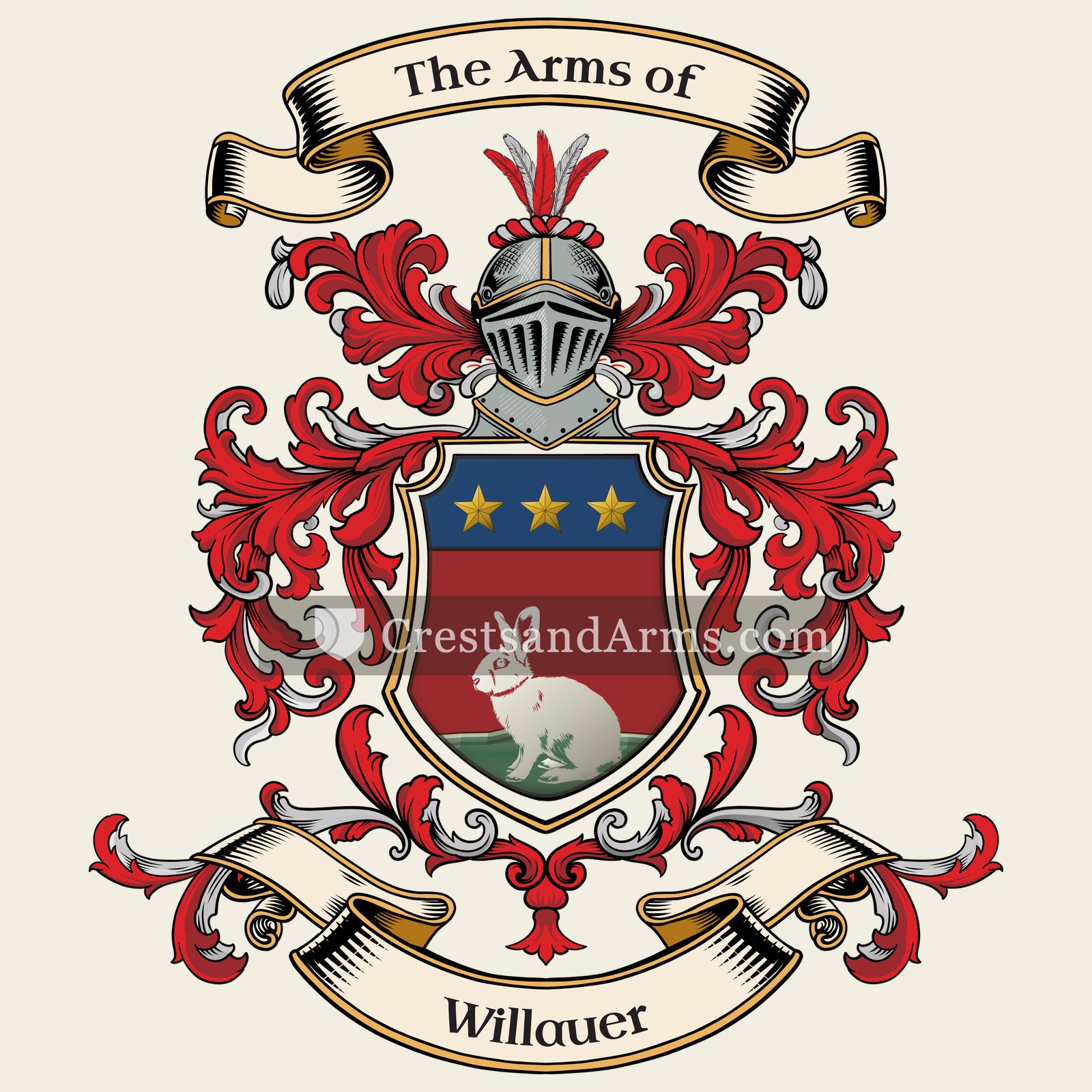
Symbols on this shield
mountThe ground held, and steadfastness upon it
chiefAuthority, wisdom and dominion
rabbitOne who lives peaceably and well
mulletThe third son, and a divine quality from above
Colours
Red (Gules)Means: Military strength
Blue (Azure)Means: Loyalty and truth
Green (Vert)Means: Hope
Silver (Argent)Means: Peace and sincerity
Gold (Or)Means: Generosity
Historical info
Source
J. B. Rietstap, Armorial Général, Gouda: G. B. van Goor Zonen, 1884–87
Blazon (the actual original written record)
“De gu. à un lièvre d'arg., courant sur une colline de sin.; au chef d'azur, ch. de trois étoiles d'or. C.: un Moscovite iss., hab. d'azur à brandebourgs d'or, au rabat de gu., coiffé d'un chapeau pointu d'arg., retr. de gu., tenant de sa main dextre levée un sabre d'arg., garni d'or, et de sa sen. un bouclier d'or. L.: à dextre d'arg. et de gu., à sen. d'or et d'azur [Comp. Reuber et Schmidt.]”
SilesiaSilesia, c. 1537
Digital archive packCoat of arms PNG, gold border print PDF, vector SVG and the certificate of authenticity. Sent to your email in minutes.
Map of Germany showing where the Willauer arms are recorded
The Willauer arms were recorded in Silesia, c. 1537.
Silesia was farming country in the east of the German lands, held in large estates by families who stayed put for generations. Owning land was what entitled a family to arms, so the region fills a good deal of the register.
This is where the arms were entered in the register. Families often moved to other parts of the country, so the same name can turn up in more than one region.
The body that granted and recorded arms in Germany in this period.
Charles V
Sovereign of the period
Charles V
1519–1556
Reigning in Netherlands when the Willauer arms are first recorded.
How Arms Worked in Germany
In the Holy Roman Empire, coats of arms were often granted to individuals by the Emperor or his representatives. These arms were then passed down through the generations to all legitimate descendants of the original holder. Younger branches of a family usually kept the same shield design without needing to change it, as the arms belonged to the entire lineage.
Granting authority
The Holy Roman Emperor held the sole power to grant new coats of arms throughout his vast imperial territories.
How they got arms
Families typically obtained their coats of arms through a formal imperial grant or by proving their noble status to the authorities.
Where arms were recorded
These grants were officially recorded in the Imperial Chancery registers, which began keeping formal records of such honors during the Middle Ages.
The family's standing
Recorded among the armigerous families of Silesia.
Origin & History of the Willauer Family in Germany
The Willauer family name has deep roots in the historical region of Silesia, where records confirm members of the family were established by the year 1537. During this period, Silesia was a vibrant crossroads of culture and trade under the influence of the Holy Roman Empire. The name likely evolved as a locative surname, which was a common practice in medieval Germany to identify individuals by their place of origin or residence. Families with this name were often integrated into the local social fabric, participating in the agricultural and craft-based economies that defined Silesian life in the sixteenth century. As the region experienced shifting political borders and religious changes, the Willauer family remained part of the local population, contributing to the development of the communities where they settled. Their early presence in this area highlights the historical movement of families across Central Europe during the late Renaissance.
Related Branches & Arms
Root word
Willa
Derived from the Germanic element wil meaning will or desire.
This name
WillauerA patronymic surname indicating descent from a person named Willa or Wilhelm.
also spelled
Willerh
Wyller
Willerre
Documented Sources
J. B. Rietstap, Armorial Général, Gouda: G. B. van Goor Zonen, 1884–87
Tresoar (Fries Historisch en Letterkundig Centrum), Burgerlijke Stand van Friesland (1811-1950)
Centraal Bureau voor Genealogie, Nederlandse Familienamenbank
Digital archive packCoat of arms PNG, gold border print PDF, vector SVG and the certificate of authenticity. Sent to your email in minutes.


 chevronProtection, and faithful service completed
 chiefAuthority, wisdom and dominion
 cockCourage, vigilance and readiness for battle
 mulletThe third son, and a divine quality from above
 chevronProtection, and faithful service completed
 chiefAuthority, wisdom and dominion
 cockCourage, vigilance and readiness for battle
 mulletThe third son, and a divine quality from above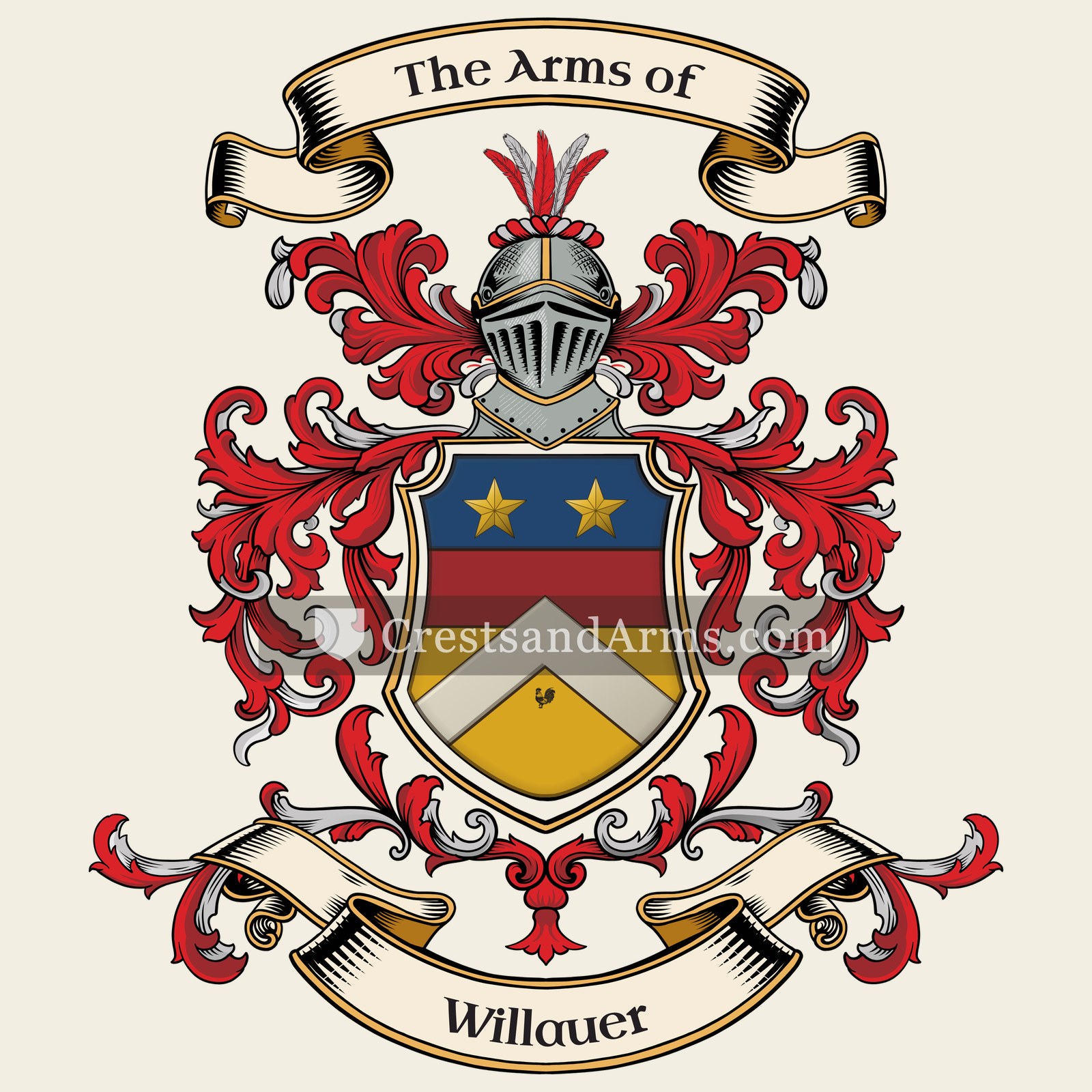


 mountThe ground held, and steadfastness upon it
 rabbitOne who lives peaceably and well