Map of England showing where the Willcox arms are recorded
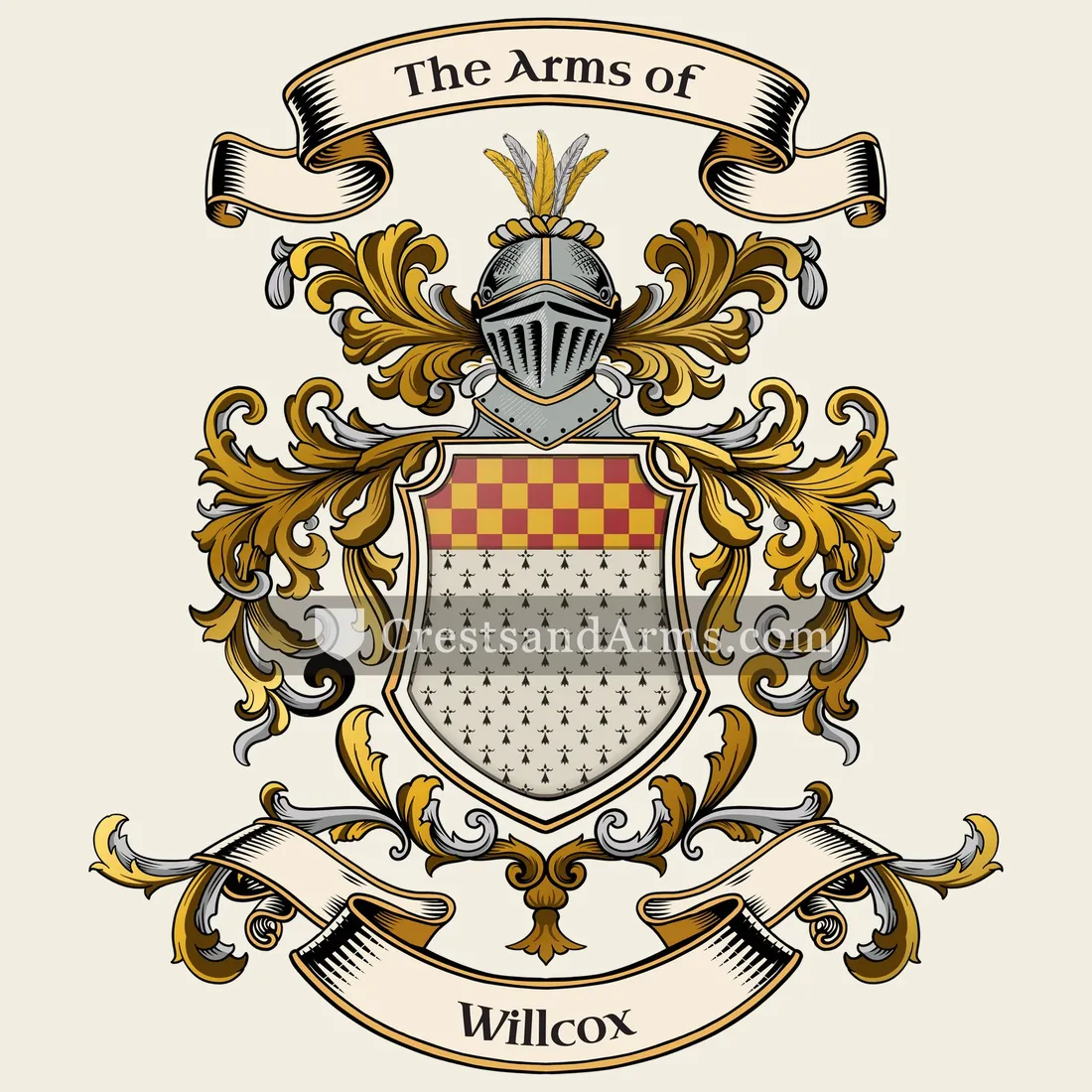
The Willcox arms were recorded in England, c. 1620.
Arms such as these were typically recorded in York.
Yorkshire is the largest of the English counties, and it held more gentry families than any other. Land there was split among a great many households rather than a few, so a great many of them carried arms.
This is where the arms were entered in the register. Families often moved to other parts of the country, so the same name can turn up in more than one region.
The body that granted and recorded arms in England in this period.
James VI and I
Sovereign of the period
James VI and I
1603–1625
Reigning in England when the Willcox arms are first recorded.
How Arms Worked in England
English heraldry allowed arms to be shared by all legitimate descendants of the original owner. These symbols were treated as personal property that moved through the generations to all children. While the eldest son kept the original design, other family members could use the same shield without needing to change it or register their own unique versions.
Granting authority
The College of Arms in London has regulated the use of coats of arms throughout England and Wales since 1484.
How they got arms
Families typically obtained their coats of arms through a formal grant from the Crown or by proving their ancient right to them.
Where arms were recorded
All official coats of arms are recorded in the registers kept at the College of Arms, which date back to the fifteenth century.
The family's standing
Recorded among the armigerous families of England.
Origin & History of the Willcox Family in England
The surname Willcox originates from the medieval period in England as a patronymic name, meaning it was derived from the given name of a father or ancestor. It is a diminutive form of William, specifically evolving from the nickname Wilkin or Will, combined with the suffix "cock," which was a common term used to denote a young or small person. By the time members of the family were documented in York in 1620, the name had already been established for several generations across various English counties. Families bearing this name were often involved in trade, agriculture, or local administration, reflecting the typical social standing of middle-class citizens in the seventeenth century. As these individuals settled in northern urban centers like York, they contributed to the growing professional and merchant classes that defined the city during that era.
Willcox Meaning & Related Branches
Root word
Wilhelm
Derived from Germanic elements meaning resolute protector or strong-willed helmet.
This name
WillcoxA patronymic surname meaning son of Will, a diminutive form of William.
also spelled
Wilcocks
Documented Sources
Sir Bernard Burke, The General Armory of England, Scotland, Ireland and Wales, London: Harrison & Sons, 1884
Bardsley, Charles Wareing, A Dictionary of English and Welsh Surnames, 1901
Reaney, Percy Hide, A Dictionary of British Surnames, 1958
Borthwick Institute for Archives, York Diocesan Probate Records, 1620
Digital archive packCoat of arms PNG, gold border print PDF, vector SVG and the certificate of authenticity. Sent to your email in minutes.


 chiefAuthority, wisdom and dominion
 chequyConstancy, and the counting-board
 chiefAuthority, wisdom and dominion
 chequyConstancy, and the counting-board