A record of documented arms, meaning and origin, researched for the Williams family lines. Documented in 3 countries.
Reg. 9725 · Welsh, W–Z
Meaning of the Williams family crest colors & symbols
Symbols on this shield
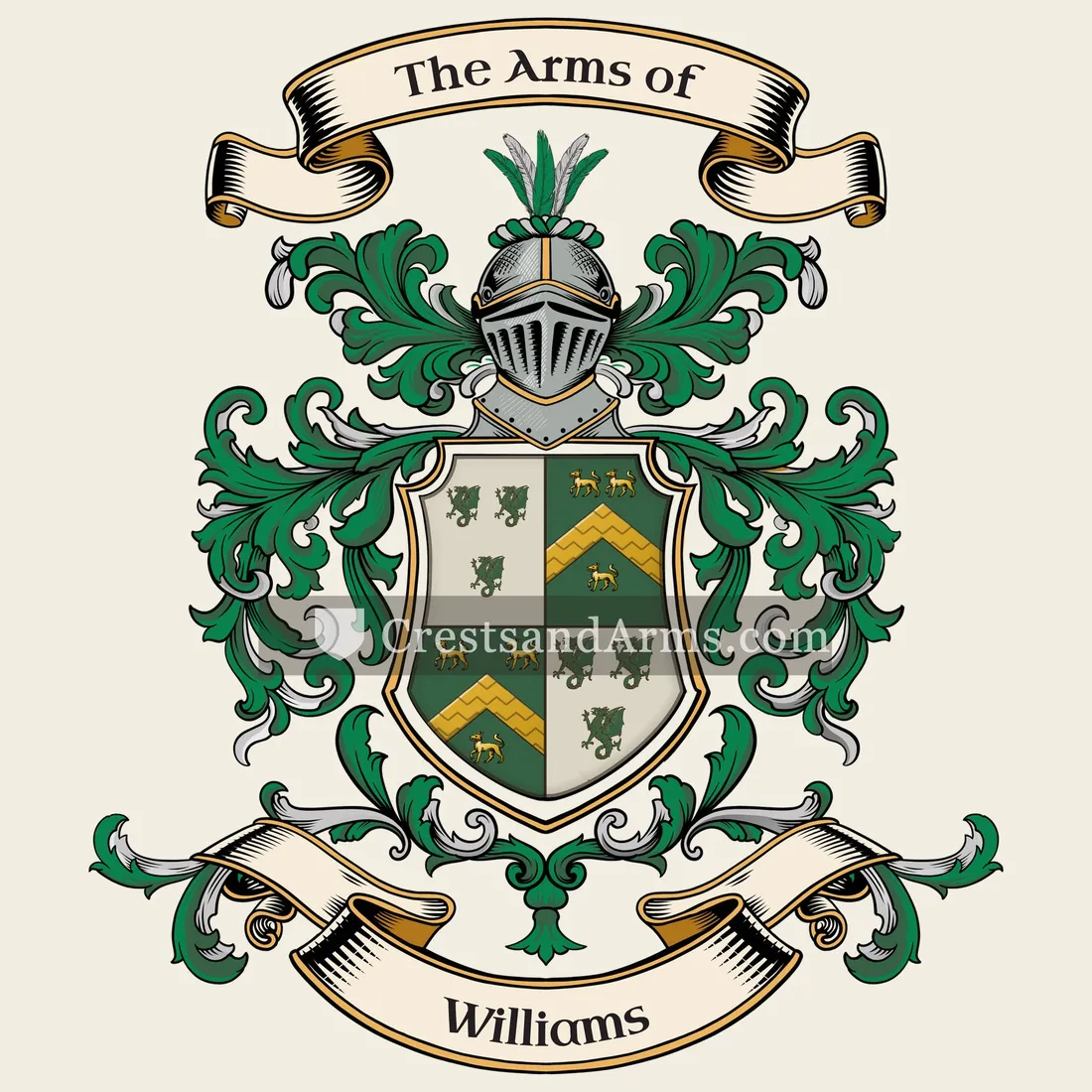
chevronProtection, and faithful service completed
wyvernValour and protection, and victory over the plague
wolfReward from long service and hard work
Colours
Silver (Argent)Means: Peace and sincerity
Green (Vert)Means: Hope
Gold (Or)Means: Generosity
Historical info
Source
Sir Bernard Burke, The General Armory of England, Scotland, Ireland and Wales, London: Harrison & Sons, 1884
Blazon (the actual original written record)
“Quarterly, 1st and 4th, ar. three wyverns' heads vert, holding in their mouths a hand couped at the wrist ppr.; 2nd and 3rd, vert a chev. betw. three wolves' heads erased or”
MonmouthPenrose · Monmouth, c. 1595
Digital archive packCoat of arms PNG, gold border print PDF, vector SVG and the certificate of authenticity. Sent to your email in minutes.
Map of Wales showing where the Williams arms are recorded
The Williams arms were recorded in Monmouth, c. 1595.
Monmouthshire lay on the Welsh border, where land was held in return for military service. Families were expected to arm and to fight, and fighting households carried shields of their own.
This is where the arms were entered in the register. Families often moved to other parts of the country, so the same name can turn up in more than one region.
The body that granted and recorded arms in Wales in this period.
Elizabeth I of England
Sovereign of the period
Elizabeth I of England
1558–1603
Reigning in Wales when the Williams arms are first recorded.
How Arms Worked in Wales
English heraldry allowed arms to be shared by all legitimate descendants of the original owner. These symbols were treated as personal property that moved through the generations to all children. While the eldest son kept the original design, other family members could use the same shield without needing to change it or register their own unique versions.
Granting authority
The College of Arms in London has regulated the use of coats of arms throughout England and Wales since 1484.
How they got arms
Families typically obtained their coats of arms through a formal grant from the Crown or by proving their ancient right to them.
Where arms were recorded
All official coats of arms are recorded in the registers kept at the College of Arms, which date back to the fifteenth century.
The family's standing
Recorded among the armigerous families of Monmouth.
Origin & History of the Williams Family in Wales
The surname Williams is a patronymic name, meaning it originated as a way to identify a person as the son of William. In Wales, this naming tradition became widespread following the influence of the English legal system, which encouraged the adoption of fixed surnames during the sixteenth century. By the year 1595, families bearing the name Williams were already well-established in the county of Monmouth. This region was a unique cultural bridge between Wales and England, where local families often adapted their traditional Welsh naming customs to fit the requirements of official government record-keeping. As these families grew, the name Williams became one of the most common identifiers in the area, reflecting a deep history of local land ownership and community involvement that helped define the social structure of Monmouthshire during the late Tudor period.
Meaning of the Williams family crest colors & symbols
Symbols on this shield
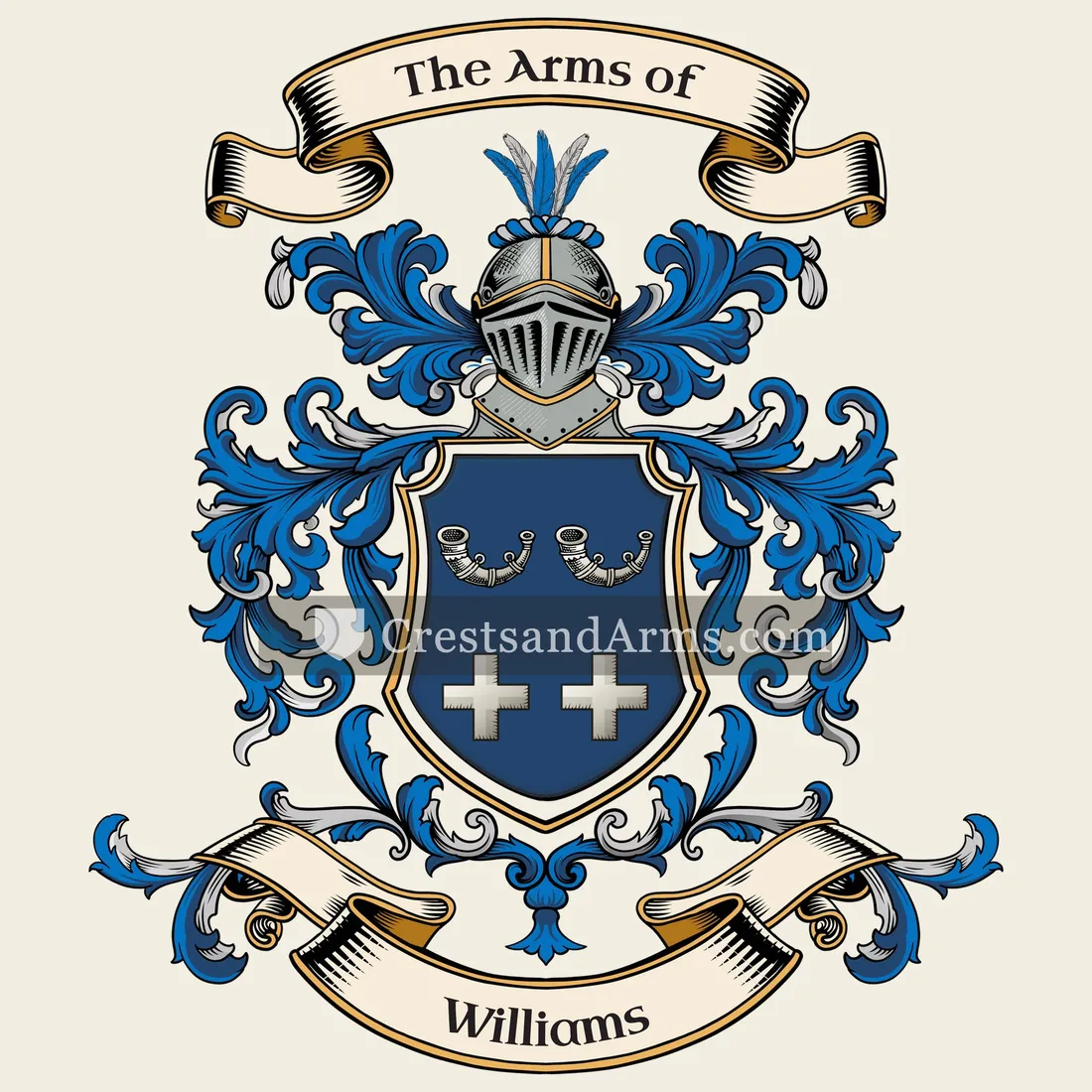
cross symbolChristian faith and service
hunting horn stringedOne who delights in the chase
Colours
Blue (Azure)Means: Loyalty and truth
Silver (Argent)Means: Peace and sincerity
Historical info
Source
Sir Bernard Burke, The General Armory of England, Scotland, Ireland and Wales, London: Harrison & Sons, 1884
Blazon (the actual original written record)
“Az. two organ pipes in saltire, the sinister surmounted of the dexter betw. two crosses pattée in pale ar”
Englandc. 1554
Digital archive packCoat of arms PNG, gold border print PDF, vector SVG and the certificate of authenticity. Sent to your email in minutes.
Map of England showing where the Williams arms are recorded
The Williams arms were recorded in England, c. 1554.
Arms such as these were typically recorded in York.
Yorkshire is the largest of the English counties, and it held more gentry families than any other. Land there was split among a great many households rather than a few, so a great many of them carried arms.
This is where the arms were entered in the register. Families often moved to other parts of the country, so the same name can turn up in more than one region.
The body that granted and recorded arms in England in this period.
Mary I
Sovereign of the period
Mary I
1553–1558
Reigning in Wales when the Williams arms are first recorded.
How Arms Worked in England
English heraldry allowed arms to be shared by all legitimate descendants of the original owner. These symbols were treated as personal property that moved through the generations to all children. While the eldest son kept the original design, other family members could use the same shield without needing to change it or register their own unique versions.
Granting authority
The College of Arms in London has regulated the use of coats of arms throughout England and Wales since 1484.
How they got arms
Families typically obtained their coats of arms through a formal grant from the Crown or by proving their ancient right to them.
Where arms were recorded
All official coats of arms are recorded in the registers kept at the College of Arms, which date back to the fifteenth century.
The family's standing
Recorded among the armigerous families of England.
Origin & History of the Williams Family in England
The surname Williams originated as a patronymic, meaning it was created by adding a suffix to the given name William to signify "son of William." This name became popular across England following the Norman Conquest of 1066, as William the Conqueror introduced the name to the English nobility and common people alike. By the mid-16th century, the name had become firmly established in various regions, including the city of York. Records from 1554 confirm that families bearing this name were active participants in the social and economic life of York during the Tudor period. At this time, the name was often spelled in several different ways depending on the local dialect and the literacy of the record keeper. As these families grew, they helped anchor the name within the local community, transitioning it from a simple description of parentage into a permanent family identifier that was passed down through generations.
Meaning of the Williams family crest colors & symbols
Symbols on this shield
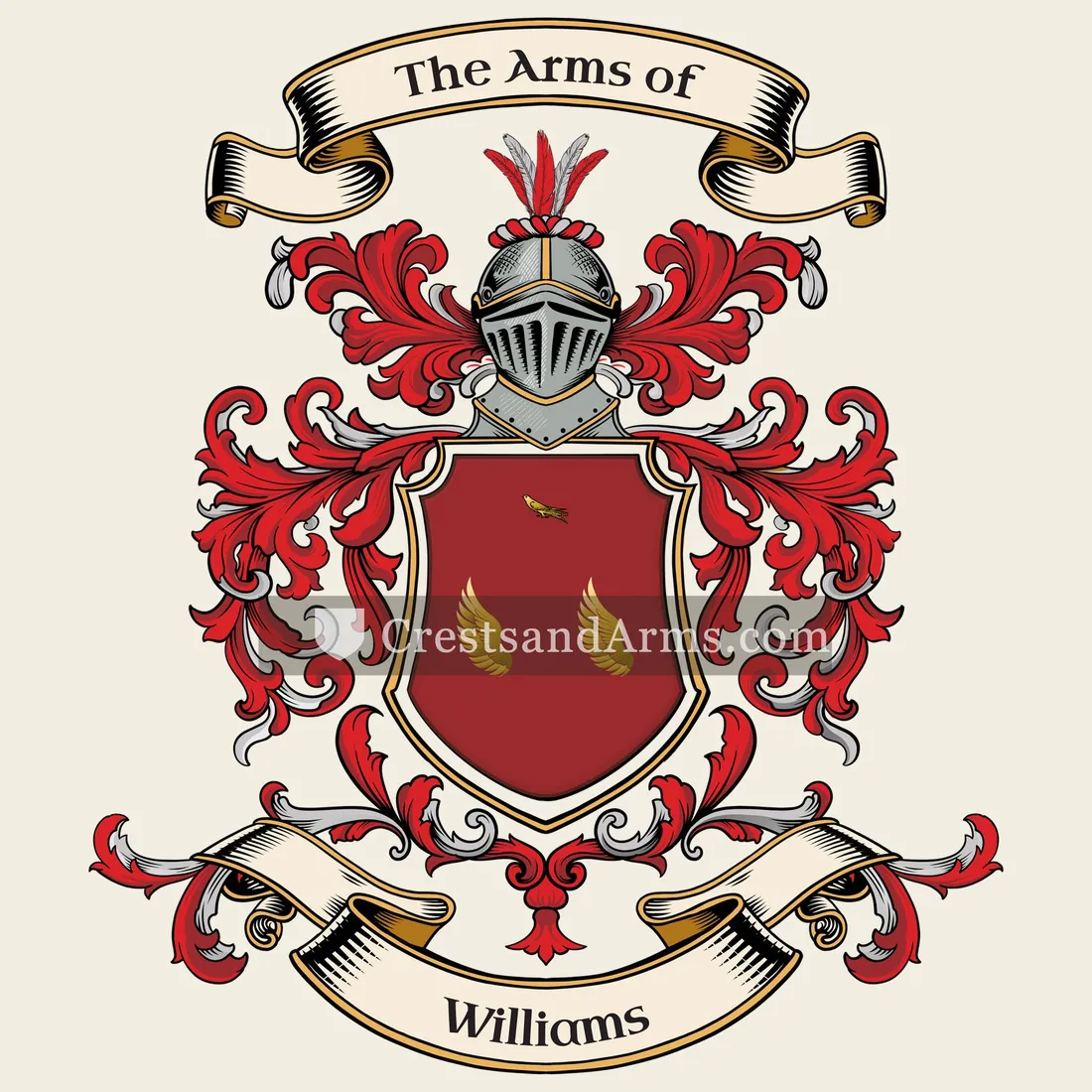
wingSwiftness, and protection under a raised wing
martletA younger son, who must win his own land
Colours
Red (Gules)Means: Military strength
Gold (Or)Means: Generosity
Historical info
Source
Sir Bernard Burke, The General Armory of England, Scotland, Ireland and Wales, London: Harrison & Sons, 1884
Blazon (the actual original written record)
“Gu. two eagle's wings conjoined in lure or, a martlet for diff”
Irelandc. 1588
Digital archive packCoat of arms PNG, gold border print PDF, vector SVG and the certificate of authenticity. Sent to your email in minutes.
Map of Ireland showing where the Williams arms are recorded
The Williams arms were recorded in Ireland, c. 1588.
Arms such as these were typically recorded in Dublin.
Dublin was the seat of government in Ireland and the place where grants were sought and recorded. Families with business at the castle or the courts settled nearby, and settling there put their arms on record.
This is where the arms were entered in the register. Families often moved to other parts of the country, so the same name can turn up in more than one region.
The body that granted and recorded arms in Ireland in this period.
Elizabeth I of England
Sovereign of the period
Elizabeth I of England
1558–1603
Reigning in Wales when the Williams arms are first recorded.
How Arms Worked in Ireland
The Ulster King of Arms granted coats of arms to individuals who proved their social standing and good character. These symbols were typically inherited by all legitimate descendants of the original holder. If a family branch wanted a unique look, they could apply for a specific change to their design through the office to ensure their identity remained distinct.
Granting authority
The Ulster King of Arms acted as the official body that regulated and issued all coats of arms throughout Ireland.
How they got arms
Families obtained their arms through formal grants issued by the office after proving their eligibility and paying the required fees.
Where arms were recorded
All official grants were recorded in the registers held by the Ulster King of Arms starting from the year 1552.
The family's standing
Recorded among the armigerous families of Ireland.
Origin & History of the Williams Family in Ireland
The family name Williams arrived in Ireland primarily through the influence of English settlers during the sixteenth century. While the name is of Welsh origin, meaning son of William, it became firmly established in Dublin by 1588 as part of the administrative and military expansion of the English Crown. During this period, individuals bearing the name often served as government officials, merchants, or soldiers who helped secure the city for the English administration. Because Dublin was a major hub for trade and governance, these early settlers integrated into the urban economy and social structure of the capital. Over time, the name spread from these initial urban centers into other parts of the country as families sought new land and professional opportunities. This movement helped the name transition from a foreign identifier to a common part of the Irish landscape.
Williams Meaning & Related Branches
Root word
Wilhelm
Derived from Germanic elements meaning resolute protector or strong-willed guardian.
This name
WilliamsA patronymic surname meaning son of William, originating from the Norman-French influence in Wales.
also spelled
Willyams
Wyllyams
Williamz
Wyliams
Related arms
Hamlynsame arms
Morgansimilar arms
Trehaimsimilar arms
Willyamsvariant spelling
Documented Sources
Sir Bernard Burke, The General Armory of England, Scotland, Ireland and Wales, London: Harrison & Sons, 1884
Morgan, Prys. Enwau Lleoedd. 2001
Rowlands, John and Sheila Rowlands. The Surnames of Wales. 1996
Digital archive packCoat of arms PNG, gold border print PDF, vector SVG and the certificate of authenticity. Sent to your email in minutes.


 chevronProtection, and faithful service completed
 wyvernValour and protection, and victory over the plague
 wolfReward from long service and hard work
 chevronProtection, and faithful service completed
 wyvernValour and protection, and victory over the plague
 wolfReward from long service and hard work


 cross symbolChristian faith and service
 hunting horn stringedOne who delights in the chase

 wingSwiftness, and protection under a raised wing
 martletA younger son, who must win his own land