A record of documented arms, meaning and origin, researched for the Williamss family lines. Documented in 3 countries.
Reg. 6192 · Welsh, W–Z
Coat of Arms & Family Crest Details
Symbols on this shield
chevronProtection, and faithful service completed
wyvernValour and protection, and victory over the plague
wolfReward from long service and hard work
Colours
Silver (Argent)Means: Peace and sincerity
Green (Vert)Means: Hope
Gold (Or)Means: Generosity
Historical info
Source
Sir Bernard Burke, The General Armory of England, Scotland, Ireland and Wales, London: Harrison & Sons, 1884
Blazon (the actual original written record)
“Quarterly, 1st and 4th, ar. three wyverns' heads vert, holding in their mouths a hand couped at the wrist ppr.; 2nd and 3rd, vert a chev. betw. three wolves' heads erased or”
MonmouthPenrose · Monmouth, c. 1595
Digital archive packCoat of arms PNG, gold border print PDF, vector SVG and the certificate of authenticity. Sent to your email in minutes.
Map of Wales showing where the Williamss arms are recorded
The Williamss arms were recorded in Monmouth, c. 1595.
Monmouthshire lay on the Welsh border, where land was held in return for military service. Families were expected to arm and to fight, and fighting households carried shields of their own.
This is where the arms were entered in the register. Families often moved to other parts of the country, so the same name can turn up in more than one region.
The body that granted and recorded arms in Wales in this period.
Elizabeth I of England
Sovereign of the period
Elizabeth I of England
1558–1603
Reigning in Wales when the Williamss arms are first recorded.
How Arms Worked in Wales
English heraldry allowed arms to be shared by all legitimate descendants of the original owner. These symbols were treated as personal property that moved through the generations to all children. While the eldest son kept the original design, other family members could use the same shield without needing to change it or register their own unique versions.
Granting authority
The College of Arms in London has regulated the use of coats of arms throughout England and Wales since 1484.
How they got arms
Families typically obtained their coats of arms through a formal grant from the Crown or by proving their ancient right to them.
Where arms were recorded
All official coats of arms are recorded in the registers kept at the College of Arms, which date back to the fifteenth century.
The family's standing
Recorded among the armigerous families of Monmouth.
Origin & History of the Williamss Family in Wales
The surname Williams is a patronymic name, which means it originated from the given name William. In Wales, this name became very popular following the Norman conquest, as the influence of French naming customs spread across the region. By the late sixteenth century, the name was firmly established in the border county of Monmouthshire. Records confirm that members of the Williams family were living in the town of Monmouth as early as 1595. During this period, families in Wales often transitioned from traditional Welsh naming patterns to fixed surnames to comply with English legal and administrative requirements. This shift helped the name Williams become one of the most common identifiers in the area, reflecting both the deep roots of the local population and the changing social landscape of early modern Wales.
Coat of Arms & Family Crest Details
Symbols on this shield
cross symbolChristian faith and service
hunting horn stringedOne who delights in the chase
Colours
Blue (Azure)Means: Loyalty and truth
Silver (Argent)Means: Peace and sincerity
Historical info
Source
Sir Bernard Burke, The General Armory of England, Scotland, Ireland and Wales, London: Harrison & Sons, 1884
Blazon (the actual original written record)
“Az. two organ pipes in saltire, the sinister surmounted of the dexter betw. two crosses pattée in pale ar”
Englandc. 1554
Digital archive packCoat of arms PNG, gold border print PDF, vector SVG and the certificate of authenticity. Sent to your email in minutes.
Map of England showing where the Williamss arms are recorded
The Williamss arms were recorded in England, c. 1554.
Arms such as these were typically recorded in York.
Yorkshire is the largest of the English counties, and it held more gentry families than any other. Land there was split among a great many households rather than a few, so a great many of them carried arms.
This is where the arms were entered in the register. Families often moved to other parts of the country, so the same name can turn up in more than one region.
The body that granted and recorded arms in England in this period.
Mary I
Sovereign of the period
Mary I
1553–1558
Reigning in Wales when the Williamss arms are first recorded.
How Arms Worked in England
English heraldry allowed arms to be shared by all legitimate descendants of the original owner. These symbols were treated as personal property that moved through the generations to all children. While the eldest son kept the original design, other family members could use the same shield without needing to change it or register their own unique versions.
Granting authority
The College of Arms in London has regulated the use of coats of arms throughout England and Wales since 1484.
How they got arms
Families typically obtained their coats of arms through a formal grant from the Crown or by proving their ancient right to them.
Where arms were recorded
All official coats of arms are recorded in the registers kept at the College of Arms, which date back to the fifteenth century.
The family's standing
Recorded among the armigerous families of England.
Origin & History of the Williamss Family in England
The surname Williams originated as a patronymic, meaning it was derived from the given name William. This name gained immense popularity in England following the Norman Conquest of 1066. During the medieval period, surnames were not fixed, and people often adopted the names of their fathers to distinguish themselves within their local communities. By the time the name appeared in York records in 1554, it had already become a well-established family identifier across the country. Families living in Northern England during the sixteenth century often relied on agriculture or local trade to sustain their households. The presence of the Williams name in York suggests that these ancestors were part of a growing urban population that was increasingly using stable surnames for legal and tax purposes. As the sixteenth century progressed, the spelling of the name began to solidify into its modern form, reflecting the transition from spoken nicknames to formal family records.
Coat of Arms & Family Crest Details
Symbols on this shield
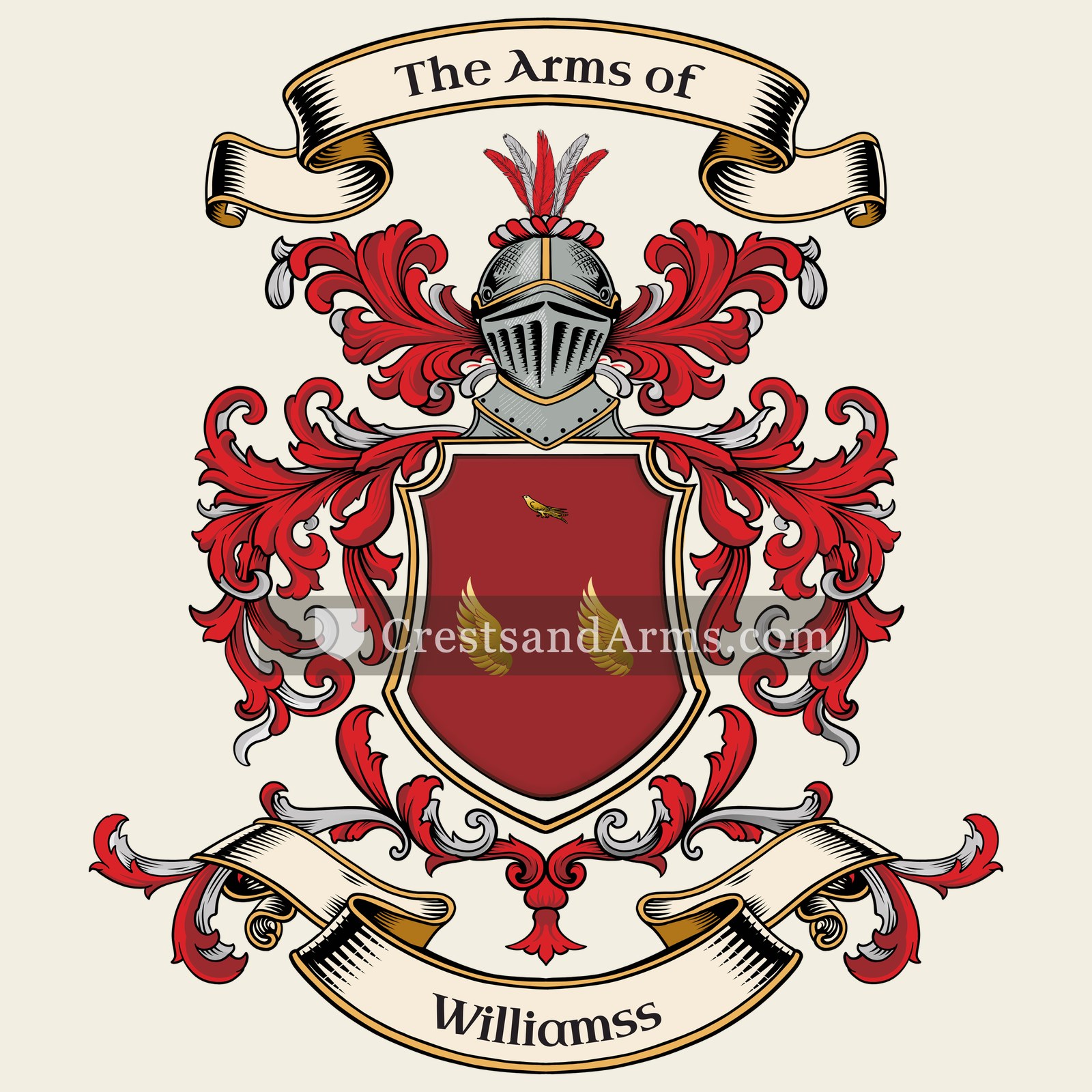
wingSwiftness, and protection under a raised wing
martletA younger son, who must win his own land
Colours
Red (Gules)Means: Military strength
Gold (Or)Means: Generosity
Historical info
Source
Sir Bernard Burke, The General Armory of England, Scotland, Ireland and Wales, London: Harrison & Sons, 1884
Blazon (the actual original written record)
“Gu. two eagle's wings conjoined in lure or, a martlet for diff”
Irelandc. 1588
Digital archive packCoat of arms PNG, gold border print PDF, vector SVG and the certificate of authenticity. Sent to your email in minutes.
Map of Ireland showing where the Williamss arms are recorded
The Williamss arms were recorded in Ireland, c. 1588.
Arms such as these were typically recorded in Dublin.
Dublin was the seat of government in Ireland and the place where grants were sought and recorded. Families with business at the castle or the courts settled nearby, and settling there put their arms on record.
This is where the arms were entered in the register. Families often moved to other parts of the country, so the same name can turn up in more than one region.
The body that granted and recorded arms in Ireland in this period.
Elizabeth I of England
Sovereign of the period
Elizabeth I of England
1558–1603
Reigning in Wales when the Williamss arms are first recorded.
How Arms Worked in Ireland
The Ulster King of Arms granted coats of arms to individuals who proved their social standing and good character. These symbols were typically inherited by all legitimate descendants of the original holder. If a family branch wanted a unique look, they could apply for a specific change to their design through the office to ensure their identity remained distinct.
Granting authority
The Ulster King of Arms acted as the official body that regulated and issued all coats of arms throughout Ireland.
How they got arms
Families obtained their arms through formal grants issued by the office after proving their eligibility and paying the required fees.
Where arms were recorded
All official grants were recorded in the registers held by the Ulster King of Arms starting from the year 1552.
The family's standing
Recorded among the armigerous families of Ireland.
Origin & History of the Williamss Family in Ireland
The surname Williams arrived in Ireland primarily through the influence of English settlers during the Tudor period. By 1588, records confirm that members of the Williams family were already established in Dublin, a city that served as the administrative heart of English authority in the country. During this era, the name functioned as a patronymic, meaning it was derived from the given name William, which had become popular across the British Isles after the Norman Conquest. As these families settled in urban centers like Dublin, they often integrated into the local merchant classes or served in official government roles. Over the following centuries, the name spread from these coastal hubs into the surrounding countryside, eventually becoming a common fixture within the Irish population. This migration reflected the broader social shifts of the time as families moved across the Irish Sea to seek new opportunities in trade, administration, and land management.
Related Branches & Arms
Root word
Wilhelm
Derived from Germanic elements meaning resolute protector or determined guardian.
This name
WilliamssA patronymic surname meaning son of William, denoting a descendant of a strong-willed protector.
also spelled
Willyams
Wyllyams
Williamz
Wyliams
Documented Sources
Sir Bernard Burke, The General Armory of England, Scotland, Ireland and Wales, London: Harrison & Sons, 1884
Bradney, Joseph Alfred, A History of Monmouthshire from the Coming of the Normans into Wales down to the Present Time, 1904
Morgan, Prys, Names for the Welsh: A Guide to Welsh Christian Names, 1998
National Library of Wales, Great Sessions of Wales Records, 1595
Digital archive packCoat of arms PNG, gold border print PDF, vector SVG and the certificate of authenticity. Sent to your email in minutes.


 chevronProtection, and faithful service completed
 wyvernValour and protection, and victory over the plague
 wolfReward from long service and hard work
 chevronProtection, and faithful service completed
 wyvernValour and protection, and victory over the plague
 wolfReward from long service and hard work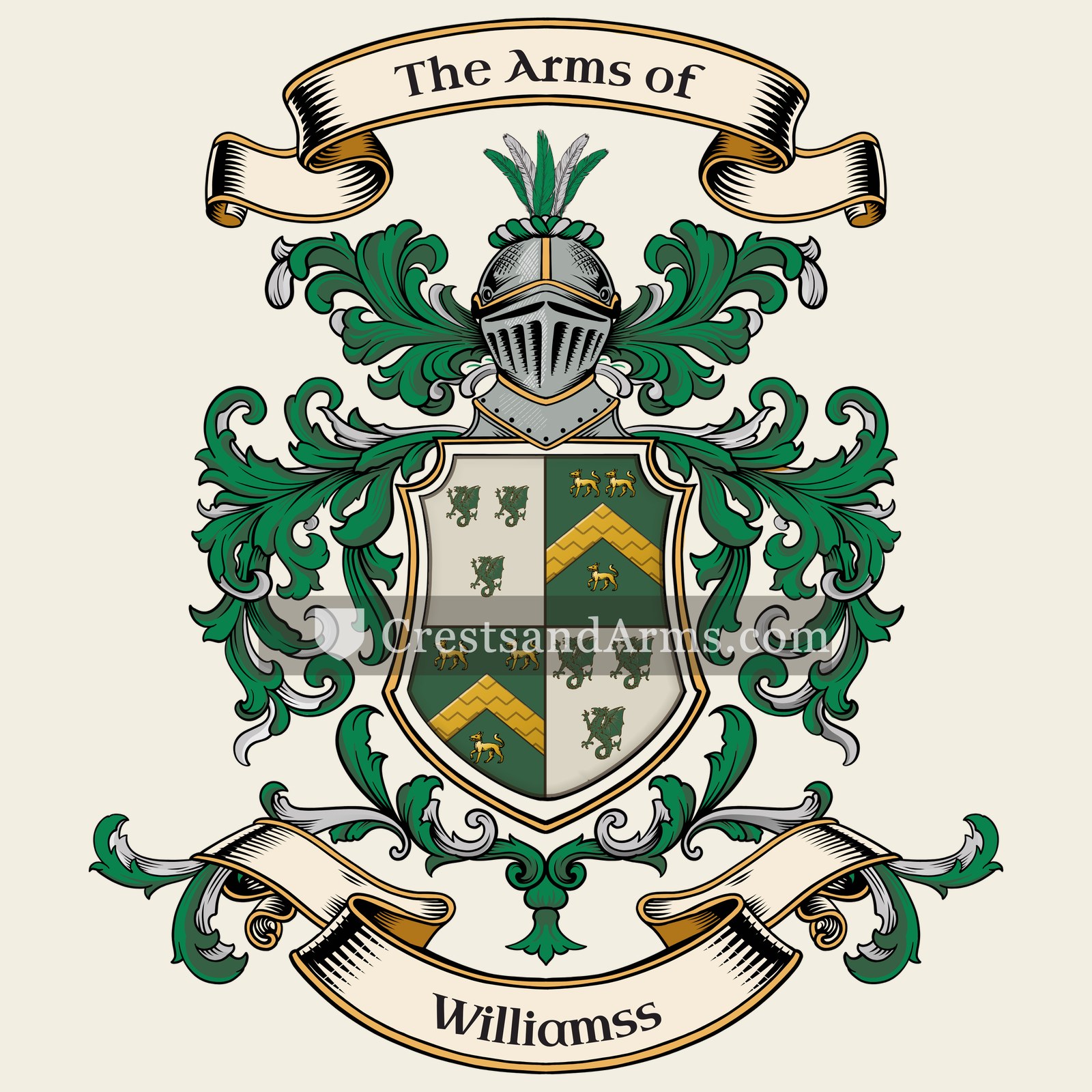


 cross symbolChristian faith and service
 hunting horn stringedOne who delights in the chase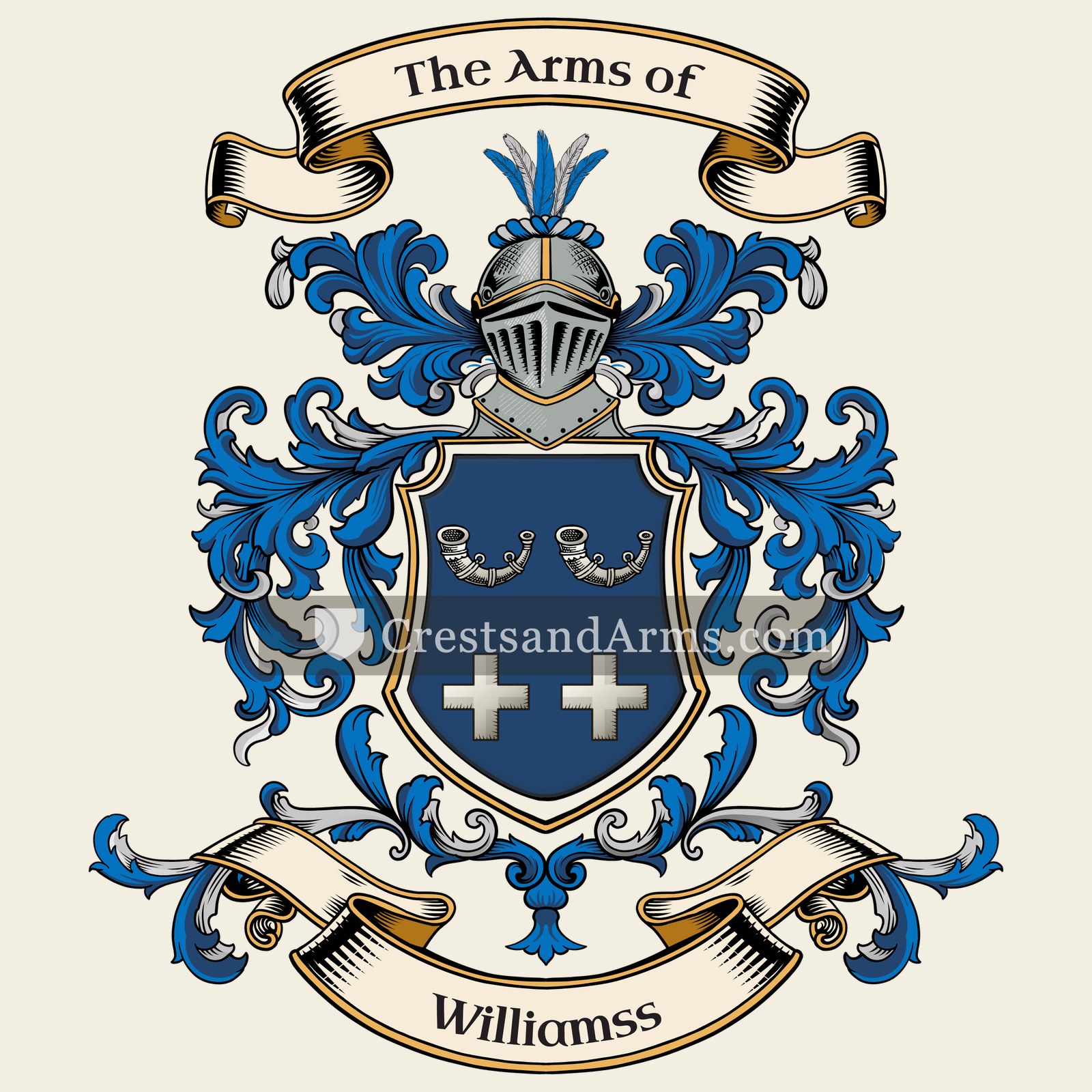

 wingSwiftness, and protection under a raised wing
 martletA younger son, who must win his own land