Map of England showing where the Wilson arms are recorded
The Wilson arms were recorded in Worcester, c. 1571.
Worcestershire was orchard and farming country with a scattering of old manors. Its gentry were middling rather than great, but a manor was a manor, and holding one was what brought arms.
This is where the arms were entered in the register. Families often moved to other parts of the country, so the same name can turn up in more than one region.
The body that granted and recorded arms in England in this period.
Elizabeth I of England
Sovereign of the period
Elizabeth I of England
1558–1603
Reigning in England when the Wilson arms are first recorded.
How Arms Worked in England
English heraldry allowed arms to be shared by all legitimate descendants of the original owner. These symbols were treated as personal property that moved through the generations to all children. While the eldest son kept the original design, other family members could use the same shield without needing to change it or register their own unique versions.
Granting authority
The College of Arms in London has regulated the use of coats of arms throughout England and Wales since 1484.
How they got arms
Families typically obtained their coats of arms through a formal grant from the Crown or by proving their ancient right to them.
Where arms were recorded
All official coats of arms are recorded in the registers kept at the College of Arms, which date back to the fifteenth century.
The family's standing
Recorded among the armigerous families of Worcester.
Origin & History of the Wilson Family in England
PronunciationWIL-suhn/ˈwɪlsən/
The surname Wilson is a classic example of a patronymic name, which means it was created to identify a person as the son of someone named Will or William. During the Middle Ages, as populations grew and people began to travel further from their birthplaces, simple first names were no longer enough to distinguish neighbors from one another. Families often adopted the father’s name as a permanent surname to clarify their lineage. By the time records appear in Worcester in 1571, the name had already become well-established across England. Many Wilsons during this era were likely part of the growing merchant or artisan classes, as the name appears frequently in parish registers and local tax records from the sixteenth century. Because the name is based on a common given name, it emerged independently in many different parts of the country rather than originating from a single ancestor. This widespread use helped the name become one of the most common surnames in the English language today.
Coat of Arms & Family Crest Details
Symbols on this shield
wolfReward from long service and hard work
starThe celestial goddess, and nobility
crescentHonour by the sovereign, and the second son
Colours
Black (Sable)Means: Constancy
Silver (Argent)Means: Peace and sincerity
Gold (Or)Means: Generosity
Historical info
Source
Sir Bernard Burke, The General Armory of England, Scotland, Ireland and Wales, London: Harrison & Sons, 1884
Blazon (the actual original written record)
“Sa. a wolf ramp. ar. armed and langued gu. betw. three estoiles or, a crescent for diff”
DonegalWilson's Court · Donegal, c. 1629
Digital archive packCoat of arms PNG, gold border print PDF, vector SVG and the certificate of authenticity. Sent to your email in minutes.
Map of Ireland showing where the Wilson arms are recorded
The Wilson arms were recorded in Donegal, c. 1629.
Donegal was remote north-western Irish country of mountain and coast. Its land was poor and its families few, but those who held ground held it for a very long time.
This is where the arms were entered in the register. Families often moved to other parts of the country, so the same name can turn up in more than one region.
The body that granted and recorded arms in Ireland in this period.
Charles I of England
Sovereign of the period
Charles I of England
1625–1649
Reigning in England when the Wilson arms are first recorded.
How Arms Worked in Ireland
The Ulster King of Arms granted coats of arms to individuals who proved their social standing and good character. These symbols were typically inherited by all legitimate descendants of the original holder. If a family branch wanted a unique look, they could apply for a specific change to their design through the office to ensure their identity remained distinct.
Granting authority
The Ulster King of Arms acted as the official body that regulated and issued all coats of arms throughout Ireland.
How they got arms
Families obtained their arms through formal grants issued by the office after proving their eligibility and paying the required fees.
Where arms were recorded
All official grants were recorded in the registers held by the Ulster King of Arms starting from the year 1552.
The family's standing
Recorded among the armigerous families of Donegal.
Origin & History of the Wilson Family in Ireland
PronunciationWIL-suhn/ˈwɪlsən/
The surname Wilson is a patronymic name that means son of Will, which was a common nickname for William. While the name has deep roots in England and Scotland, it became firmly established in Ireland during the seventeenth century. By 1629, records confirm that members of the Wilson family were settled in County Donegal. This migration was part of a larger movement of people from the Scottish Lowlands to the northern parts of Ireland during the Plantation of Ulster. These early settlers often moved to Donegal to manage land or participate in the growing trade networks of the region. Over time, these families integrated into the local community while maintaining their distinct cultural identity. Their presence in Donegal highlights the long history of movement and connection between Ireland and its neighbors across the sea.
Coat of Arms & Family Crest Details
Symbols on this shield
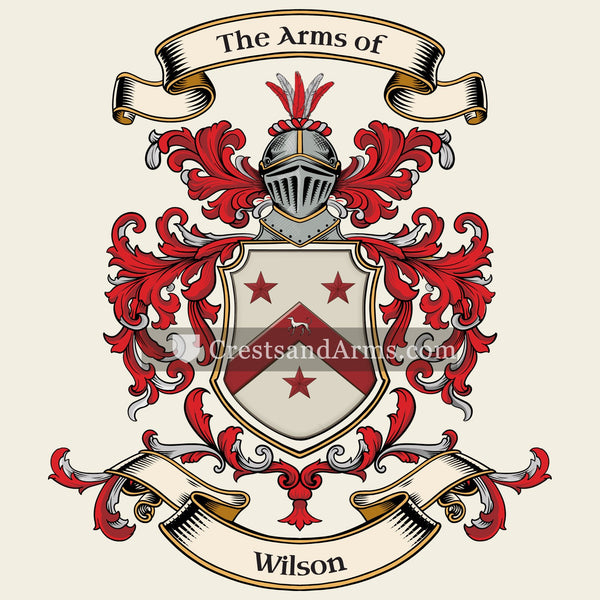
chevronProtection, and faithful service completed
mulletThe third son, and a divine quality from above
greyhoundCourage, vigilance and loyalty
Colours
Silver (Argent)Means: Peace and sincerity
Red (Gules)Means: Military strength
Historical info
Source
Sir Bernard Burke, The General Armory of England, Scotland, Ireland and Wales, London: Harrison & Sons, 1884
Blazon (the actual original written record)
“Ar. on a chev. betw. three mullets gu. a talbot's head erased of the first”
EdinburghEdinburgh, c. 1674
Digital archive packCoat of arms PNG, gold border print PDF, vector SVG and the certificate of authenticity. Sent to your email in minutes.
Map of Scotland showing where the Wilson arms are recorded
The Wilson arms were recorded in Edinburgh, c. 1674.
Edinburgh was the seat of Scotland's government, its courts and its heralds. Families with business there settled nearby, and being close to where arms were recorded is exactly why so many of them appear.
This is where the arms were entered in the register. Families often moved to other parts of the country, so the same name can turn up in more than one region.
The body that granted and recorded arms in Scotland in this period.
Charles II of England
Sovereign of the period
Charles II of England
1660–1685
Reigning in England when the Wilson arms are first recorded.
How Arms Worked in Scotland
Scottish heraldry is unique because it treats a coat of arms as a piece of personal property protected by law. Only one person can own a specific design at any given time. When a family grows, the head keeps the original shield while other relatives must apply for their own distinct version with slight changes to prove their specific identity.
Granting authority
The Court of the Lord Lyon acts as the official body that regulates and controls all heraldic matters throughout Scotland.
How they got arms
Individuals obtain a legal right to their arms through a formal petition process that confirms their identity and family connection.
Where arms were recorded
All valid coats of arms are officially entered into the Public Register of All Arms and Bearings starting from 1672.
The family's standing
Recorded among the armigerous families of Edinburgh.
Origin & History of the Wilson Family in Scotland
PronunciationWIL-suhn/ˈwɪlsən/
The surname Wilson is a patronymic name, which means it originated as a way to identify a person as the son of Will or William. In Scotland, this name became common because William was a popular given name during the Middle Ages. By the late seventeenth century, the Wilson family had established a notable presence in the city of Edinburgh. Records from 1674 show members of the family living and working within the capital, where they were integrated into the local urban community. During this period, Edinburgh was a center of trade and legal activity, and families like the Wilsons often contributed to the growth of the city through various crafts and businesses. As the name spread across the Lowlands, it became one of the most frequent surnames in the region, reflecting the deep roots that many families established in Scottish society long before the modern era.
Wilson Meaning & Related Branches
Root word
William
Derived from Germanic elements meaning resolute protector or strong-willed warrior.
This name
WilsonA patronymic surname meaning son of the resolute protector.
also spelled
Wylson
Wilsonn
Wilsson
Wylsone
Related arms
Andrewrecorded with Wilson, same area
Birdrecorded with Wilson, same area
Boultonrecorded with Wilson, same area
Braithwaiterecorded with Wilson, same area
Documented Sources
Sir Bernard Burke, The General Armory of England, Scotland, Ireland and Wales, London: Harrison & Sons, 1884
Bardsley, Charles Wareing, A Dictionary of English and Welsh Surnames, 1901
Reaney, P.H., A Dictionary of British Surnames, 1958
Worcestershire Archives, Parish Register Transcripts for the City of Worcester, 1571
Digital archive packCoat of arms PNG, gold border print PDF, vector SVG and the certificate of authenticity. Sent to your email in minutes.


 wolfReward from long service and hard work
 mulletThe third son, and a divine quality from above
 wolfReward from long service and hard work
 mulletThe third son, and a divine quality from above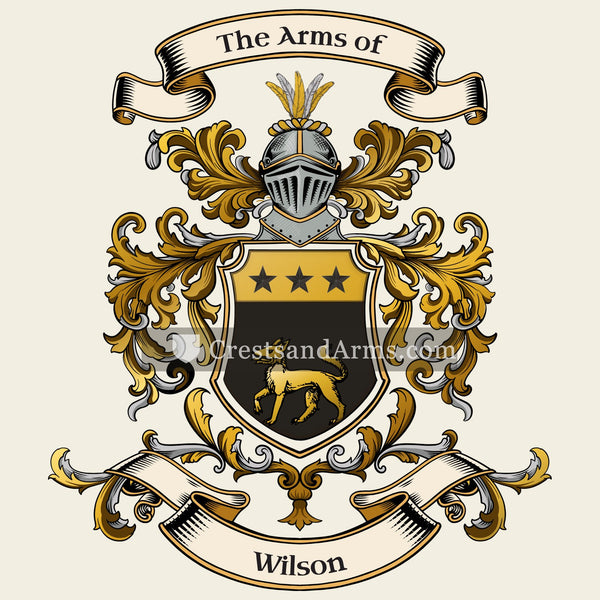


 starThe celestial goddess, and nobility
 crescentHonour by the sovereign, and the second son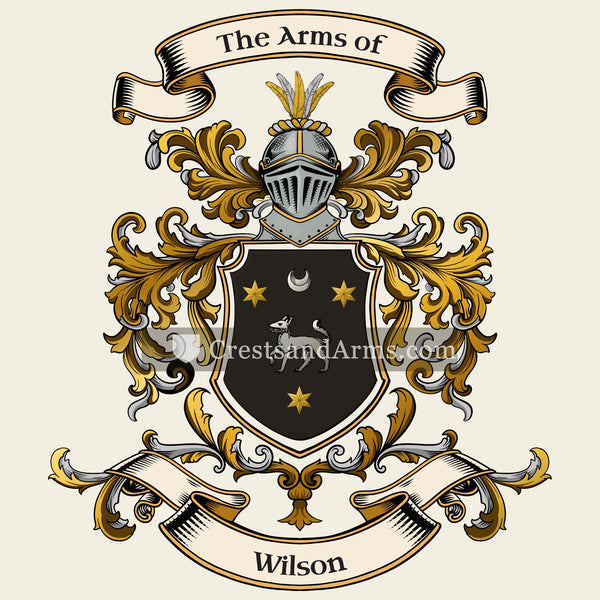


 chevronProtection, and faithful service completed
 greyhoundCourage, vigilance and loyalty