Map of Spain showing where the Winstanley arms are recorded
The Winstanley arms were recorded in Lancaster, c. 1722.
Lancashire was divided among a great many small landed families, more than most northern counties. Estates were passed down whole rather than split up, so the same names hold the same ground for centuries in the records.
This is where the arms were entered in the register. Families often moved to other parts of the country, so the same name can turn up in more than one region.
The body that granted and recorded arms in Spain in this period.
Philip V of Spain
Sovereign of the period
Philip V of Spain
1714–1724
Reigning in Spain when the Winstanley arms are first recorded.
How Arms Worked in Spain
In Spain, a coat of arms was considered a form of property that belonged to the entire family line. These arms were passed down from a father to all his children equally. Younger branches of the family usually kept the original design without needing to add any special marks to distinguish their specific line.
Granting authority
The Cronista Rey de Armas was the official body that regulated and granted coats of arms throughout Spain.
How they got arms
Families often obtained their arms through royal grants or by proving their noble status to the official heraldic authority.
Where arms were recorded
Coats of arms were officially recorded in the registers of the Cronista Rey de Armas starting in 1496.
The family's standing
Recorded among the armigerous families of Lancaster.
Origin & History of the Winstanley Family in Spain
The surname Winstanley is a locative name, meaning it originated from a specific place rather than a trade or a personal characteristic. It is derived from the township of Winstanley, which is located near Wigan in the historic county of Lancashire. The name itself comes from Old English roots, likely combining the words for a friend or a personal name with the word for a clearing in a forest. By the early 18th century, members of the Winstanley family were well-established in the Lancaster area, where they participated in the local economy and social life of the growing town. As the family spread from their ancestral lands, they maintained a strong connection to the region of Lancashire, which remained the primary heartland for the name throughout the 1700s.
Related Branches & Arms
Root word
Wynstan-leah
Old English for Wynstan's woodland clearing or meadow.
This name
WinstanleyDerived from a place name in Lancashire, England, signifying a clearing belonging to a person named Wynstan.
also spelled
Winstanly
Wynstanley
Wynstanly
Related arms
Reynoldsrecorded with Winstanley, same area
Documented Sources
Sir Bernard Burke, The General Armory of England, Scotland, Ireland and Wales, London: Harrison & Sons, 1884
Ekwall, Eilert. The Place-Names of Lancashire. 1922
Farrer, William and Brownbill, John. A History of the County of Lancaster. 1906–1914
Lancashire Archives, Bishop’s Transcripts of Burials, Baptisms and Marriages for the Parish of Lancaster, 1722
Digital archive packCoat of arms PNG, gold border print PDF, vector SVG and the certificate of authenticity. Sent to your email in minutes.


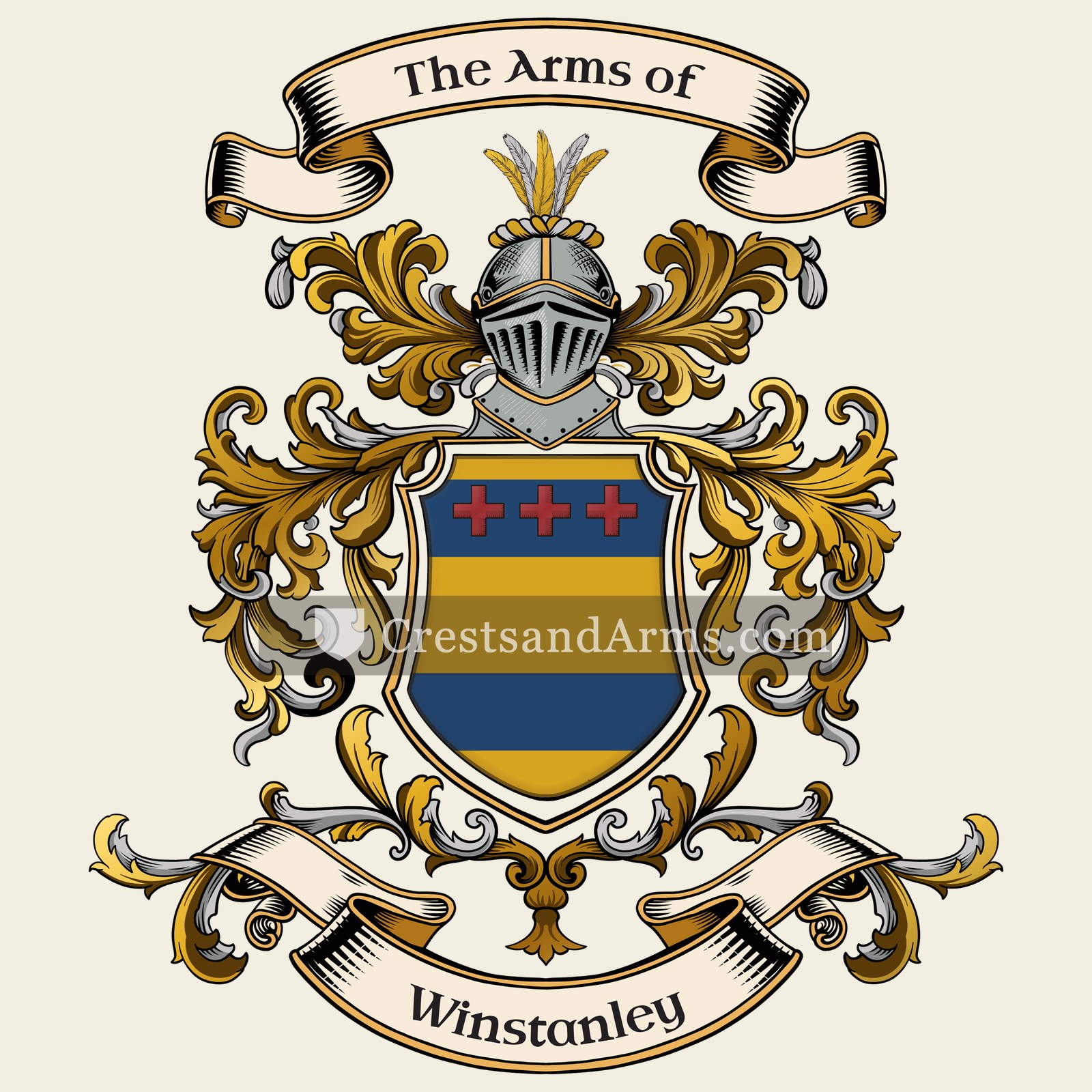
 cross symbolChristian faith and service
 cross symbolChristian faith and service