Map of England showing where the Wiseman arms are recorded
The Wiseman arms were recorded in Essex, c. 1572.
Essex lay close enough to London for City money to buy land there. Merchants who prospered moved out to estates within a day's ride, and a new landowner almost always wanted arms to go with the ground.
This is where the arms were entered in the register. Families often moved to other parts of the country, so the same name can turn up in more than one region.
The body that granted and recorded arms in England in this period.
Elizabeth I of England
Sovereign of the period
Elizabeth I of England
1558–1603
Reigning in England when the Wiseman arms are first recorded.
How Arms Worked in England
English heraldry allowed arms to be shared by all legitimate descendants of the original owner. These symbols were treated as personal property that moved through the generations to all children. While the eldest son kept the original design, other family members could use the same shield without needing to change it or register their own unique versions.
Granting authority
The College of Arms in London has regulated the use of coats of arms throughout England and Wales since 1484.
How they got arms
Families typically obtained their coats of arms through a formal grant from the Crown or by proving their ancient right to them.
Where arms were recorded
All official coats of arms are recorded in the registers kept at the College of Arms, which date back to the fifteenth century.
The family's standing
Recorded among the armigerous families of Essex.
Origin & History of the Wiseman Family in England
The surname Wiseman originated in England as a descriptive nickname, likely bestowed upon an individual known for their sagacity, learning, or prudent nature. By the late sixteenth century, the family had established a notable presence in the county of Essex, where records from 1572 confirm their integration into the local social fabric. During this period, members of the Wiseman family were frequently associated with the landed gentry and held positions of influence within their communities. They often served as local administrators or landowners, which allowed them to leave behind detailed records in parish registers and legal documents. Their rise in Essex reflects a broader trend of families gaining prominence through steady land management and civic participation in post-medieval England.
Meaning of the Wiseman family crest colors & symbols
Symbols on this shield
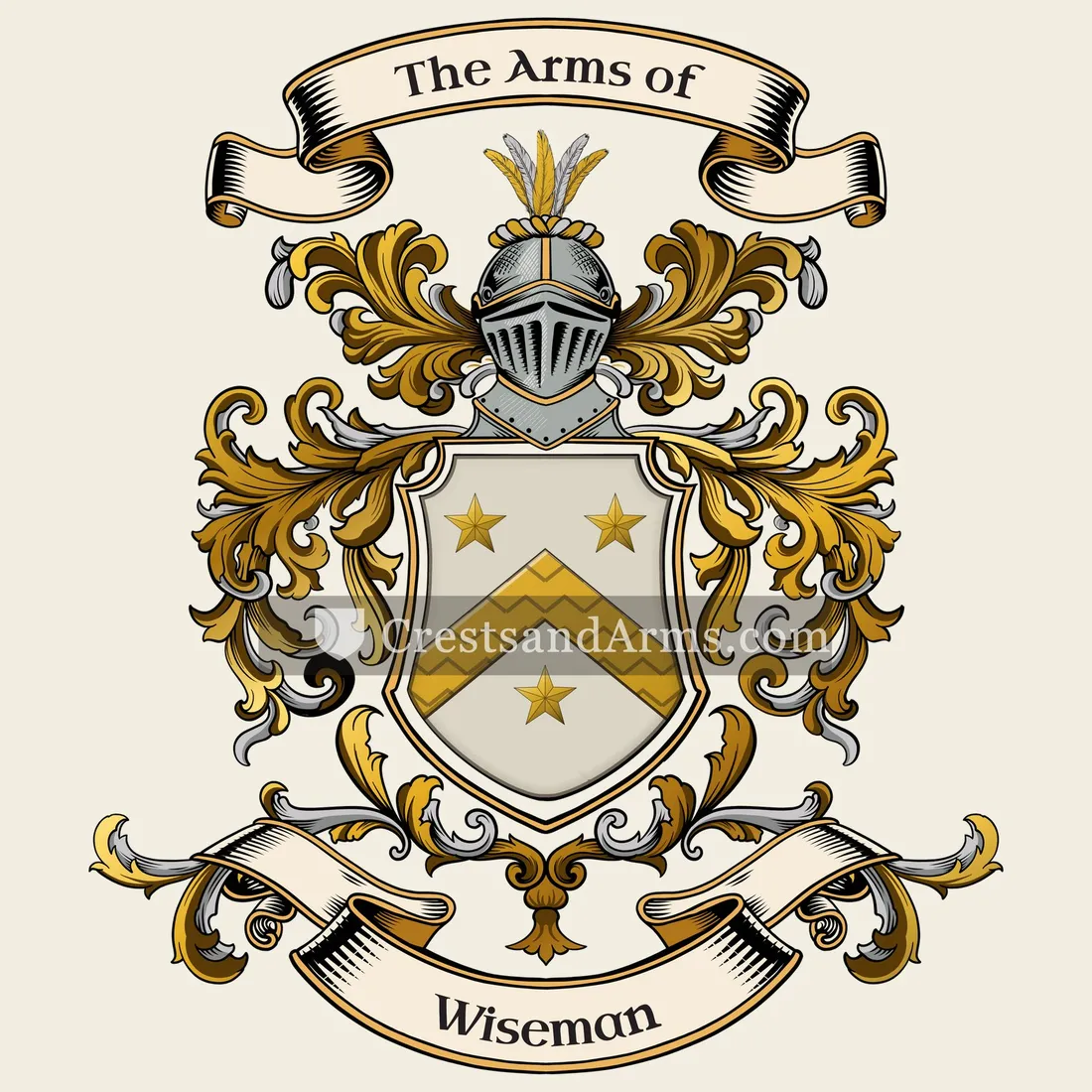
chevronProtection, and faithful service completed
mulletThe third son, and a divine quality from above
Colours
Silver (Argent)Means: Peace and sincerity
Gold (Or)Means: Generosity
Historical info
Source
Sir Bernard Burke, The General Armory of England, Scotland, Ireland and Wales, London: Harrison & Sons, 1884
Blazon (the actual original written record)
“Ar. a chev. betw. three stars of eight points wavy or”
Scotlandc. 1748
Digital archive packCoat of arms PNG, gold border print PDF, vector SVG and the certificate of authenticity. Sent to your email in minutes.
Map of Scotland showing where the Wiseman arms are recorded
The Wiseman arms were recorded in Scotland, c. 1748.
Arms such as these were typically recorded in Edinburgh.
Edinburgh was the seat of Scotland's government, its courts and its heralds. Families with business there settled nearby, and being close to where arms were recorded is exactly why so many of them appear.
This is where the arms were entered in the register. Families often moved to other parts of the country, so the same name can turn up in more than one region.
The body that granted and recorded arms in Scotland in this period.
George II of Great Britain
Sovereign of the period
George II of Great Britain
1727–1760
Reigning in England when the Wiseman arms are first recorded.
How Arms Worked in Scotland
Scottish heraldry is unique because it treats a coat of arms as a piece of personal property protected by law. Only one person can own a specific design at any given time. When a family grows, the head keeps the original shield while other relatives must apply for their own distinct version with slight changes to prove their specific identity.
Granting authority
The Court of the Lord Lyon acts as the official body that regulates and controls all heraldic matters throughout Scotland.
How they got arms
Individuals obtain a legal right to their arms through a formal petition process that confirms their identity and family connection.
Where arms were recorded
All valid coats of arms are officially entered into the Public Register of All Arms and Bearings starting from 1672.
The family's standing
Recorded among the armigerous families of Scotland.
Origin & History of the Wiseman Family in Scotland
The name Wiseman originated as a descriptive nickname for a person known for their wisdom, prudence, or sound judgment. In Scotland, the name appears in historical records as early as the 18th century, with documented evidence placing members of the family in Edinburgh by 1748. During this period, the city was undergoing significant social and intellectual changes as part of the Scottish Enlightenment. Families with this name were often integrated into the urban life of the capital, working in trades or professional roles that required literacy and community standing. Because the name was linked to a personal trait rather than a specific geographic location, it likely emerged independently in different regions before becoming established within the growing population of Edinburgh. By the mid-1700s, the Wiseman family was part of the fabric of Scottish city life, contributing to the development of the nation during a time of rapid modernization.
Wiseman Meaning & Related Branches
Root word
wis
Old English word meaning knowledge, learning, or intelligence.
This name
WisemanA descriptive occupational or nickname for a learned, prudent, or sagacious person.
also spelled
Wysman
Wyseman
Wysmanne
Related arms
Poolerecorded with Wiseman, same area
Sorrellrecorded with Wiseman, same area
Warnerrecorded with Wiseman, same area
Documented Sources
Sir Bernard Burke, The General Armory of England, Scotland, Ireland and Wales, London: Harrison & Sons, 1884
Reaney, P.H., A Dictionary of British Surnames, 1958
Morant, Philip, The History and Antiquities of the County of Essex, 1768
Essex Record Office, Quarter Sessions Records, 1572
Digital archive packCoat of arms PNG, gold border print PDF, vector SVG and the certificate of authenticity. Sent to your email in minutes.


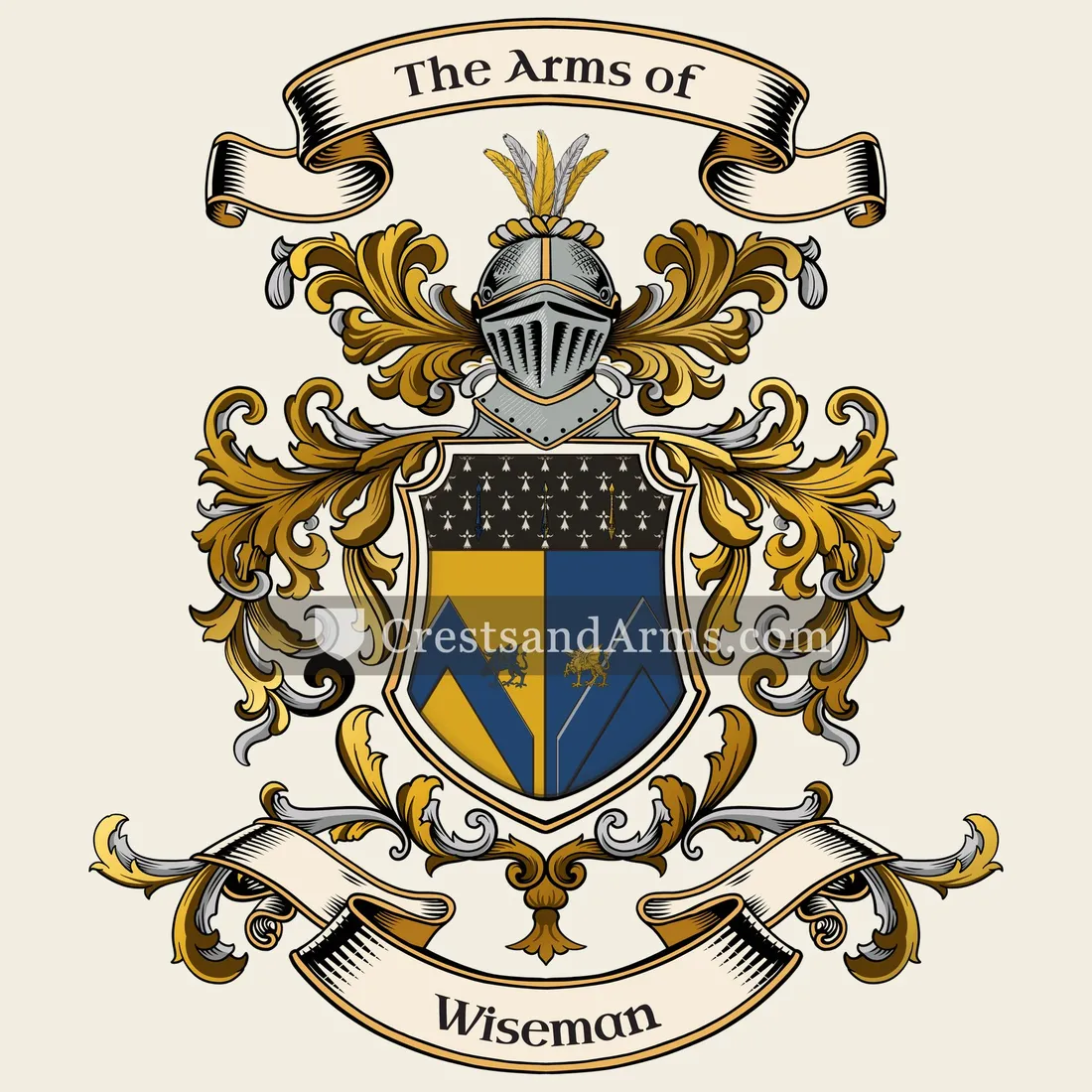
 chevronProtection, and faithful service completed
 chiefAuthority, wisdom and dominion
 ermineDignity and rank
 dragonA most valiant defender of treasure
 lanceKnightly service and the tilt
 chevronProtection, and faithful service completed
 chiefAuthority, wisdom and dominion
 ermineDignity and rank
 dragonA most valiant defender of treasure
 lanceKnightly service and the tilt


 mulletThe third son, and a divine quality from above