Map of England showing where the Wistar arms are recorded
The Wistar arms were recorded in Hants, c. 1620.
Hampshire had the naval dockyards at Portsmouth on one side and good farmland on the other. Sea money and land money both bought estates, and an estate was what brought a family its coat of arms.
This is where the arms were entered in the register. Families often moved to other parts of the country, so the same name can turn up in more than one region.
The body that granted and recorded arms in England in this period.
James VI and I
Sovereign of the period
James VI and I
1603–1625
Reigning in England when the Wistar arms are first recorded.
How Arms Worked in England
English heraldry allowed arms to be shared by all legitimate descendants of the original owner. These symbols were treated as personal property that moved through the generations to all children. While the eldest son kept the original design, other family members could use the same shield without needing to change it or register their own unique versions.
Granting authority
The College of Arms in London has regulated the use of coats of arms throughout England and Wales since 1484.
How they got arms
Families typically obtained their coats of arms through a formal grant from the Crown or by proving their ancient right to them.
Where arms were recorded
All official coats of arms are recorded in the registers kept at the College of Arms, which date back to the fifteenth century.
The family's standing
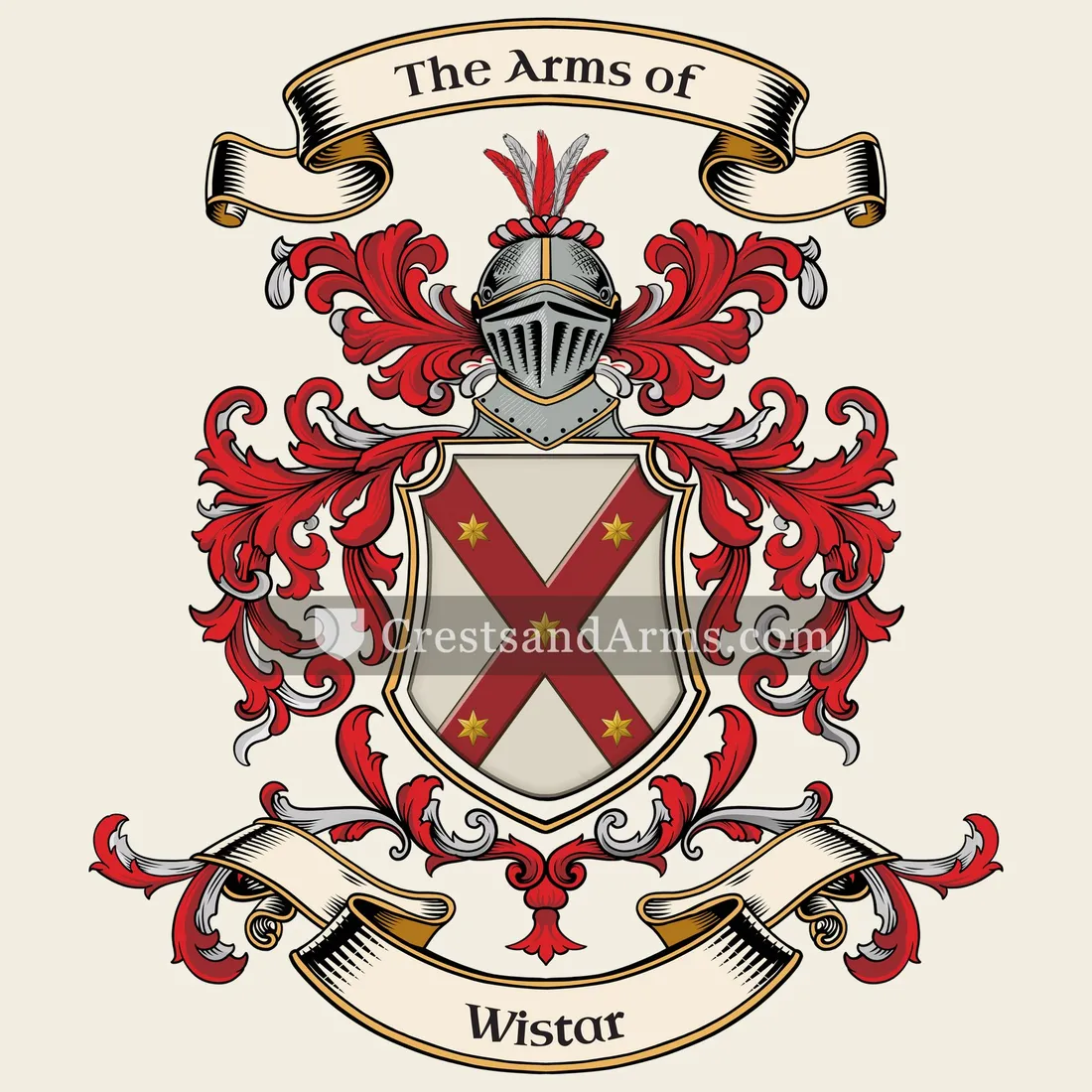
Recorded among the armigerous families of Hants.
Origin & History of the Wistar Family in England
The Wistar family name traces its roots back to early seventeenth-century England, with documented records confirming their presence in the county of Hants by 1620. During this period, the family lived as part of the rural gentry and yeomanry, navigating a time of significant social and religious change in the English countryside. The name itself likely evolved from older regional dialects, reflecting the specific geography or local landmarks where the family first established their homesteads. As the seventeenth century progressed, members of the family became part of the broader movement of people seeking new opportunities, eventually leading them to play notable roles in the development of colonial trade and medicine in North America. Their early history remains a clear example of how small, localized family groups transitioned from regional English life to become influential figures in the early modern Atlantic world.
Wistar Meaning & Related Branches
Root word
Wistow
A place name derived from Old English meaning a dwelling place.
This name
WistarA locational surname referring to someone who originated from the village of Wistow.
also spelled
Wystern
Wysterne
Wisternne
Documented Sources
Sir Bernard Burke, The General Armory of England, Scotland, Ireland and Wales, London: Harrison & Sons, 1884
Banks, Charles Edward, The English Ancestry and Homes of the Pilgrim Fathers, 1929
Hampshire Record Office, Hampshire Parish Registers, 1620
Hotten, John Camden, The Original Lists of Persons of Quality: Emigrants, Religious Exiles, Political Rebels, Serving Men Sold for a Term of Years, Apprentices, Children Stolen, Maidens Pressed, and Others Who Went from Great Britain to the American Plantations, 1600–1700, 1874
Digital archive packCoat of arms PNG, gold border print PDF, vector SVG and the certificate of authenticity. Sent to your email in minutes.


 saltireResolution, and St Andrew's cross
 starThe celestial goddess, and nobility
 saltireResolution, and St Andrew's cross
 starThe celestial goddess, and nobility