A record of documented arms, meaning and origin, researched for the Wolff family lines. Documented in 3 countries.
Reg. 8433 · German, W–Z
Coat of Arms & Family Crest Details
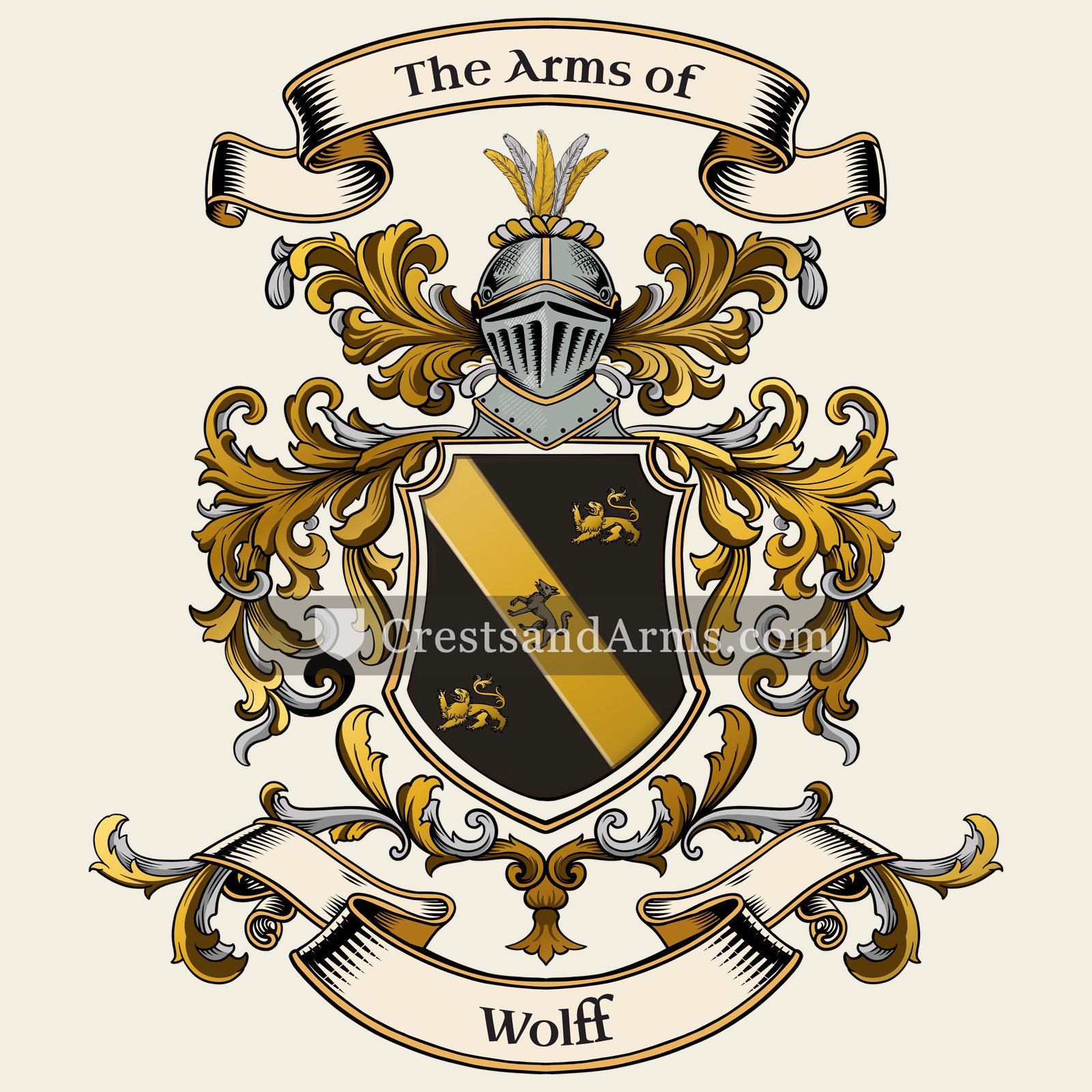
Symbols on this shield
bendDefence, and the scarf of a commander
wolfReward from long service and hard work
lionCourage, strength and royalty
Colours
Black (Sable)Means: Constancy
Gold (Or)Means: Generosity
Historical info
Source
J. B. Rietstap, Armorial Général, Gouda: G. B. van Goor Zonen, 1884–87
Blazon (the actual original written record)
“De sa. à la bande d'or, ch. d'un loup courant au nat. et acc. de deux têtes de léopard du sec. C.: le loup, iss., entre deux prob. coupées alt. d'or et de sa.”
Germanyc. 1563
Digital archive packCoat of arms PNG, gold border print PDF, vector SVG and the certificate of authenticity. Sent to your email in minutes.
Map of Germany showing where the Wolff arms are recorded
The Wolff arms were recorded in Germany, c. 1563.
Arms such as these were typically recorded in Bavaria.
Bavaria was a country of old landed families and walled market towns. Estates passed down the same line for centuries, and both the landowners and the leading townsmen kept arms, which is why so many Bavarian names sit in the registers.
This is where the arms were entered in the register. Families often moved to other parts of the country, so the same name can turn up in more than one region.
The body that granted and recorded arms in Germany in this period.
Ferdinand I, Holy Roman Emperor
Sovereign of the period
Ferdinand I, Holy Roman Emperor
1556–1564
Reigning in Germany when the Wolff arms are first recorded.
How Arms Worked in Germany
In the Holy Roman Empire, coats of arms were often granted to individuals by the Emperor or his representatives. These arms were then passed down through the generations to all legitimate descendants of the original holder. Younger branches of a family usually kept the same shield design without needing to change it, as the arms belonged to the entire lineage.
Granting authority
The Holy Roman Emperor held the sole power to grant new coats of arms throughout his vast imperial territories.
How they got arms
Families typically obtained their coats of arms through a formal imperial grant or by proving their noble status to the authorities.
Where arms were recorded
These grants were officially recorded in the Imperial Chancery registers, which began keeping formal records of such honors during the Middle Ages.
The family's standing
Recorded among the armigerous families of Germany.
Origin & History of the Wolff Family in Germany
The surname Wolff originated as a descriptive nickname in medieval Germany, often given to individuals who displayed the strength, cunning, or fierce nature associated with the wolf. By the mid-16th century, the name was well-established across the German-speaking lands, including the southern region of Bavaria. Historical records confirm that members of the Wolff family were active in Bavarian society by 1563, a time when the region was deeply influenced by the religious and political shifts of the Reformation. During this era, families with this name were often found among the growing merchant classes and skilled tradespeople who helped shape the local economy. As the name spread through various German states, it became a common identifier for families who lived near forests or those who served as protectors of their local communities. The presence of the Wolff name in 16th-century Bavaria reflects the broader trend of surnames becoming permanent markers of family identity as populations became more settled and organized.
Coat of Arms & Family Crest Details
Symbols on this shield
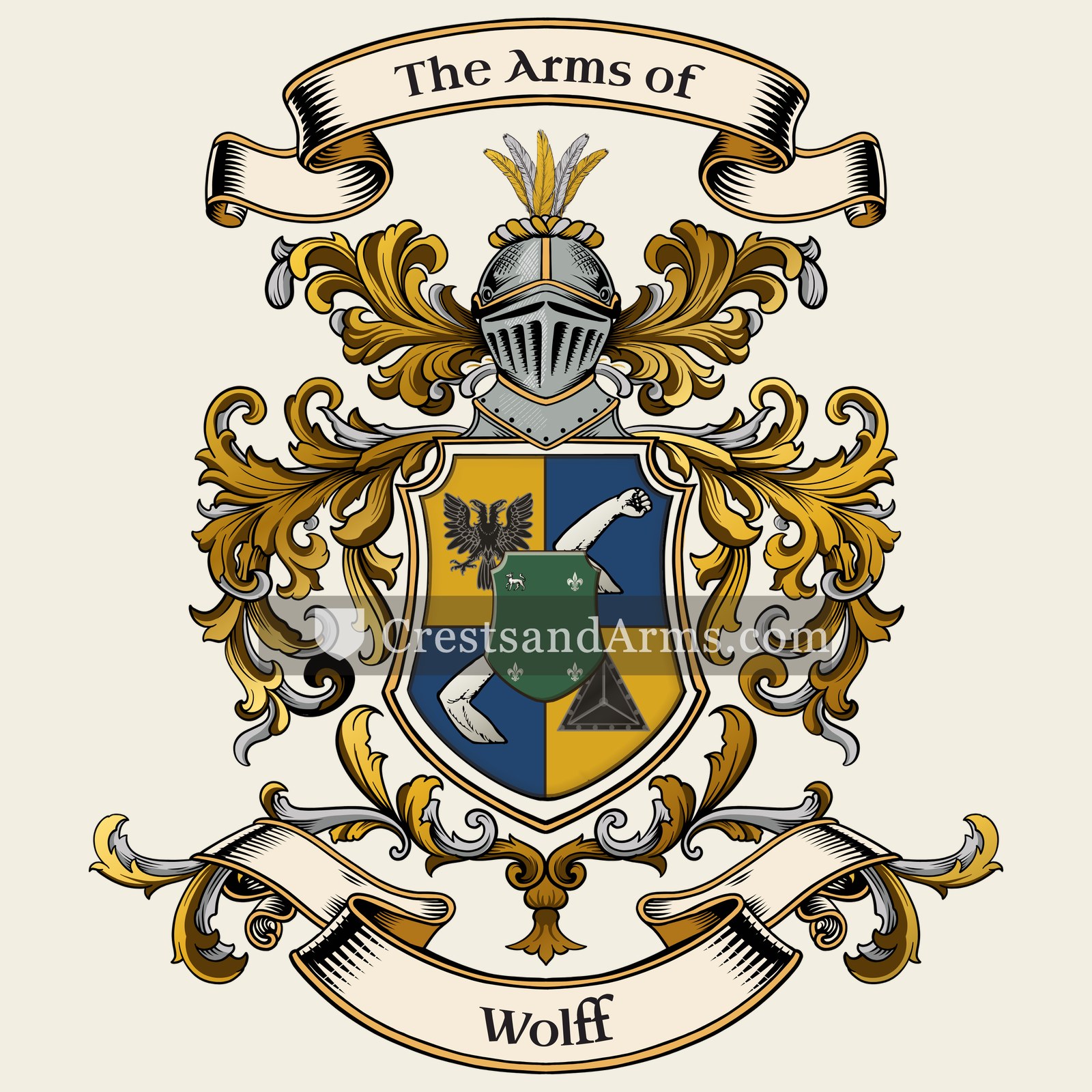
wolfReward from long service and hard work
fleur de lisPurity, light, and the sixth son
eagleNobility, strength and a keen mind
armA person of action, industrious and laborious
triangleThe Trinity, and stability
Colours
Gold (Or)Means: Generosity
Blue (Azure)Means: Loyalty and truth
Green (Vert)Means: Hope
Silver (Argent)Means: Peace and sincerity
Black (Sable)Means: Constancy
Historical info
Source
J. B. Rietstap, Armorial Général, Gouda: G. B. van Goor Zonen, 1884–87
Blazon (the actual original written record)
“Ec.: au 1 d'or à l'aigle de sa., cour. de gu.; au 2 d'azur à un senestrochère, arm. au nat., iss. d'une nuée mouv. du flanc, et tenant une épée d'arg., garnie d'or; au 3 d'arg. à un senestrochère de carn., tenant une palme de sin. et iss. d'une nuée au nat., mouv. du parti; au 4 d'or à un triangle vidé de sa. Sur le tout de sin. à un loup pass. au nat., acc. de trois fleurs-de-lis d'arg., rangées en chef. Trois cq. cour. C.: 1° une fleur-de-lis d'arg., entre un vol de sa.; 2° le loup, iss.; 3° l'aigle du 1. L.: à dextre d'arg. et de sin., à sen. d'or et de sa. S.: deux lions reg. d'or. D.: DANTE DEO.”
Britainc. 1747
Digital archive packCoat of arms PNG, gold border print PDF, vector SVG and the certificate of authenticity. Sent to your email in minutes.
Map of Britain showing where the Wolff arms are recorded
The Wolff arms were recorded in Britain, c. 1747.
Arms such as these were typically recorded in Kent.
Kent sits between London and the short crossing to Europe, and the trade passing through made it wealthy. Merchant families bought land with that money, and it was landowners who took coats of arms.
This is where the arms were entered in the register. Families often moved to other parts of the country, so the same name can turn up in more than one region.
The body that granted and recorded arms in Britain in this period.
George II of Great Britain
Sovereign of the period
George II of Great Britain
1727–1760
Reigning in Germany when the Wolff arms are first recorded.
How Arms Worked in Britain
English heraldry allowed arms to be shared by all legitimate descendants of the original owner. These symbols were treated as personal property that moved through the generations to all children. While the eldest son kept the original design, other family members could use the same shield without needing to change it or register their own unique versions.
Granting authority
The College of Arms in London has regulated the use of coats of arms throughout England and Wales since 1484.
How they got arms
Families typically obtained their coats of arms through a formal grant from the Crown or by proving their ancient right to them.
Where arms were recorded
All official coats of arms are recorded in the registers kept at the College of Arms, which date back to the fifteenth century.
The family's standing
Recorded among the armigerous families of Britain.
Origin & History of the Wolff Family in Britain
The surname Wolff has deep roots in Germanic naming traditions, where it originated as a descriptive name for someone who possessed the strength or fierce nature of a wolf. While the name is famously associated with Central Europe, it began to appear in British records as families migrated across the North Sea for trade and religious reasons. By the middle of the eighteenth century, the name was firmly established in the county of Kent. Records from 1747 show that members of the Wolff family were active in this region, likely integrating into the local agricultural or mercantile communities. These early settlers often maintained their distinct spelling to preserve their cultural heritage while adapting to the social and economic life of southern England. Over time, the family name became a permanent part of the local landscape, reflecting the broader history of migration that shaped the British population during the Enlightenment era.
Coat of Arms & Family Crest Details
Symbols on this shield
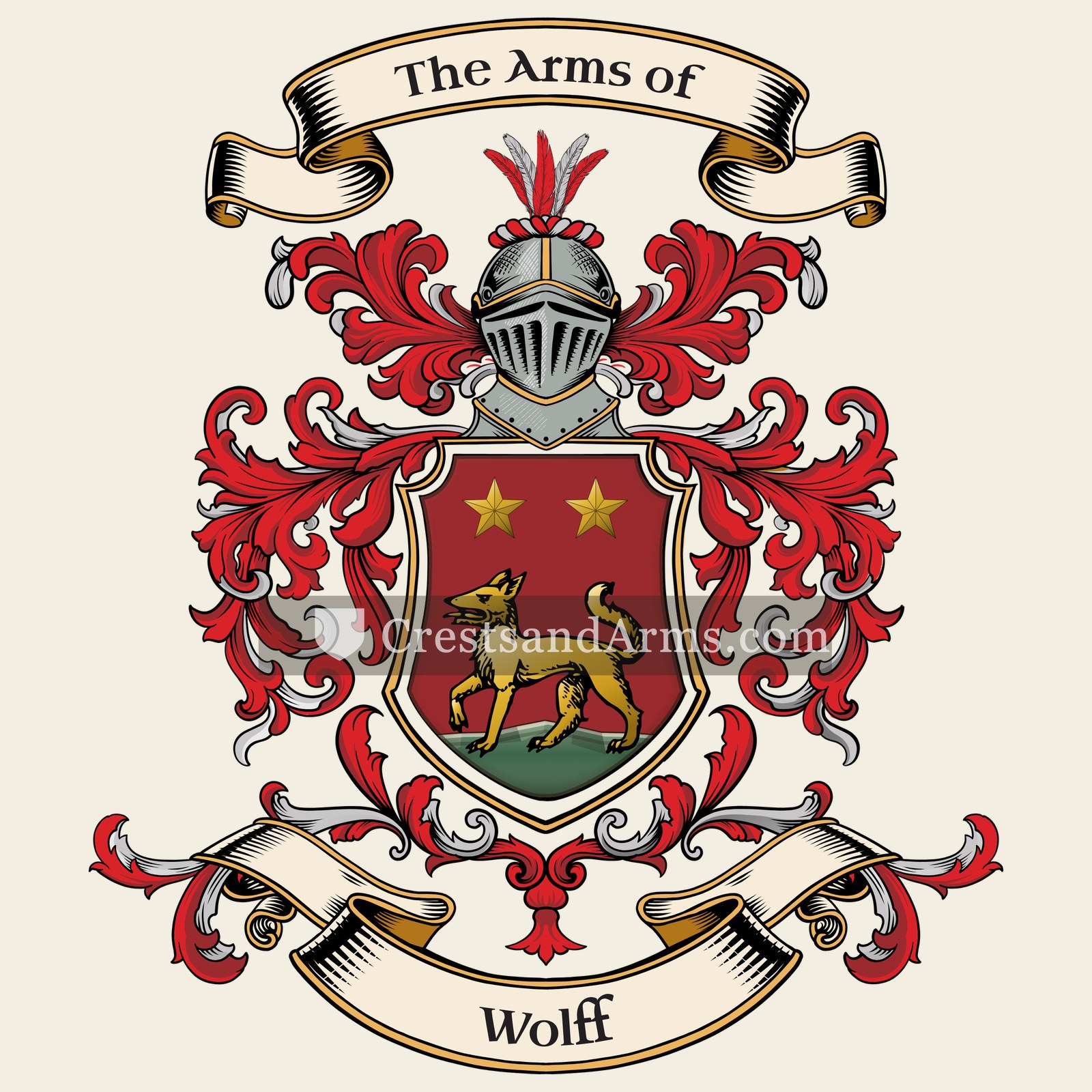
mountThe ground held, and steadfastness upon it
wolfReward from long service and hard work
mulletThe third son, and a divine quality from above
Colours
Red (Gules)Means: Military strength
Green (Vert)Means: Hope
Gold (Or)Means: Generosity
Historical info
Source
J. B. Rietstap, Armorial Général, Gouda: G. B. van Goor Zonen, 1884–87
Blazon (the actual original written record)
“De gu. à un loup ramp. d'or, soutenu d'une terrasse de sin. et acc. en chef de deux étoiles du sec.”
SwitzerlandBerne, c. 1745
Digital archive packCoat of arms PNG, gold border print PDF, vector SVG and the certificate of authenticity. Sent to your email in minutes.
Map of Switzerland showing where the Wolff arms are recorded
The Wolff arms were recorded in Berne, c. 1745.
This is where the arms were entered in the register. Families often moved to other parts of the country, so the same name can turn up in more than one region.
The body that granted and recorded arms in Switzerland in this period.
How Arms Worked in Switzerland
In Switzerland, coats of arms were not restricted to the nobility and were often adopted by common citizens and families. These symbols were passed down through generations to show family identity. When branches of a family grew, they often changed small details of the design to distinguish their own line from the original group.
Granting authority
Cantonal and civic authorities managed the use of coats of arms within their specific regions and local jurisdictions.
How they got arms
Families typically assumed their own coats of arms based on local custom rather than receiving them from a central monarch.
Where arms were recorded
Arms were recorded in various cantonal and civic registers starting from the fourteenth century throughout the Swiss region.
The family's standing
Recorded among the armigerous families of Switzerland.
Origin & History of the Wolff Family in Switzerland
The surname Wolff originates from the Germanic word for wolf, a name often bestowed upon individuals to signify strength, courage, or a connection to the wild landscape of the Alpine region. By the mid-18th century, the family had firmly established roots in the city of Berne, Switzerland, where records confirm their presence by 1745. During this era, families in Berne often played active roles in the local guilds or the civic administration that governed the Swiss cantons. As members of a society defined by strict social structures and regional loyalties, the Wolff family likely contributed to the agricultural or mercantile life that sustained the growing city. Their presence in Berne suggests they were part of the steady migration and settlement patterns that shaped the Swiss identity during the Enlightenment period. Over time, the family name became a permanent fixture in the local population, reflecting the broader history of Swiss families who helped build the foundations of their specific cantons through generations of community involvement.
Wolff Meaning & Related Branches
Root word
Wulf
An Old High German word meaning wolf.
This name
WolffA habitational or occupational name for someone associated with the animal or a brave warrior.
also spelled
Wolf
Wulf
Wolfe
Woolfe
Related arms
de Wolfvariant spelling
Wolfvariant spelling
Wolfevariant spelling
Woolfevariant spelling
Documented Sources
J. B. Rietstap, Armorial Général, Gouda: G. B. van Goor Zonen, 1884–87
Bahlow, Hans, Deutsches Namenlexikon: Familien- und Vornamen nach Ursprung und Sinn erklärt, 1967
Gottschald, Max, Deutsche Namenkunde: Unsere Familiennamen, 1971


 bendDefence, and the scarf of a commander
 wolfReward from long service and hard work
 lionCourage, strength and royalty
 bendDefence, and the scarf of a commander
 wolfReward from long service and hard work
 lionCourage, strength and royalty


 fleur de lisPurity, light, and the sixth son
 eagleNobility, strength and a keen mind
 armA person of action, industrious and laborious
 triangleThe Trinity, and stability


 mountThe ground held, and steadfastness upon it
 mulletThe third son, and a divine quality from above