Map of England showing where the Woodhall arms are recorded
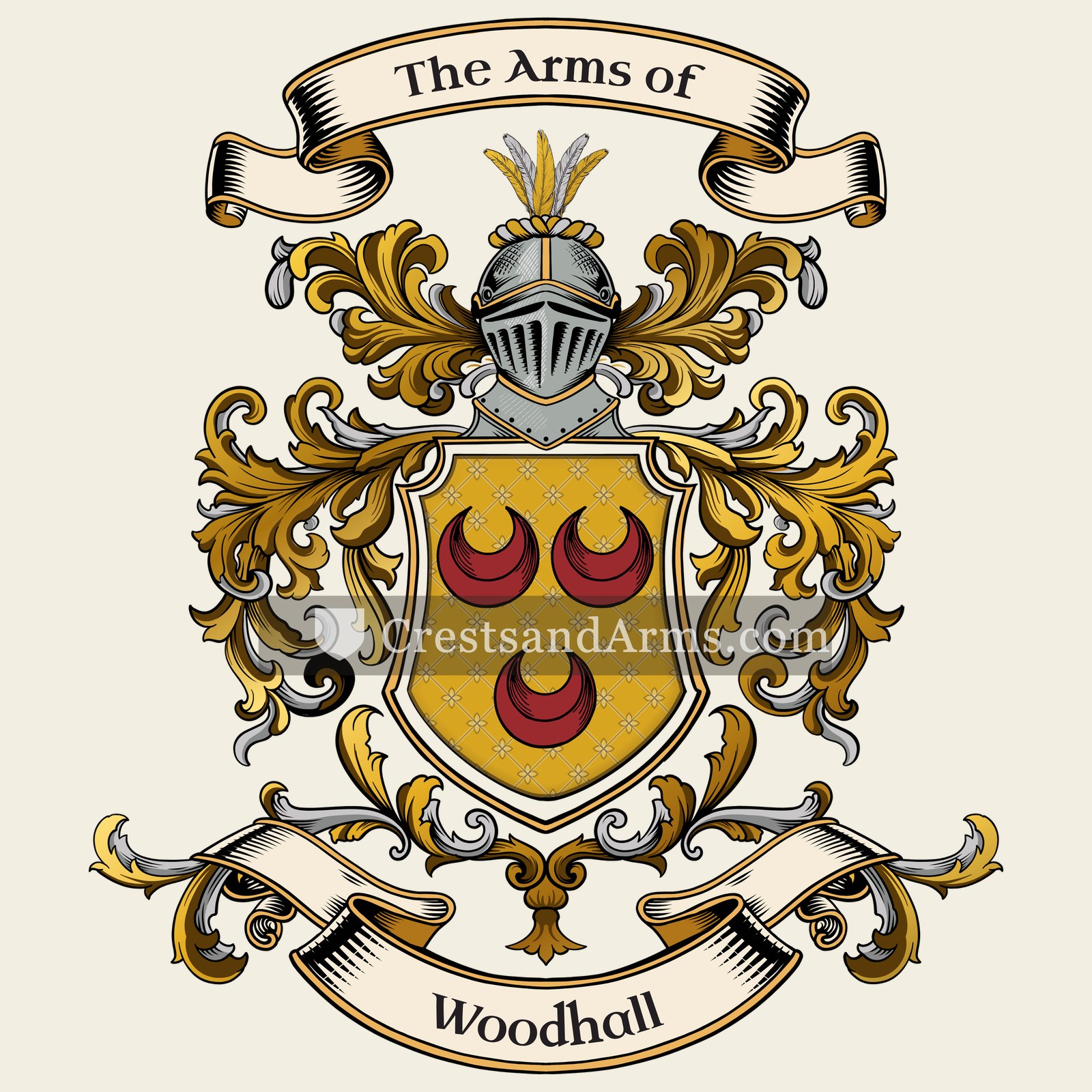
The Woodhall arms were recorded in Northampton, c. 1620.
Northamptonshire was grazing and hunting country in the middle of England, thick with manor houses. Its families were numerous and long-settled, and a settled landed family almost always ended up with arms.
This is where the arms were entered in the register. Families often moved to other parts of the country, so the same name can turn up in more than one region.
The body that granted and recorded arms in England in this period.
James VI and I
Sovereign of the period
James VI and I
1603–1625
Reigning in England when the Woodhall arms are first recorded.
How Arms Worked in England
English heraldry allowed arms to be shared by all legitimate descendants of the original owner. These symbols were treated as personal property that moved through the generations to all children. While the eldest son kept the original design, other family members could use the same shield without needing to change it or register their own unique versions.
Granting authority
The College of Arms in London has regulated the use of coats of arms throughout England and Wales since 1484.
How they got arms
Families typically obtained their coats of arms through a formal grant from the Crown or by proving their ancient right to them.
Where arms were recorded
All official coats of arms are recorded in the registers kept at the College of Arms, which date back to the fifteenth century.
The family's standing
Recorded among the armigerous families of Northampton.
Origin & History of the Woodhall Family in England
The surname Woodhall is a locational name that originated in England, specifically referring to people who lived near a wooden hall or a clearing in a forest. By the early 17th century, the family had established a notable presence in Northampton, a town with deep roots in medieval trade and administration. Records confirm that members of the Woodhall family were living in this region by 1620, a time when the town was a bustling center of the leather and wool industries. Families with this name were often associated with the local gentry or skilled tradespeople who helped shape the community during the transition into the Stuart period. Because the name is tied to the physical landscape, it suggests that the earliest ancestors were likely stewards or residents of significant timber-framed estates that gave the family its lasting identity.
Related Branches & Arms
Root word
wudu and halh
Old English terms for wood or forest and a nook or hollow.
This name
WoodhallA habitational name referring to someone who lived in a nook or hollow within a wooded area.
also spelled
Woodhale
Wodhale
Related arms
Woodallvariant spelling
Adamrecorded with Woodhall, same area
Asherburn, or Ashburnerrecorded with Woodhall, same area
Audleyrecorded with Woodhall, same area
Documented Sources
Sir Bernard Burke, The General Armory of England, Scotland, Ireland and Wales, London: Harrison & Sons, 1884
Bardsley, Charles Wareing, A Dictionary of English and Welsh Surnames, 1901
Mills, Anthony David, A Dictionary of English Place-Names, 1991
Northamptonshire Archives, Northampton St Sepulchre Parish Registers, 1620
Digital archive packCoat of arms PNG, gold border print PDF, vector SVG and the certificate of authenticity. Sent to your email in minutes.


 crescentHonour by the sovereign, and the second son
 crescentHonour by the sovereign, and the second son