Map of Germany showing where the Wrede arms are recorded
The Wrede arms were recorded in Westphalia, c. 1765.
Westphalia was a land of small estates and fortified farmhouses in western Germany. Its families were numerous and not especially rich, but each held its own ground, and holding ground was what brought arms.
This is where the arms were entered in the register. Families often moved to other parts of the country, so the same name can turn up in more than one region.
The body that granted and recorded arms in Germany in this period.
Francis I, Holy Roman Emperor
Sovereign of the period
Francis I, Holy Roman Emperor
1745–1765
Reigning in Germany when the Wrede arms are first recorded.
How Arms Worked in Germany
In the Holy Roman Empire, coats of arms were often granted to individuals by the Emperor or his representatives. These arms were then passed down through the generations to all legitimate descendants of the original holder. Younger branches of a family usually kept the same shield design without needing to change it, as the arms belonged to the entire lineage.
Granting authority
The Holy Roman Emperor held the sole power to grant new coats of arms throughout his vast imperial territories.
How they got arms
Families typically obtained their coats of arms through a formal imperial grant or by proving their noble status to the authorities.
Where arms were recorded
These grants were officially recorded in the Imperial Chancery registers, which began keeping formal records of such honors during the Middle Ages.
The family's standing
Recorded among the armigerous families of Westphalia.
Origin & History of the Wrede Family in Germany
The family name Wrede has deep roots in the northern regions of Germany, particularly within the historical territory of Westphalia. Linguists believe the name originated as a descriptive nickname derived from the Middle Low German word "wrede," which meant fierce, angry, or stern. In the social structure of the eighteenth century, families often settled in specific rural districts where they worked as landowners or skilled tradespeople. By 1765, records confirm that members of the Wrede family were well-established in Westphalian communities, living as part of the local agrarian society. As these families grew, they helped shape the cultural and social fabric of their villages through their involvement in local parish life and regional trade. Over time, the name became a permanent fixture in the area, reflecting the transition from simple descriptive labels to formal family surnames that defined their place in German history.
Coat of Arms & Family Crest Details
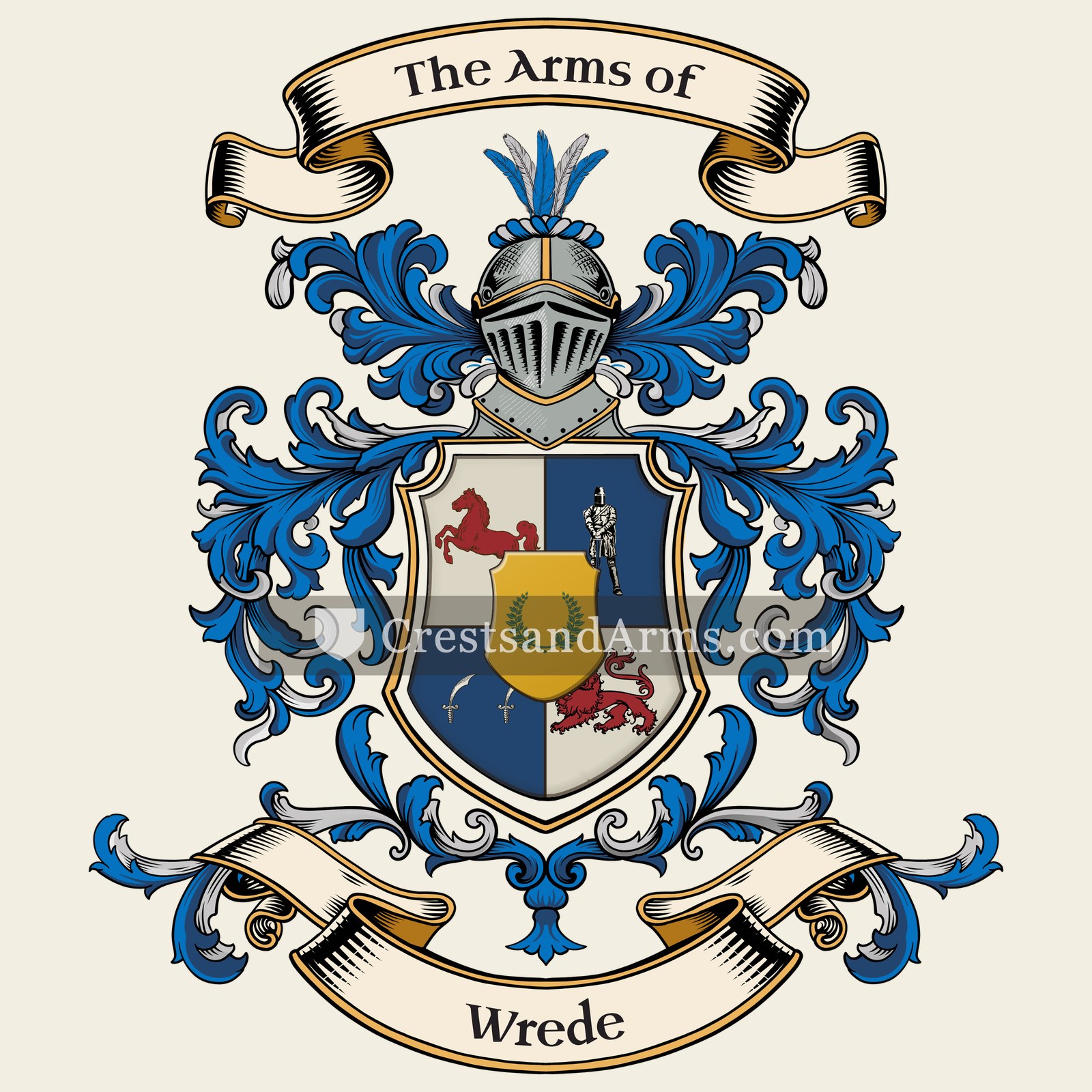
Symbols on this shield
wreathHonour, and a victory crowned
horseReadiness to serve king and country
knightChivalry and service in arms
swordJustice, and military honour
lionCourage, strength and royalty
Colours
Silver (Argent)Means: Peace and sincerity
Blue (Azure)Means: Loyalty and truth
Gold (Or)Means: Generosity
Green (Vert)Means: Hope
Red (Gules)Means: Military strength
Historical info
Source
J. B. Rietstap, Armorial Général, Gouda: G. B. van Goor Zonen, 1884–87
Blazon (the actual original written record)
“Ec.: au 1 d'arg. à un cheval cabré de gu., cour. d'or, sellé et bridé d'arg.; au 2 d'azur à un chevalier, arm. de toutes pièces au nat., tenant une épée de sa.; au 3 d'azur à deux épées d'arg., garnies d'or, passées en saut. dans une couronne d'or; au 4 d'arg. au lion de gu. Sur le tout d'or à une couronne de laurier de sin., fleurie de cinq roses de gu., 1, 2 et 2. Trois cq. cour. C.: 1º un senestrochère, arm. d'arg., posé sur le coude, la main de carn. tenant une clé d'or, en barre, le panneton en haut à dextre; 2º la couronne de laurier, entre un vol, d'or et de gu.; 3º un lion iss. d'or, devant quatre pennons alt. d'arg. et d'azur, deux à dextre et deux à sen. D.: VIRTUTI PRO PATRIA.”
Swedenc. 1687
Digital archive packCoat of arms PNG, gold border print PDF, vector SVG and the certificate of authenticity. Sent to your email in minutes.
Map of Sweden showing where the Wrede arms are recorded
The Wrede arms were recorded in Sweden, c. 1687.
Arms such as these were typically recorded in Stockholm.
Stockholm held the Swedish court and the House of Nobility, where every noble family's arms were entered and kept. Families ennobled for service registered there, which is why so many are recorded around the city.
This is where the arms were entered in the register. Families often moved to other parts of the country, so the same name can turn up in more than one region.
The body that granted and recorded arms in Sweden in this period.
Charles XI of Sweden
Sovereign of the period
Charles XI of Sweden
1660–1697
Reigning in Germany when the Wrede arms are first recorded.
How Arms Worked in Sweden
In Sweden, a coat of arms belonged to a noble family as a whole rather than just one individual. These arms were passed down through the generations to all legitimate descendants. Younger branches of the family used the same shield without needing to change it. This system ensured that the entire lineage shared the same identity and status under the law.
Granting authority
The Riddarhuset, or House of Nobility, regulated all noble coats of arms in Sweden under royal authority.
How they got arms
Families received their coats of arms through royal grants of nobility which were then officially registered with the House.
Where arms were recorded
Coats of arms were officially recorded in the Swedish House of Nobility register starting in the year 1626.
The family's standing
Recorded among the armigerous families of Sweden.
Origin & History of the Wrede Family in Sweden
The Wrede family name has deep roots in the history of the Swedish nobility, with records confirming their influential presence in Stockholm by 1687. The family originally migrated from the Baltic regions, eventually becoming a prominent part of the Swedish administrative and military elite during the era of the Swedish Empire. As the family established itself in the capital, members began to serve in high-ranking government positions, which helped them secure a lasting legacy within the country. By the late 17th century, the Wredes were well integrated into the social and political life of Stockholm. Their rise to power was typical of families who moved to Sweden to support the crown during a time of expansion. Through their service to the state, the family name became synonymous with the governance and development of the Swedish realm.
Related Branches & Arms
Root word
Wred
Old High German word meaning angry, fierce, or untamed.
This name
WredeA descriptive nickname for a person with a fierce, wild, or irritable temperament.
also spelled
Wredes
Wredde
Wred
Vrede
Rede
Documented Sources
J. B. Rietstap, Armorial Général, Gouda: G. B. van Goor Zonen, 1884–87
Bahlow, Hans, Deutsches Namenlexikon: Familien- und Vornamen nach Ursprung und Sinn erklärt, 1967
Gottschald, Max, Deutsche Namenkunde: Unsere Familiennamen, 1971
Landesarchiv Nordrhein-Westfalen, Kirchenbücher der evangelischen und katholischen Kirchengemeinden in Westfalen, 1765
Digital archive packCoat of arms PNG, gold border print PDF, vector SVG and the certificate of authenticity. Sent to your email in minutes.


 wreathHonour, and a victory crowned
 wreathHonour, and a victory crowned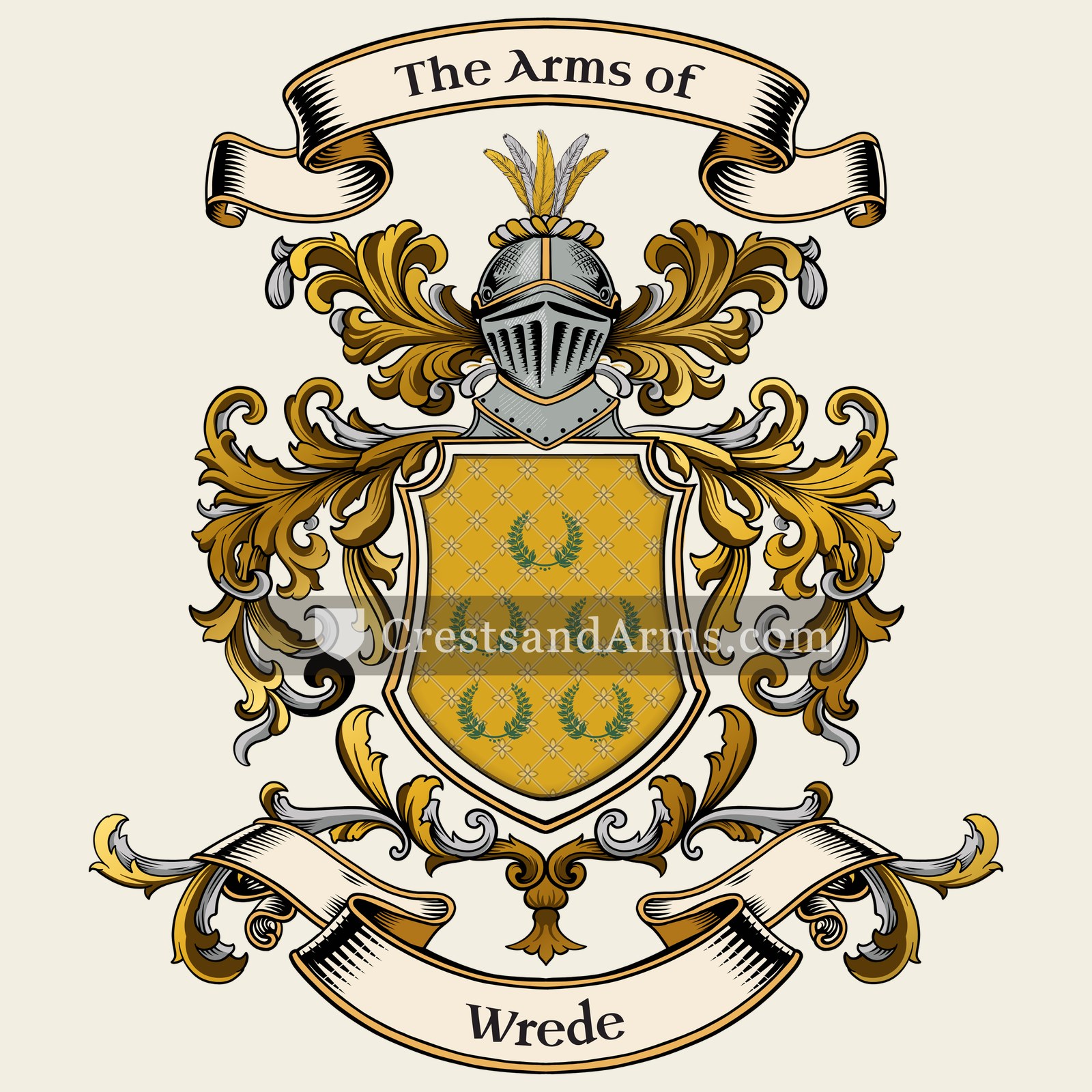


 horseReadiness to serve king and country
 knightChivalry and service in arms
 swordJustice, and military honour
 lionCourage, strength and royalty