Map of Germany showing where the Zanker arms are recorded
The Zanker arms were recorded in Saxony, c. 1821.
Saxony had mines, trade and old landed families all at once. Silver made some fortunes and land held others, and both sorts of family kept arms, which is why Saxon names appear so often in the registers.
This is where the arms were entered in the register. Families often moved to other parts of the country, so the same name can turn up in more than one region.
The body that granted and recorded arms in Germany in this period.
Frederick William III of Prussia
Sovereign of the period
Frederick William III of Prussia
1797–1840
Reigning in Germany when the Zanker arms are first recorded.
How Arms Worked in Germany
Prussian heraldry was strictly tied to social rank and noble status rather than being a free choice for every citizen. These symbols were treated as permanent family property that moved through the generations to all legitimate heirs. If a family branch wanted to change their design to stand out, they had to apply for official permission to alter their specific version of the shield.
Granting authority
The Prussian Heroldsamt acted as the central state office that managed and strictly controlled all noble titles and coats of arms.
How they got arms
Families usually obtained their arms through formal royal grants or by proving their long-standing noble status to the state authorities.
Where arms were recorded
All official coats of arms were kept in the rolls of the Prussian Heroldsamt, which functioned from 1706 until 1918.
The family's standing
Recorded among the armigerous families of Saxony.
Origin & History of the Zanker Family in Germany
The surname Zanker is rooted in the linguistic traditions of the German language, likely originating as a descriptive nickname for a person with a quarrelsome or contentious nature. The name is derived from the Middle High German word "zanken," which means to argue or to bicker. By the early 19th century, records confirm that families bearing this name were well-established in the region of Saxony. During this period, Saxony was a kingdom undergoing significant social and industrial changes, and families like the Zankers were often part of the hardworking agrarian or emerging artisan classes. Because surnames were often assigned based on personality traits or local reputation in small villages, the Zanker name serves as a historical marker of the social dynamics within these tight-knit German communities. The presence of the family in Saxony by 1821 suggests they were deeply integrated into the local culture and regional economy long before the unification of the German Empire.
Coat of Arms & Family Crest Details
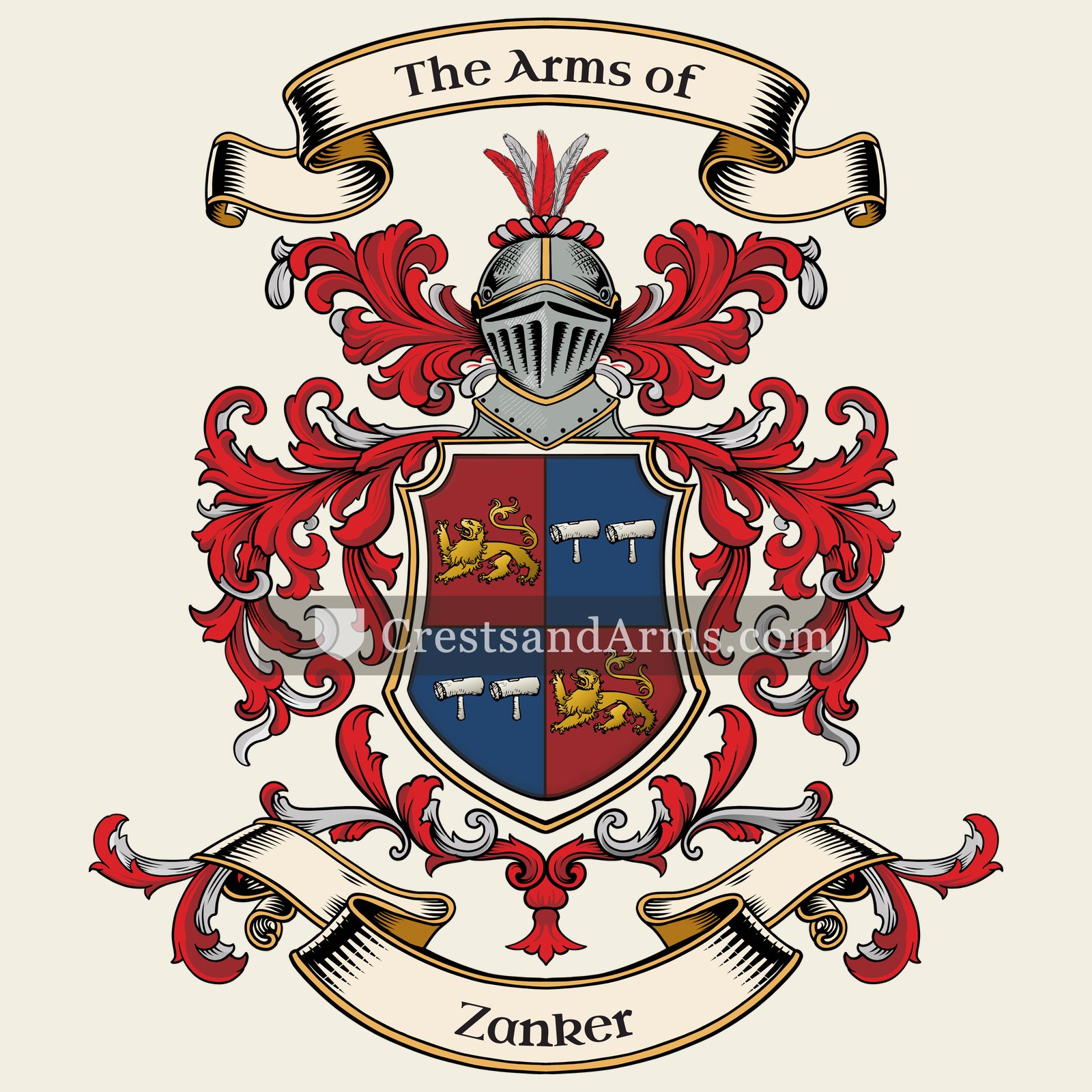
Symbols on this shield
saltireResolution, and St Andrew's cross
lionCourage, strength and royalty
hammerHonest labour, and the smith's craft
Colours
Red (Gules)Means: Military strength
Blue (Azure)Means: Loyalty and truth
Gold (Or)Means: Generosity
Silver (Argent)Means: Peace and sincerity
Historical info
Source
J. B. Rietstap, Armorial Général, Gouda: G. B. van Goor Zonen, 1884–87
Blazon (the actual original written record)
“Ec.: aux 1 et 4 de gu. au lion d'or, cour. du même, celui du 1 cont.; aux 2 et 3 d'azur à un marteau d'arg. en bande et un maillet du même en barre, passés en saut. Deux cq. cour. C.: 1º le lion du 1, iss.; l. d'or et de gu.; 2º les meubles du 2, entre un vol de sa.; l. d'arg. et d'azur.”
Austriac. 1754
Digital archive packCoat of arms PNG, gold border print PDF, vector SVG and the certificate of authenticity. Sent to your email in minutes.
Map of Austria showing where the Zanker arms are recorded
The Zanker arms were recorded in Austria, c. 1754.
Arms such as these were typically recorded in Tyrol.
Tyrol was mountain country in western Austria, where the valleys were held by families who had been there a very long time. Old tenure counted for more than money, and old families carried arms.
This is where the arms were entered in the register. Families often moved to other parts of the country, so the same name can turn up in more than one region.
Region
Tyrol
First recorded
1754
Granting Authority for the Zanker Arms
Imperial and Royal chancery
Sodacan · CC BY-SA 3.0
The body that granted and recorded arms in Austria in this period.
Francis I, Holy Roman Emperor
Sovereign of the period
Francis I, Holy Roman Emperor
1745–1765
Reigning in Germany when the Zanker arms are first recorded.
How Arms Worked in Austria
Austrian coats of arms were often linked directly to noble titles granted by the Emperor. These symbols belonged to the entire family line rather than just one individual. When a family grew, new branches kept the original design without needing to change it. This system allowed all members of a noble house to share the same identity across many generations.
Granting authority
The Imperial and Royal chancery managed all heraldic matters and controlled the official granting of arms throughout the Austrian lands.
How they got arms
Families typically received their arms through a formal imperial decree that often accompanied the elevation of a person to noble status.
Where arms were recorded
Official records of these grants were kept in the Imperial Register of Nobility which began its formal documentation process in 1453.
The family's standing
Recorded among the armigerous families of Austria.
Origin & History of the Zanker Family in Austria
The family name Zanker has deep roots in the mountainous landscape of Tyrol, where records confirm members of the family were living as early as 1754. In this region, surnames often developed based on a person’s trade, physical traits, or the specific farmstead they managed. The name Zanker likely stems from the Middle High German word "zanken," which refers to someone who is argumentative or prone to disputes. In the tight-knit communities of the Austrian Alps, such a name might have originally served as a descriptive nickname for a local resident known for their stubborn nature or their role in settling communal disagreements. As families became more settled in these alpine valleys, this nickname transitioned into a permanent hereditary surname, marking the Zanker family as part of the long-standing social fabric of the Tyrol region.
Related Branches & Arms
Root word
Zanke
A Middle High German term referring to a quarrel or dispute.
This name
ZankerA nickname for a quarrelsome, argumentative, or contentious individual.
also spelled
Zenkar
Zenke
Documented Sources
J. B. Rietstap, Armorial Général, Gouda: G. B. van Goor Zonen, 1884–87
Bahlow, Hans, Deutsches Namenlexikon: Familien- und Vornamen nach Ursprung und Sinn erklärt, 1967
Heintze, Albert, Die deutschen Familien-Namen: geschichtlich, geographisch, sprachlich, 1903
Sächsisches Staatsarchiv, Kirchenbücher der evangelisch-lutherischen Landeskirche Sachsens, 1821
Digital archive packCoat of arms PNG, gold border print PDF, vector SVG and the certificate of authenticity. Sent to your email in minutes.


 saltireResolution, and St Andrew's cross
 lionCourage, strength and royalty
 saltireResolution, and St Andrew's cross
 lionCourage, strength and royalty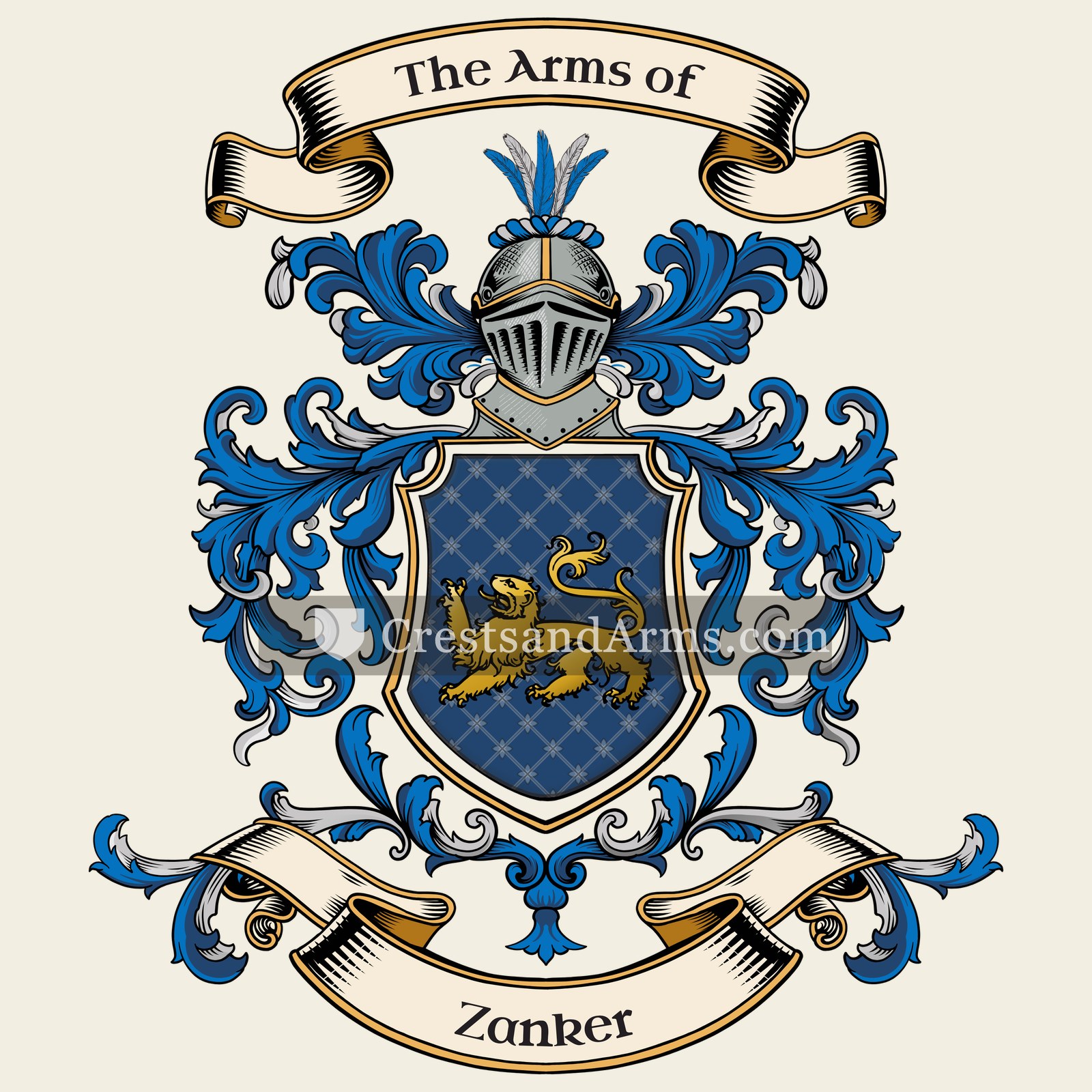


 hammerHonest labour, and the smith's craft