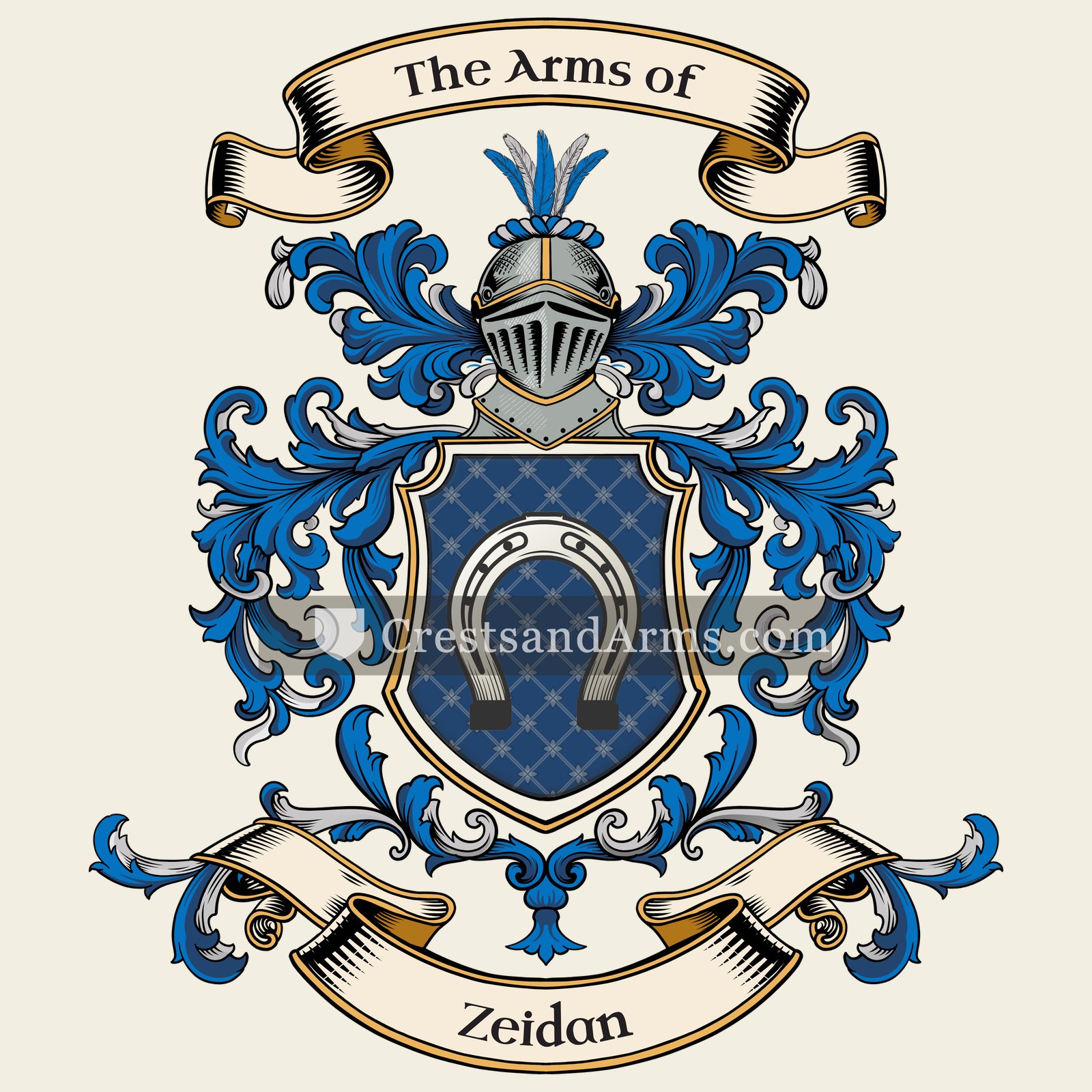
A record of documented arms, meaning and origin, researched for the Zeidan family of Poland.
Reg. 2435 · Polish
Coat of Arms & Family Crest Details
Symbols on this shield
horseshoeGood fortune and protection from harm
Colours
Blue (Azure)Means: Loyalty and truth
Silver (Argent)Means: Peace and sincerity
Historical info
Source
J. B. Rietstap, Armorial Général, Gouda: G. B. van Goor Zonen, 1884–87
Blazon (the actual original written record)
“D'azur à un fer-à-cheval, les bouts en bas, sommé d'un cimeterre en pal, la pointe en haut et à dextre, le tout d'arg. Cq. cour. C.: un bras, paré d'arg., brandissant un cimeterre.”
Polandc. 1772
Digital archive packCoat of arms PNG, gold border print PDF, vector SVG and the certificate of authenticity. Sent to your email in minutes.
Map of Poland showing where the Zeidan arms are recorded
The Zeidan arms were recorded in Poland, c. 1772.
Arms such as these were typically recorded in Mazovia.
Mazovia held Warsaw, the Polish court and the assemblies where the szlachta met. Poland's nobles were unusually numerous and every one of them bore arms, and Warsaw is where those arms were argued over and recorded.
This is where the arms were entered in the register. Families often moved to other parts of the country, so the same name can turn up in more than one region.
Region
Mazovia
First recorded
1772
Granting Authority for the Zeidan Arms
Ennoblement by the Sejm
Author: Olek Remesz · CC BY-SA 3.0
The body that granted and recorded arms in Poland in this period.
Stanisław August Poniatowski
Sovereign of the period
Stanisław August Poniatowski
1764–1795
Reigning in Poland when the Zeidan arms are first recorded.
How Arms Worked in Poland
Polish noble families shared a single coat of arms across many different surnames, creating large clans rather than individual designs. These symbols were held collectively by all members of the clan regardless of their specific family name. When a new family joined the nobility, they were adopted into an existing clan and began using that group's established shield.
Granting authority
The Sejm, which was the Polish parliament, held the power to grant noble status and the right to bear arms.
How they got arms
Families typically received their coat of arms through a formal act of ennoblement granted by the Sejm for distinguished service.
Where arms were recorded
These grants were officially recorded in the Crown Metrica, which served as the central archive for state documents starting in the sixteenth century.
The family's standing
Recorded among the armigerous families of Poland.
Origin & History of the Zeidan Family in Poland
The Zeidan family name carries a deep history rooted in the cultural crossroads of Central Europe. By 1772, records confirm that members of the family were established in the Mazovia region of Poland. During this period, Mazovia served as a vital hub for trade and administration, placing the family in a dynamic environment that connected various ethnic and linguistic groups. The name itself is often associated with Semitic origins, suggesting that early ancestors may have migrated across vast distances before settling in the Polish heartland. Over generations, the family integrated into the local social fabric of Mazovia, adapting to the customs and languages of their new home while maintaining a distinct identity. This transition from mobile origins to a settled life in the eighteenth century highlights the resilience and adaptability of the early Zeidan ancestors as they navigated the changing political landscape of the Polish-Lithuanian Commonwealth.
Related Branches & Arms
Root word
Zaid
Arabic root meaning to increase, grow, or abundance.
This name
ZeidanA surname indicating one who is prosperous, abundant, or growing in stature.
also spelled
Sdan
Documented Sources
J. B. Rietstap, Armorial Général, Gouda: G. B. van Goor Zonen, 1884–87
Gieysztor, Aleksander. Dzieje Mazowsza. 1994
Archiwum Główne Akt Dawnych (AGAD), Metryki Koronne
Digital archive packCoat of arms PNG, gold border print PDF, vector SVG and the certificate of authenticity. Sent to your email in minutes.


 horseshoeGood fortune and protection from harm
 horseshoeGood fortune and protection from harm