Map of Netherlands showing where the Zeiler arms are recorded
The Zeiler arms were recorded in Guelders, c. 1815.
Guelders was river country in the east of the Netherlands, held by families whose estates sat along the water. Land there stayed in the same hands for generations, and long tenure is what fills a register of arms.
This is where the arms were entered in the register. Families often moved to other parts of the country, so the same name can turn up in more than one region.
Region
Guelders
First recorded
1815
Granting Authority for the Zeiler Arms
Hoge Raad van Adel
Photograph made by me · CC BY-SA 3.0
The body that granted and recorded arms in Netherlands in this period.
William I of the Netherlands
Sovereign of the period
William I of the Netherlands
1815–1840
Reigning in Netherlands when the Zeiler arms are first recorded.
How Arms Worked in Netherlands
In the Netherlands, coats of arms were often used by noble families and those who held specific public offices. These arms were passed down through the generations to legitimate descendants. Younger branches of a family usually kept the original design without needing to add special marks. This system ensured that the family identity remained clear and consistent over many years.
Granting authority
The Hoge Raad van Adel is the official body that regulates and manages noble titles and coats of arms in the Netherlands.
How they got arms
Families typically obtained their coats of arms through official royal grants or by proving their long-standing historical use of the symbols.
Where arms were recorded
Coats of arms are officially recorded in the registers held by the Hoge Raad van Adel, which began its work in 1814.
The family's standing
Recorded among the armigerous families of Guelders.
Origin & History of the Zeiler Family in Netherlands
The Zeiler family name has deep roots in the historical region of Guelders, where members of the family were documented as early as 1815. In the Dutch language, the name is likely derived from the occupational term "zeiler," which refers to a person who worked with sails or operated a sailing vessel. During the early 19th century, Guelders served as a vital hub for river trade along the Rhine and IJssel rivers. Families with this name were often connected to the maritime industry, playing a practical role in the transport of goods across the inland waterways of the Netherlands. As the family established itself in this region, they became part of the local social fabric, transitioning from specialized laborers into the broader community of the Dutch provinces. Their presence in the official records of 1815 reflects a time when the Netherlands was reorganizing as a kingdom, marking a period where many families began to solidify their surnames in civil registries.
Coat of Arms & Family Crest Details
Symbols on this shield
chevronProtection, and faithful service completed
applePeace, plenty and long-standing settlement
Colours
Black (Sable)Means: Constancy
Red (Gules)Means: Military strength
Historical info
Source
J. B. Rietstap, Armorial Général, Gouda: G. B. van Goor Zonen, 1884–87
Blazon (the actual original written record)
“De sa. à deux chev. de gu., dont l'un renv. et mouv. du chef; acc. de trois pommes mal-ordonnées de gu. C.: un vol à l'antique de sa. L. de sa. et de gu.”
AustriaLinz Aut, c. 1772
Digital archive packCoat of arms PNG, gold border print PDF, vector SVG and the certificate of authenticity. Sent to your email in minutes.
Map of Austria showing where the Zeiler arms are recorded
The Zeiler arms were recorded in Linz Aut, c. 1772.
This is where the arms were entered in the register. Families often moved to other parts of the country, so the same name can turn up in more than one region.
Region
Linz
Town
Linz Aut
First recorded
1772
Granting Authority for the Zeiler Arms
Imperial and Royal chancery
Sodacan · CC BY-SA 3.0
The body that granted and recorded arms in Austria in this period.
Joseph II, Holy Roman Emperor
Sovereign of the period
Joseph II, Holy Roman Emperor
1765–1790
Reigning in Netherlands when the Zeiler arms are first recorded.
How Arms Worked in Austria
Austrian coats of arms were often linked directly to noble titles granted by the Emperor. These symbols belonged to the entire family line rather than just one individual. When a family grew, new branches kept the original design without needing to change it. This system allowed all members of a noble house to share the same identity across many generations.
Granting authority
The Imperial and Royal chancery managed all heraldic matters and controlled the official granting of arms throughout the Austrian lands.
How they got arms
Families typically received their arms through a formal imperial decree that often accompanied the elevation of a person to noble status.
Where arms were recorded
Official records of these grants were kept in the Imperial Register of Nobility which began its formal documentation process in 1453.
The family's standing
Recorded among the armigerous families of Austria.
Origin & History of the Zeiler Family in Austria
The family name Zeiler has deep roots in the Austrian landscape, particularly within the historic city of Linz. By the year 1772, records confirm that members of the Zeiler family were already established residents of this region. The name itself is occupational in origin, likely derived from the Middle High German word "zeil," which refers to a row or a line. This suggests that the earliest ancestors may have been individuals who lived in a specific row of houses or worked as laborers who arranged goods in orderly lines. As the family grew within the Danube region, they became part of the local social fabric of Upper Austria. Their presence in Linz during the late 18th century reflects a time of steady growth and urbanization in the city, where families often identified themselves by their trade or their specific location within the town walls.
Coat of Arms & Family Crest Details
Symbols on this shield
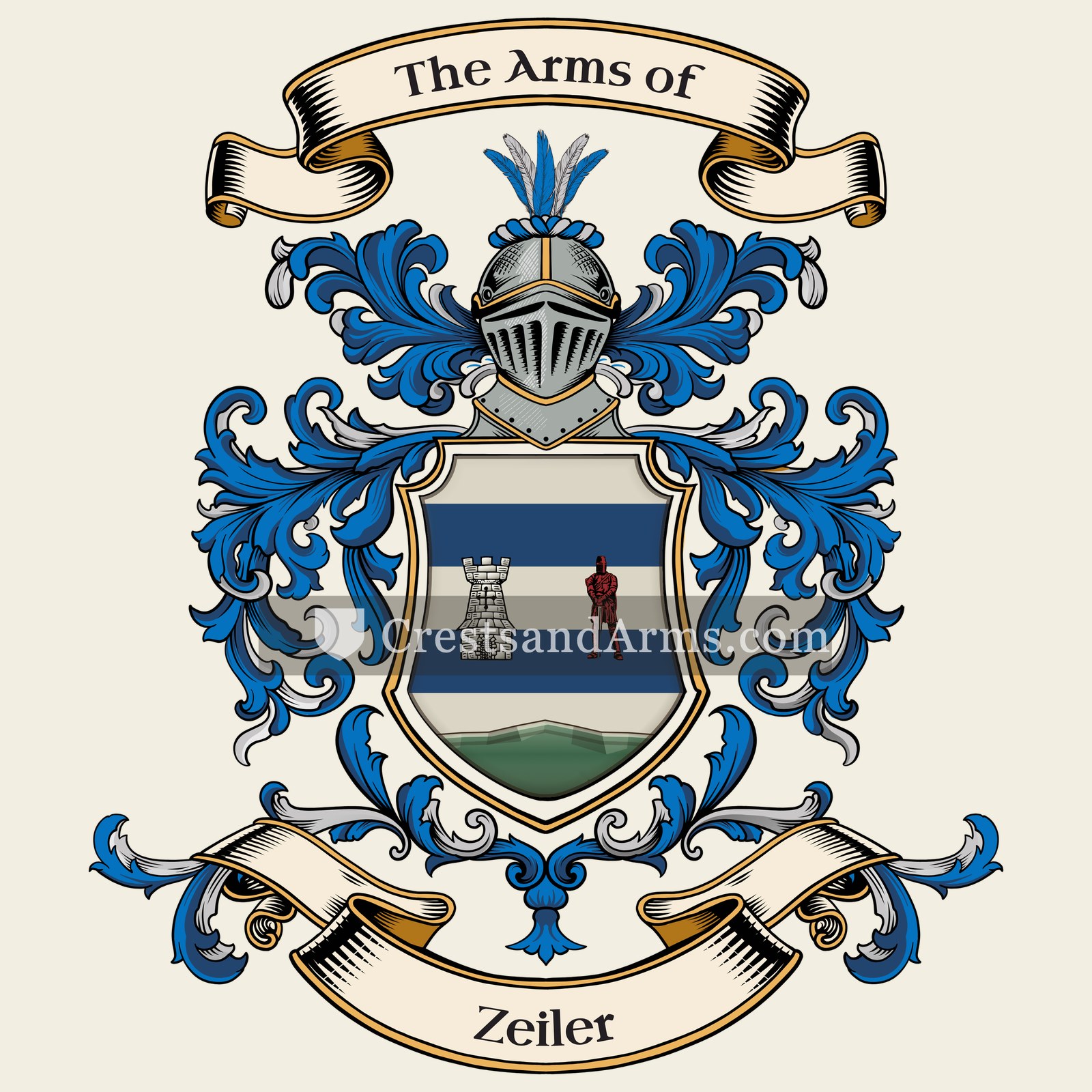
mountThe ground held, and steadfastness upon it
fessThe military belt, and readiness to serve
towerGrandeur and solidity, and a stronghold defended
knightChivalry and service in arms
Colours
Blue (Azure)Means: Loyalty and truth
Green (Vert)Means: Hope
Silver (Argent)Means: Peace and sincerity
Red (Gules)Means: Military strength
Historical info
Source
J. B. Rietstap, Armorial Général, Gouda: G. B. van Goor Zonen, 1884–87
Blazon (the actual original written record)
“D'azur à une tente blanche, l'intérieur d'arg., sommée d'un toit pointu de gu.; et un homme à sen., montant la garde devant l'entrée, hab. de gu., coiffé d'un bonnet du même, tenant une hallebarde au nat.; le tout soutenu d'une terrasse de sin. Brl. de gu. et d'arg. C.: un drapeau fascé de gu. et d'arg. de quatre pièces, flottant à sen., attaché à une pique d'or. L. d'arg. et de gu.”
SwitzerlandBâle, c. 1745
Digital archive packCoat of arms PNG, gold border print PDF, vector SVG and the certificate of authenticity. Sent to your email in minutes.
Map of Switzerland showing where the Zeiler arms are recorded
The Zeiler arms were recorded in Bâle, c. 1745.
This is where the arms were entered in the register. Families often moved to other parts of the country, so the same name can turn up in more than one region.
The body that granted and recorded arms in Switzerland in this period.
How Arms Worked in Switzerland
In Switzerland, coats of arms were not restricted to the nobility and were often adopted by common citizens and families. These symbols were passed down through generations to show family identity. When branches of a family grew, they often changed small details of the design to distinguish their own line from the original group.
Granting authority
Cantonal and civic authorities managed the use of coats of arms within their specific regions and local jurisdictions.
How they got arms
Families typically assumed their own coats of arms based on local custom rather than receiving them from a central monarch.
Where arms were recorded
Arms were recorded in various cantonal and civic registers starting from the fourteenth century throughout the Swiss region.
The family's standing
Recorded among the armigerous families of Switzerland.
Origin & History of the Zeiler Family in Switzerland
The surname Zeiler is deeply rooted in the German-speaking regions of Europe, where it historically functioned as an occupational name. In the context of Switzerland, the name is derived from the Middle High German word "zeile," which refers to a row or a line. This suggests that the earliest ancestors bearing this name were likely involved in organized labor, such as farmers working in rows or craftsmen who lived along a specific street or row of houses. By the time the family was documented in Basel in 1745, they were part of the vibrant urban culture of a city known for its trade and intellectual life. During the eighteenth century, Basel served as a major crossroads for merchants and skilled workers, and families like the Zeilers contributed to the city's growth through their participation in local guilds and civic life. The presence of the family in such a prominent Swiss center indicates that they were integrated into the social and economic fabric of the region during a period of significant industrial and cultural development.
Related Branches & Arms
Root word
Zeil
A sail or a piece of cloth used for navigation.
This name
ZeilerAn occupational name for a sailmaker or someone who worked with sails.
also spelled
Zeler
Documented Sources
J. B. Rietstap, Armorial Général, Gouda: G. B. van Goor Zonen, 1884–87
Archives: Gelders Archief, Burgerlijke Stand Gelderland
Books: Berkel, G. van and Samplonius, K., Nederlandse plaatsnamen verklaard, 2018
Books: Winkler, J., De Nederlandsche geslachtsnamen in oorsprong, geschiedenis en beteekenis, 1885
Digital archive packCoat of arms PNG, gold border print PDF, vector SVG and the certificate of authenticity. Sent to your email in minutes.


 armA person of action, industrious and laborious
 armA person of action, industrious and laborious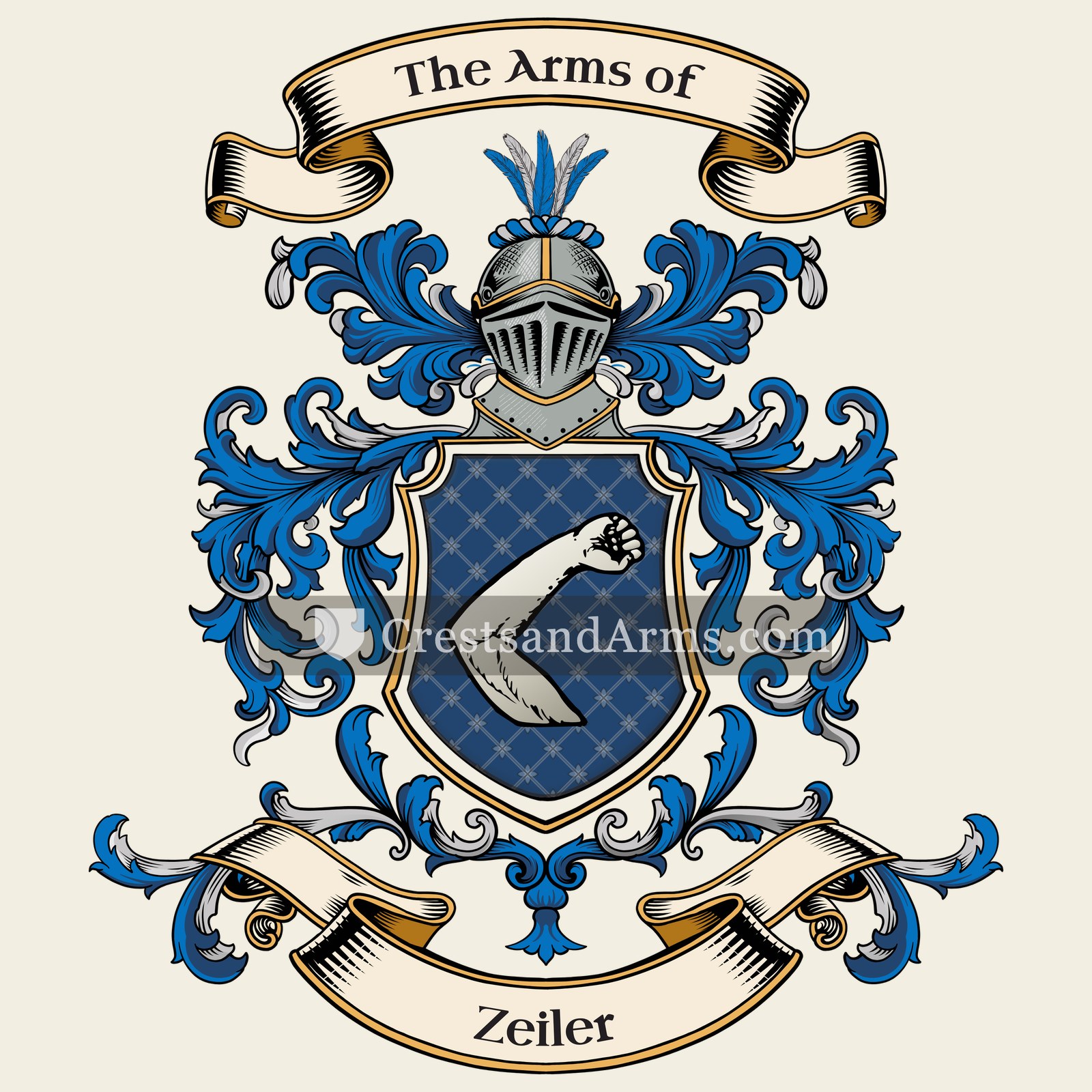


 chevronProtection, and faithful service completed
 applePeace, plenty and long-standing settlement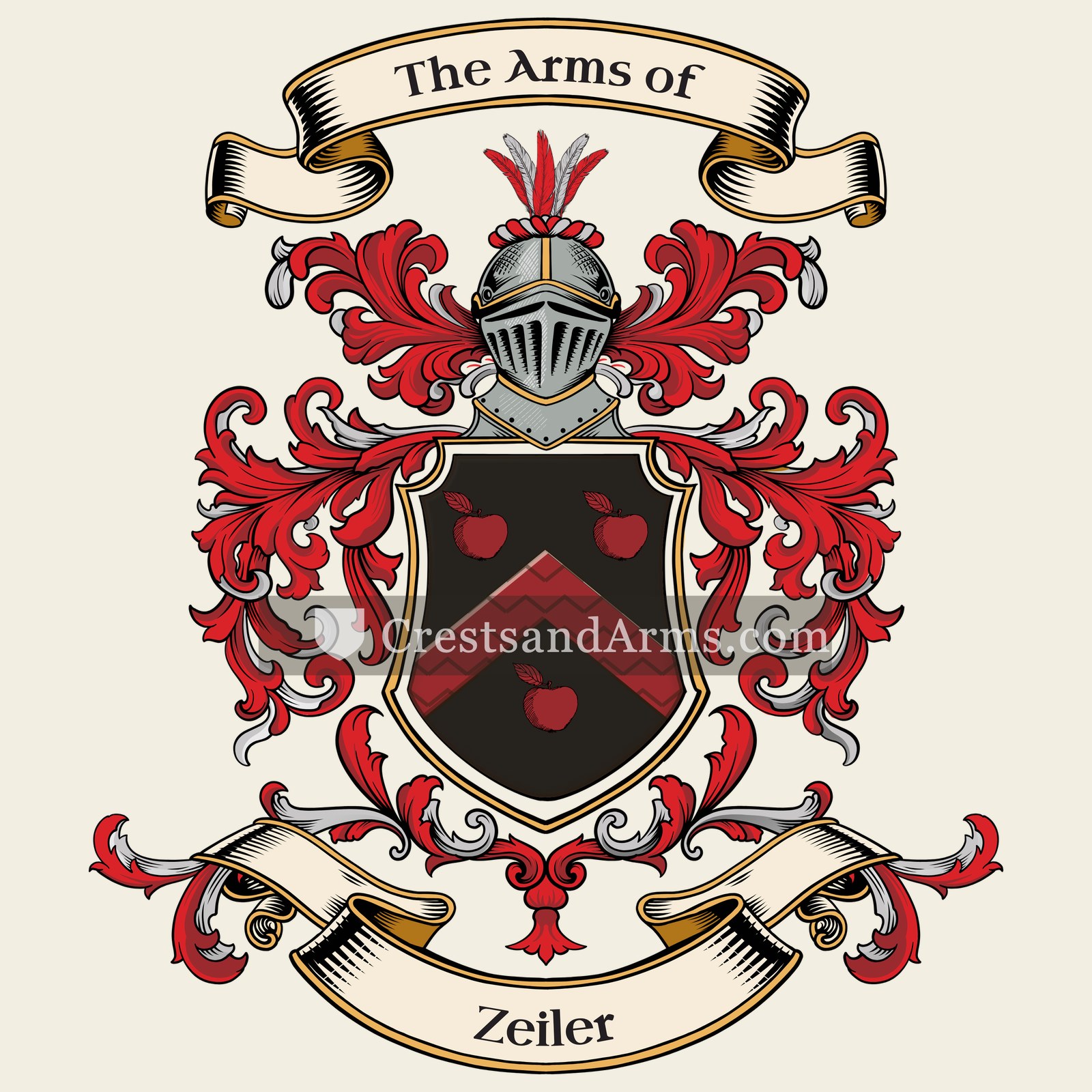


 mountThe ground held, and steadfastness upon it
 fessThe military belt, and readiness to serve
 towerGrandeur and solidity, and a stronghold defended
 knightChivalry and service in arms