A record of documented arms, meaning and origin, researched for the Zeis family lines. Documented in 2 countries.
Reg. 1572 · German
Meaning of the Zeis family crest colors & symbols
Symbols on this shield
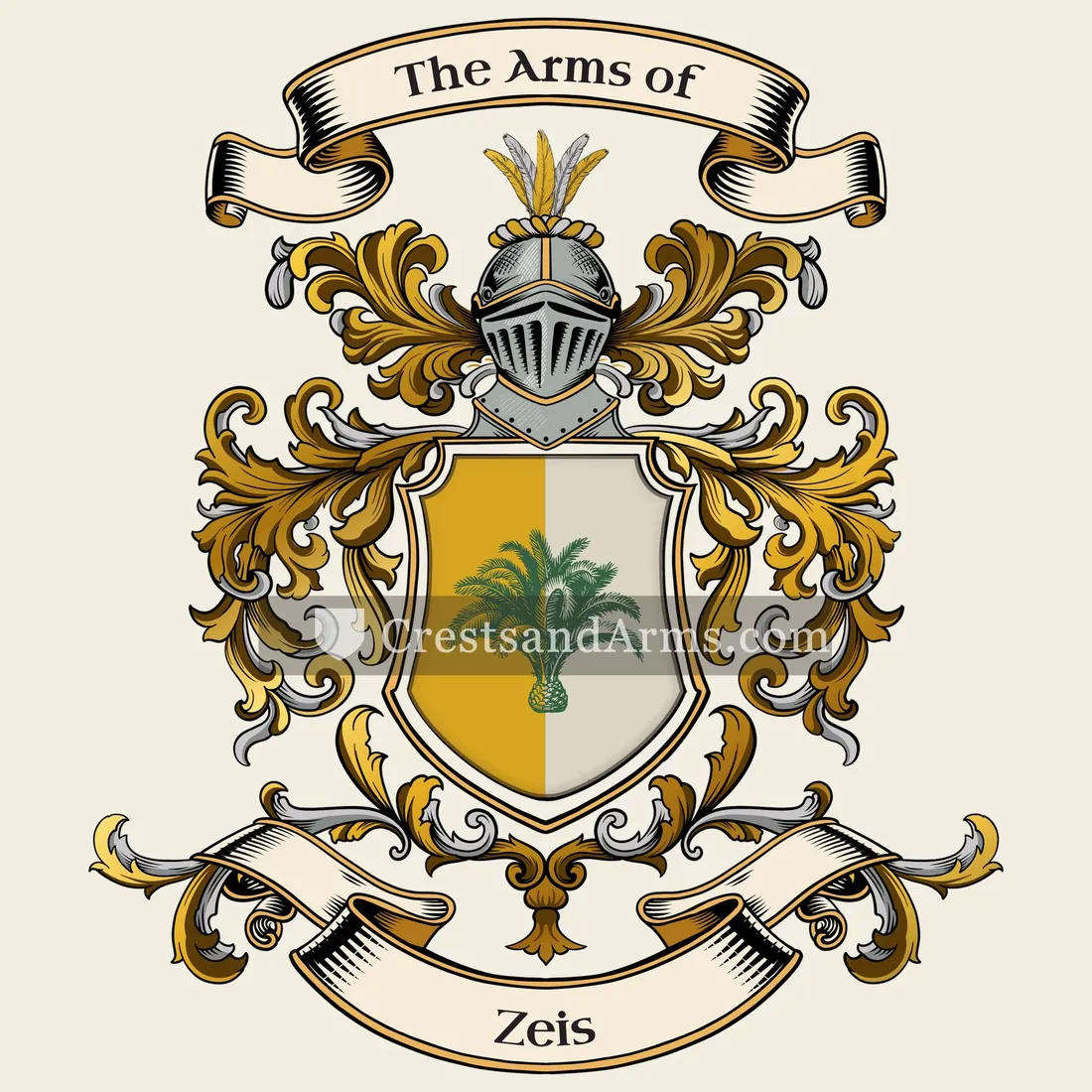
palm treeVictory, and righteousness that flourishes
Colours
Gold (Or)Means: Generosity
Silver (Argent)Means: Peace and sincerity
Green (Vert)Means: Hope
Historical info
Source
J. B. Rietstap, Armorial Général, Gouda: G. B. van Goor Zonen, 1884–87
Blazon (the actual original written record)
“Parti: au 1 coupé: a. d'or à une tête de serin au nat., posée de front; b. d'azur à un serin d'or, perché sur la branche dextre d'un tronc au nat., mouv. de la p.; au 2 d'arg. à une palme de sin. C.: un serin d'or. L.: à dextre d'or et d'azur, à sen. d'arg. et d'azur.”
Germanyc. 1765
Digital archive packCoat of arms PNG, gold border print PDF, vector SVG and the certificate of authenticity. Sent to your email in minutes.
Map of Germany showing where the Zeis arms are recorded
The Zeis arms were recorded in Germany, c. 1765.
Arms such as these were typically recorded in Bavaria.
Bavaria was a country of old landed families and walled market towns. Estates passed down the same line for centuries, and both the landowners and the leading townsmen kept arms, which is why so many Bavarian names sit in the registers.
This is where the arms were entered in the register. Families often moved to other parts of the country, so the same name can turn up in more than one region.
The body that granted and recorded arms in Germany in this period.
Francis I, Holy Roman Emperor
Sovereign of the period
Francis I, Holy Roman Emperor
1745–1765
Reigning in Germany when the Zeis arms are first recorded.
How Arms Worked in Germany
In the Holy Roman Empire, coats of arms were often granted to individuals by the Emperor or his representatives. These arms were then passed down through the generations to all legitimate descendants of the original holder. Younger branches of a family usually kept the same shield design without needing to change it, as the arms belonged to the entire lineage.
Granting authority
The Holy Roman Emperor held the sole power to grant new coats of arms throughout his vast imperial territories.
How they got arms
Families typically obtained their coats of arms through a formal imperial grant or by proving their noble status to the authorities.
Where arms were recorded
These grants were officially recorded in the Imperial Chancery registers, which began keeping formal records of such honors during the Middle Ages.
The family's standing
Recorded among the armigerous families of Germany.
Origin & History of the Zeis Family in Germany
The surname Zeis finds its roots in the southern German regions, particularly within the historic landscape of Bavaria. By the mid-18th century, the family was firmly established in this area, as evidenced by records dating back to 1765. The name likely originated as a shortened form of names beginning with "Zeis-," such as Zeisolf, or it may have functioned as a descriptive nickname derived from the Middle High German word "zeisig," which refers to a siskin or a type of small finch. In the social structure of 18th-century Bavaria, families with this name were often integrated into the local agrarian or artisan communities that defined the rural economy of the Holy Roman Empire. As the family grew, they participated in the typical life of the region, navigating the complex religious and political shifts that characterized German history during the Enlightenment era.
Meaning of the Zeis family crest colors & symbols
Symbols on this shield
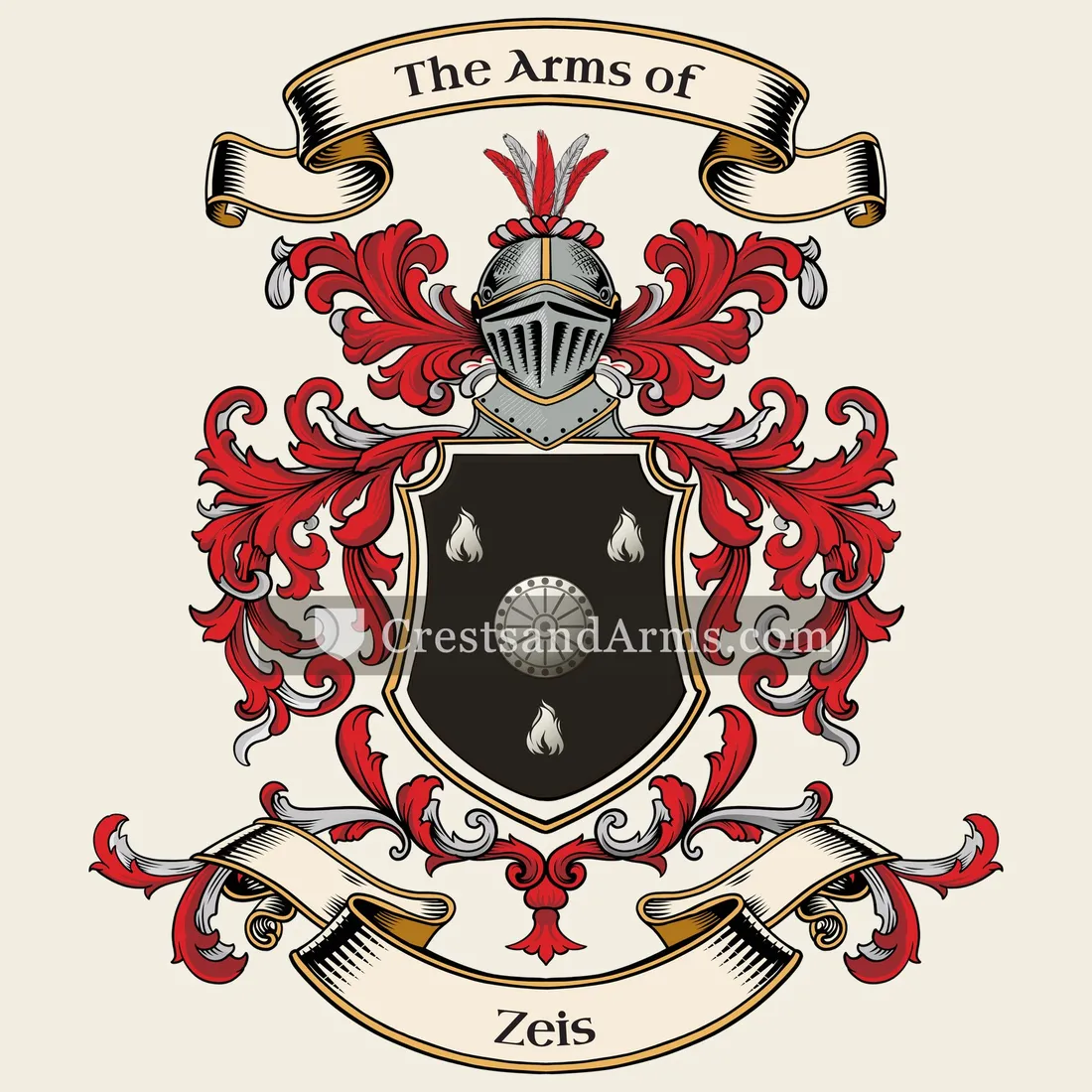
roundelA coin, and one who has been to the crusades
fireZeal and purification
Colours
Black (Sable)Means: Constancy
Silver (Argent)Means: Peace and sincerity
Historical info
Source
J. B. Rietstap, Armorial Général, Gouda: G. B. van Goor Zonen, 1884–87
Blazon (the actual original written record)
“De sa. à une boule d'arg., lançant trois foudres d'en pairle. C.: le meuble de l'écu, entre deux prob. de sa.”
TyrolTyrol, c. 1772
Digital archive packCoat of arms PNG, gold border print PDF, vector SVG and the certificate of authenticity. Sent to your email in minutes.
Map of Austria showing where the Zeis arms are recorded
The Zeis arms were recorded in Tyrol, c. 1772.
Tyrol was mountain country in western Austria, where the valleys were held by families who had been there a very long time. Old tenure counted for more than money, and old families carried arms.
This is where the arms were entered in the register. Families often moved to other parts of the country, so the same name can turn up in more than one region.
Region
Tyrol
First recorded
1772
Granting Authority for the Zeis Arms
Imperial and Royal chancery
Sodacan · CC BY-SA 3.0
The body that granted and recorded arms in Austria in this period.
Joseph II, Holy Roman Emperor
Sovereign of the period
Joseph II, Holy Roman Emperor
1765–1790
Reigning in Germany when the Zeis arms are first recorded.
How Arms Worked in Austria
Austrian coats of arms were often linked directly to noble titles granted by the Emperor. These symbols belonged to the entire family line rather than just one individual. When a family grew, new branches kept the original design without needing to change it. This system allowed all members of a noble house to share the same identity across many generations.
Granting authority
The Imperial and Royal chancery managed all heraldic matters and controlled the official granting of arms throughout the Austrian lands.
How they got arms
Families typically received their arms through a formal imperial decree that often accompanied the elevation of a person to noble status.
Where arms were recorded
Official records of these grants were kept in the Imperial Register of Nobility which began its formal documentation process in 1453.
The family's standing
Recorded among the armigerous families of Tyrol.
Origin & History of the Zeis Family in Austria
The family name Zeis has deep roots in the mountainous landscape of Tyrol, where records confirm members of the family were living as early as 1772. During this period, Tyrol was a vital part of the Habsburg Monarchy, and the name likely emerged as a descriptive term or a shortened form of a longer Germanic name common to the Alpine region. Families like the Zeis clan often lived in small, tight-knit village communities where they worked as skilled tradespeople or farmers on the rugged mountain slopes. Because Tyrol served as a major crossroads for trade routes connecting northern Europe to Italy, the family likely interacted with diverse groups of travelers and merchants. This environment helped shape the identity of the family as they navigated the social and economic changes occurring within the Austrian Empire during the late eighteenth century.
Zeis Meaning & Related Branches
Root word
Zeisig
A small songbird known as the siskin.
This name
ZeisA nickname for a person with a cheerful or chirpy personality.
also spelled
Seiss
Zis
Documented Sources
J. B. Rietstap, Armorial Général, Gouda: G. B. van Goor Zonen, 1884–87
Bahlow, Hans, Deutsches Namenlexikon: Familien- und Vornamen nach Ursprung und Sinn erklärt, 1967


 palm treeVictory, and righteousness that flourishes
 palm treeVictory, and righteousness that flourishes


 roundelA coin, and one who has been to the crusades
 fireZeal and purification