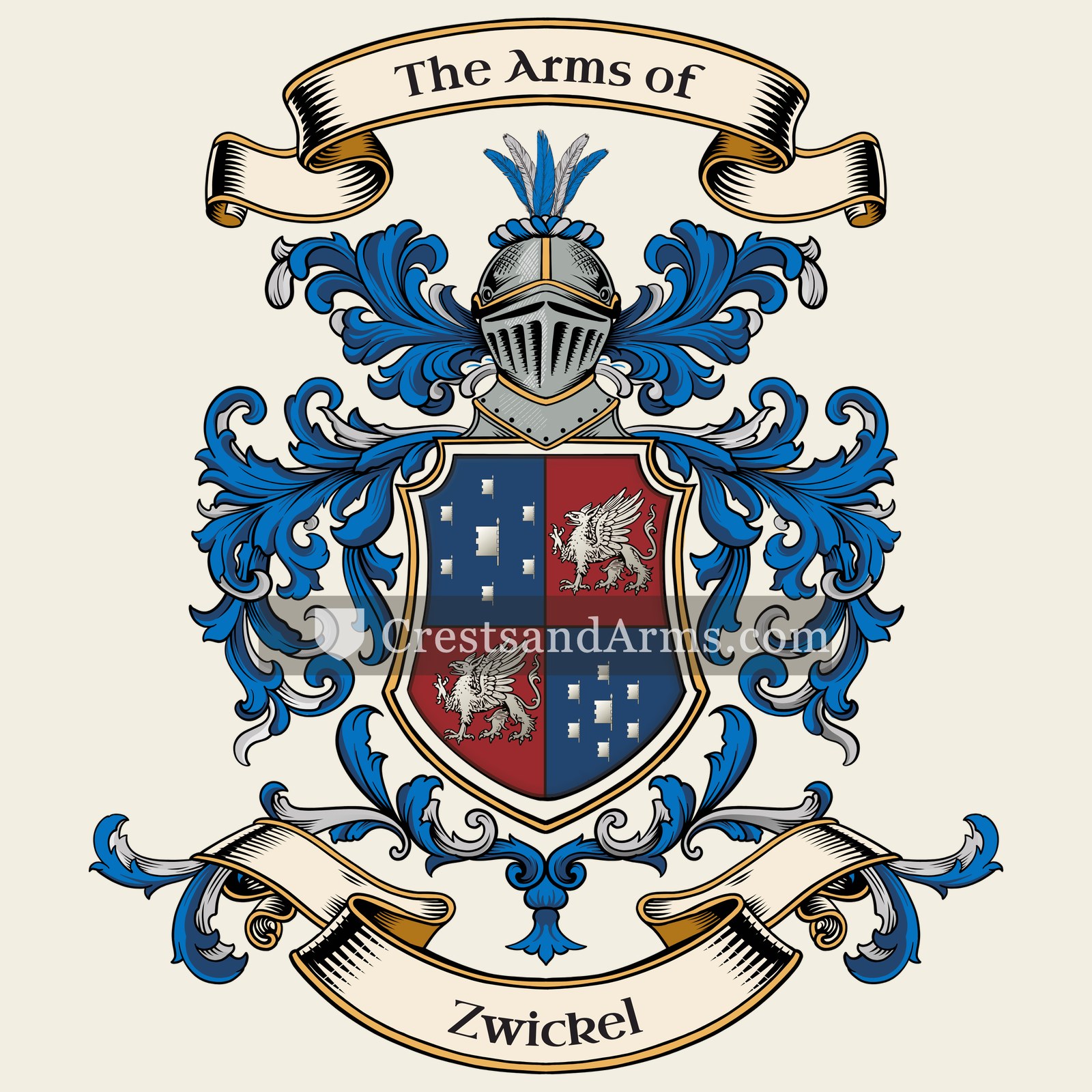
A record of documented arms, meaning and origin, researched for the Zwickel family lines. Documented in 2 countries.
Reg. 7123 · German
Coat of Arms & Family Crest Details
Symbols on this shield
flag / pennantA command held, and a following kept
griffinValour and vigilance, guarding great treasure
Colours
Blue (Azure)Means: Loyalty and truth
Red (Gules)Means: Military strength
Silver (Argent)Means: Peace and sincerity
Historical info
Source
J. B. Rietstap, Armorial Général, Gouda: G. B. van Goor Zonen, 1884–87
Blazon (the actual original written record)
“Ec.: aux 1 et 4 d'azur à six pennons d'arg., attachés à des lances de tournoi du même, passés en triple saut., et un pennon pareil en pal, br. sur le tout; aux 2 et 3 de gu. à un griffon d'arg., tenant de sa patte dextre une épée et appuyant sa sen. sur un livre fermé, aussi d'arg., le griffon du 3 cont. A une Foi de carn., sortant de nuées, mouv. des flancs de l'écu, et br. sur l'écartelé. Cq. cour. C.: le griffon du 2, iss. L. de sa. et d'azur.”
GermanyNuremberg, c. 1765
Digital archive packCoat of arms PNG, gold border print PDF, vector SVG and the certificate of authenticity. Sent to your email in minutes.
Map of Germany showing where the Zwickel arms are recorded
The Zwickel arms were recorded in Nuremberg, c. 1765.
This is where the arms were entered in the register. Families often moved to other parts of the country, so the same name can turn up in more than one region.
The body that granted and recorded arms in Germany in this period.
Francis I, Holy Roman Emperor
Sovereign of the period
Francis I, Holy Roman Emperor
1745–1765
Reigning in Germany when the Zwickel arms are first recorded.
How Arms Worked in Germany
In the Holy Roman Empire, coats of arms were often granted to individuals by the Emperor or his representatives. These arms were then passed down through the generations to all legitimate descendants of the original holder. Younger branches of a family usually kept the same shield design without needing to change it, as the arms belonged to the entire lineage.
Granting authority
The Holy Roman Emperor held the sole power to grant new coats of arms throughout his vast imperial territories.
How they got arms
Families typically obtained their coats of arms through a formal imperial grant or by proving their noble status to the authorities.
Where arms were recorded
These grants were officially recorded in the Imperial Chancery registers, which began keeping formal records of such honors during the Middle Ages.
The family's standing
Recorded among the armigerous families of Germany.
Origin & History of the Zwickel Family in Germany
The surname Zwickel originates from the Middle High German word *zwickel*, which referred to a small wedge-shaped piece of fabric used in tailoring or a triangular plot of land. In the context of medieval Germany, names were often derived from a person’s trade, meaning the earliest ancestors likely worked as skilled tailors or lived on a specific triangular patch of property. By the mid-18th century, the family established a notable presence in the city of Nuremberg. During this period, Nuremberg was a major center for craftsmanship and trade, providing a stable environment for families to build their reputations. Records from 1765 confirm that the Zwickel name was already well-integrated into the social and economic life of the city. This suggests that the family had likely been settled in the Franconian region for several generations prior, contributing to the local culture through their professional work and community involvement.
Coat of Arms & Family Crest Details
Colours
Red (Gules)Means: Military strength
Historical info
Source
J. B. Rietstap, Armorial Général, Gouda: G. B. van Goor Zonen, 1884–87
Blazon (the actual original written record)
“De gu. à trois clous d'arg., posés et rangés en bande, entre deux cotices d'arg. Cq. cour. C.: deux prob., d'arg. et de gu.”
StyriaStyria, c. 1772
Digital archive packCoat of arms PNG, gold border print PDF, vector SVG and the certificate of authenticity. Sent to your email in minutes.
Map of Austria showing where the Zwickel arms are recorded
The Zwickel arms were recorded in Styria, c. 1772.
Styria was mountain and forest country in southern Austria, with iron in its hills. Mining and landholding both made money, and families who held either kind of property took arms to seal their papers with.
This is where the arms were entered in the register. Families often moved to other parts of the country, so the same name can turn up in more than one region.
Region
Styria
First recorded
1772
Granting Authority for the Zwickel Arms
Imperial and Royal chancery
Sodacan · CC BY-SA 3.0
The body that granted and recorded arms in Austria in this period.
Joseph II, Holy Roman Emperor
Sovereign of the period
Joseph II, Holy Roman Emperor
1765–1790
Reigning in Germany when the Zwickel arms are first recorded.
How Arms Worked in Austria
Austrian coats of arms were often linked directly to noble titles granted by the Emperor. These symbols belonged to the entire family line rather than just one individual. When a family grew, new branches kept the original design without needing to change it. This system allowed all members of a noble house to share the same identity across many generations.
Granting authority
The Imperial and Royal chancery managed all heraldic matters and controlled the official granting of arms throughout the Austrian lands.
How they got arms
Families typically received their arms through a formal imperial decree that often accompanied the elevation of a person to noble status.
Where arms were recorded
Official records of these grants were kept in the Imperial Register of Nobility which began its formal documentation process in 1453.
The family's standing
Recorded among the armigerous families of Styria.
Origin & History of the Zwickel Family in Austria
The family name Zwickel has deep roots in the Austrian region of Styria, where records confirm members of the family were established by at least 1772. The name itself is likely derived from the Middle High German word "zwickel," which refers to a small wedge or a triangular piece of fabric used in tailoring. This suggests that the earliest ancestors to carry the name may have been skilled tradespeople or tailors who earned their living by crafting clothing. During the late 18th century, families in Styria were often tied to the land or specific local industries, and the name would have served as a way to identify a person based on their profession or a distinct physical feature. As the family grew, they became part of the social fabric of the Austrian countryside, moving through the generations as part of the local community life that defined the region before the modern era.
Zwickel Meaning & Related Branches
Root word
Zwick
A wedge or a pointed piece of fabric used in tailoring.
This name
ZwickelA diminutive form referring to a tailor or someone who worked with wedges.
also spelled
Swickel
Zwickl
Related arms
Zwicklevariant spelling
Documented Sources
J. B. Rietstap, Armorial Général, Gouda: G. B. van Goor Zonen, 1884–87
Heintze, Albert. Die deutschen Familiennamen: geschichtlich, geographisch, sprachlich. 1903
Bahlow, Hans. Deutsches Namenlexikon: Familien- und Vornamen nach Ursprung und Sinn erklärt. 1967
Stadtarchiv Nürnberg. Bürgerbücher der Reichsstadt Nürnberg. 1765
Digital archive packCoat of arms PNG, gold border print PDF, vector SVG and the certificate of authenticity. Sent to your email in minutes.


 flag / pennantA command held, and a following kept
 griffinValour and vigilance, guarding great treasure
 flag / pennantA command held, and a following kept
 griffinValour and vigilance, guarding great treasure